

Market Overview:
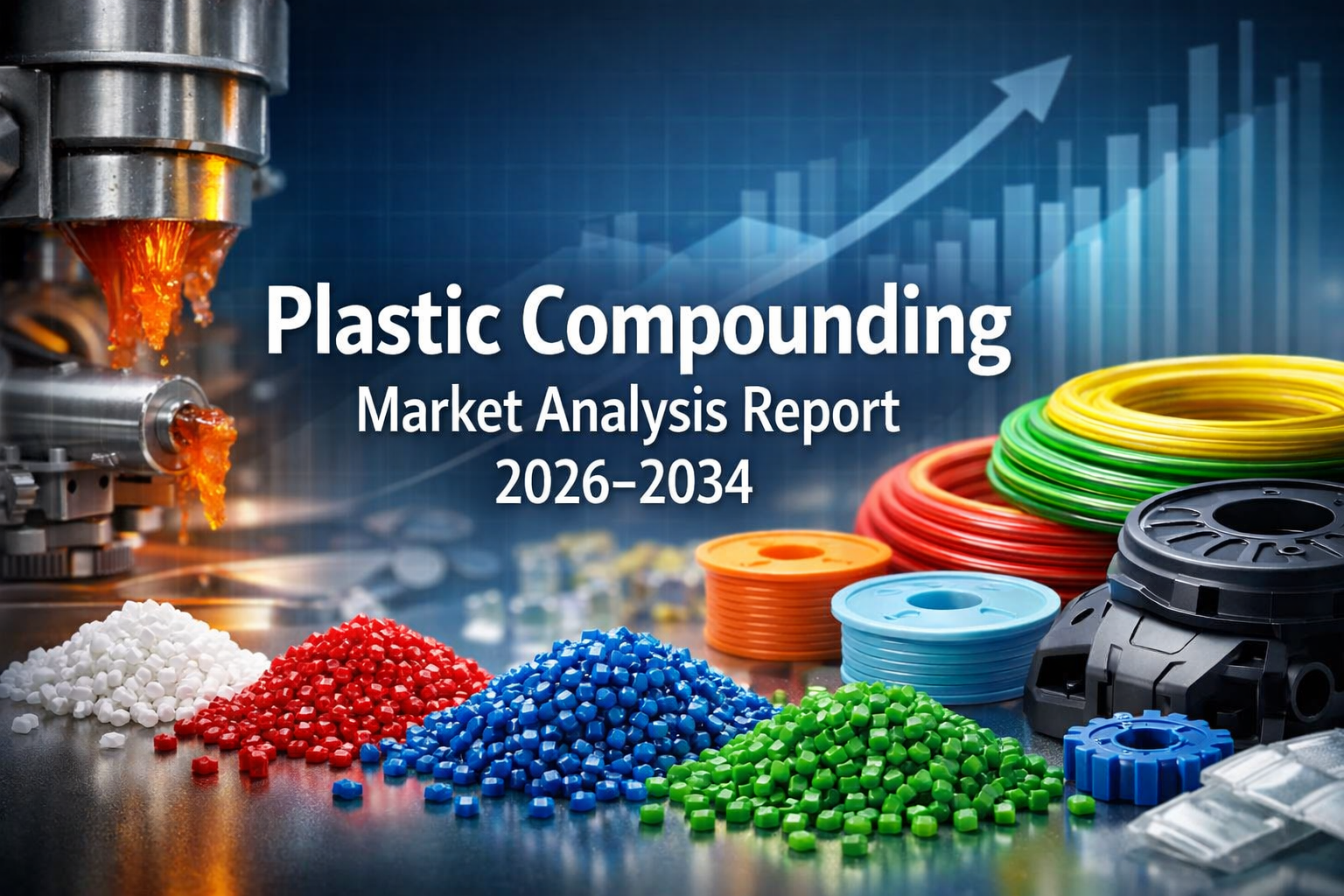
The plastic compounding market is experiencing rapid growth, driven by expanding automotive lightweighting and electric vehicle integration, surging infrastructure development and modern construction spending, and rising consumer demand for durable goods and efficient product packaging. According to IMARC Group’s latest research publication, “Plastic Compounding Market Size, Share, Trends and Forecast by Product, Application, and Region, 2026-2034”, The global plastic compounding market size was valued at USD 76.33 Billion in 2025. Looking forward, IMARC Group estimates the market to reach USD 117.17 Billion by 2034, exhibiting a CAGR of 4.88% from 2026-2034.
This detailed analysis primarily encompasses industry size, business trends, market share, key growth factors, and regional forecasts. The report offers a comprehensive overview and integrates research findings, market assessments, and data from different sources. It also includes pivotal market dynamics like drivers and challenges, while also highlighting growth opportunities, financial insights, technological improvements, emerging trends, and innovations. Besides this, the report provides regional market evaluation, along with a competitive landscape analysis.
Download a sample PDF of this report: https://www.imarcgroup.com/plastic-compounding-market/requestsample
Our report includes:
- Market Dynamics
- Market Trends and Market Outlook
- Competitive Analysis
- Industry Segmentation
- Strategic Recommendations
Growth Factors in the Plastic Compounding Market
- Expanding Automotive Lightweighting and Electric Vehicle Integration
The automotive plastic compounding market is heavily influenced by the automotive sector’s reliance on engineered polymer blends to achieve substantial weight reduction, directly improving fuel efficiency and lowering carbon emissions. Modern electric vehicles require specialized plastic formulations for protective battery housings, complex thermal management components, and structural under-the-hood applications that demand exceptional heat resistance. In the automotive plastic compounding market, compounded plastics increasingly replace heavy structural metals and steel alloys by offering comparable durability alongside customizable electrical insulation properties. Global original equipment manufacturers frequently collaborate with chemical producers to integrate high-performance polypropylene and polyamide compounds into mass-production assembly lines. This material substitution trend continues to gain traction across major automotive manufacturing regions, where producers face stringent corporate average fuel economy standards and regulatory pressure to reduce tailpipe emissions. Consequently, the transportation industry accounts for approximately twenty-nine percent of global demand within the automotive plastic compounding market.
- Surging Infrastructure Development and Modern Construction Spending
Accelerating commercial and residential construction projects in rapidly developing economies continuously drive the high consumption of reinforced polyvinyl chloride and chlorinated polyvinyl chloride formulations. Structural building components like high-durability plumbing pipes, electrical conduit wiring, heavy-duty waterproofing membranes, and composite structural wood alternatives require extensive compounding with stabilizers and fillers to ensure long-term environmental resistance. Rising consumer demand for premium, modern interior designs further stimulates the structural use of lightweight, aesthetically flexible building materials. Governments globally support this sector through multi-billion-dollar infrastructure development grants and public housing expansion programs that incentivize the utilization of durable, cost-effective synthetic materials over traditional copper or cast iron. Private construction firms heavily adopt these advanced polymer products because their lightweight nature drastically reduces on-site labor times and overall project shipping costs without compromising building safety standards.
- Rising Consumer Demand for Durable Goods and Efficient Product Packaging
Massive consumption patterns across major global economies significantly expand the application scope of customized plastic formulations within consumer durables and advanced product packaging systems. Modern consumer appliances like automated washing machines, household refrigerators, and miniaturized smart electronics require specialized polymer compounds embedded with specialized anti-oxidants, unique colorants, and active ultraviolet stabilizers. Similarly, the global food, beverage, and textile industries actively prioritize high-performance packaging materials that possess high physical stress resistance, long-term flexibility, and lower product contamination rates. Leading processing firms continually introduce low-volatile organic compound and highly barrier-efficient compound formats to elevate the visual appeal and preservation qualities of commercial packaging. This continuous cross-industry demand is especially robust in manufacturing hubs across the Asia Pacific region, which supplies a vast majority of the world’s retail packaging and domestic household consumer goods.
Key Trends in the Plastic Compounding Market
- Accelerating Adoption of Recycled and Circular Economy Materials
Processing firms are shifting their operations toward post-consumer and post-industrial recycled inputs to establish verifiable material circularity. This structural transition is highly pronounced across European and North American markets where stringent corporate sustainability frameworks mandate minimum recycled volumetric contents for consumer-facing goods. Compounding specialists are developing sophisticated compatibilizers and additive formulations to overcome traditional mechanical degradation challenges associated with reprocessed resins. Major chemical suppliers now offer premium portfolios of high-performing recycled polyolefins that match the exact structural integrity, tensile strength, and processing ease of virgin fossil-based materials.
- Rapid Proliferation of Smart Nanoplastics and Conductive Compounds
The integration of advanced nanomaterials into base polymer matrices represents a critical technological milestone for high-performance applications. By compounding tiny carbon nanotubes, graphene sheets, or specialized metallic nanoparticles into regular plastics, manufacturers create engineering masterbatches with exceptional electrical conductivity and thermal dissipation profiles. These specialized smart compounds find immediate use in advanced aerospace shielding, high-frequency telecommunication hardware, and miniaturized circuit designs. This formulation approach allows electronics designers to replace bulky aluminum heat sinks with thin, injection-molded plastic enclosures that prevent delicate microprocessors from overheating.
- Growing Integration of Automation and Artificial Intelligence in Compounding Lines
The implementation of automated manufacturing systems and artificial intelligence algorithms is actively transforming traditional extrusion and blending facilities. Modern compounding operations utilize real-time sensor arrays to monitor polymer viscosity, color consistency, and additive dispersion directly inside the twin-screw extruder barrel. Machine learning software analyzes this streaming operational data to execute instantaneous, micro-adjustments to feeding rates and zone temperatures without stopping production lines. This digital transformation dramatically minimizes material wastage during product switchovers, ensures tight batch-to-batch consistency, and lowers total factory energy consumption across complex production catalogs.
Leading Companies Operating in the Global Plastic Compounding Industry:
- BASF SE
- Clariant AG
- DowDuPont Inc.
- Solvay S.A.
- LyondellBasell Industries Holdings B.V.
- SABIC
- Covestro AG
- Celanese Corporation
- Asahi Kasei Corporation
- RTP Company
Plastic Compounding Market Report Segmentation:
By Product Type:
- Polyethylene (PE)
- Polypropylene (PP)
- Thermoplastic Vulcanizates (TPV)
- Thermoplastic Polyolefins (TPO)
- Polyvinyl Chloride (PVC)
- Polystyrene (PS)
- Polyethylene Terephthalate (PET)
- Polybutylene Terephthalate (PBT)
- Polyamide (PA)
- Polycarbonate (PC)
- Acrylonitrile Butadiene Systems (ABS)
- Others
Polypropylene compounds account for the majority of shares due to their versatility and cost-effectiveness.
By Application:
- Automotive
- Building & Construction
- Electrical & Electronics
- Packaging
- Consumer Goods
- Industrial Machinery
- Medical Device
- Optical Media
- Others
Automotive dominates the market due to increasing vehicle production and lightweighting requirements.
Regional Insights:
- North America (United States, Canada)
- Asia Pacific (China, Japan, India, South Korea, Australia, Indonesia, Others)
- Europe (Germany, France, United Kingdom, Italy, Spain, Russia, Others)
- Latin America (Brazil, Mexico, Others)
- Middle East and Africa
Asia Pacific enjoys the leading position owing to rapid industrialization and growing automotive production.
Note: If you require specific details, data, or insights that are not currently included in the scope of this report, we are happy to accommodate your request. As part of our customization service, we will gather and provide the additional information you need, tailored to your specific requirements. Please let us know your exact needs, and we will ensure the report is updated accordingly to meet your expectations.
About Us:
IMARC Group is a global management consulting firm that helps the world’s most ambitious changemakers to create a lasting impact. The company provide a comprehensive suite of market entry and expansion services. IMARC offerings include thorough market assessment, feasibility studies, company incorporation assistance, factory setup support, regulatory approvals and licensing navigation, branding, marketing and sales strategies, competitive landscape and benchmarking analyses, pricing and cost research, and procurement research.
Contact Us:
IMARC Group
134 N 4th St. Brooklyn, NY 11249, USA
Email: sales@imarcgroup.com
Tel No:(D) +91 120 433 0800
United States: +1-201-971-6302
