

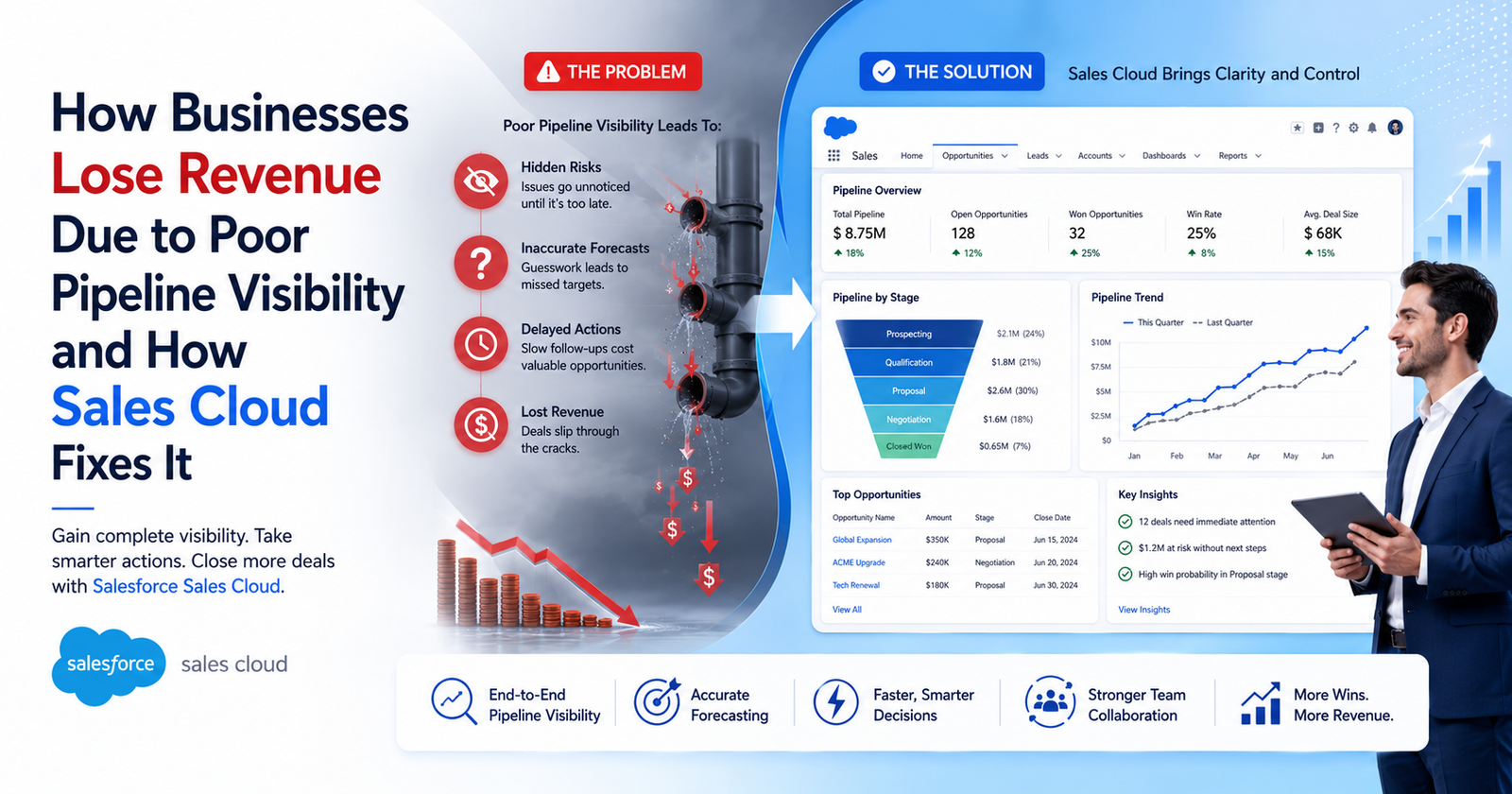
Revenue growth depends on more than generating leads. Businesses must also understand what happens inside the sales pipeline. Unfortunately, many organizations operate with limited visibility into deal progress, sales activity, customer interactions, and forecasting accuracy. As a result, sales leaders often make decisions based on incomplete or outdated information.
Recent industry research highlights the scale of the problem. According to Salesforce’s State of Sales Report 2026, only 35% of sales professionals completely trust the accuracy of their sales data. The same research found that data silos and disconnected systems contribute to lost revenue opportunities and hinder decision-making across sales organizations. Additionally, 42% of sales representatives report feeling overwhelmed by the number of tools they use, creating further challenges for maintaining accurate pipeline data.
Sales performance data also reveals growing pressure on revenue teams. Salesforce research shows that 67% of sales representatives do not expect to meet their quota, while 84% missed quota attainment in the previous year. These numbers indicate that visibility problems extend beyond reporting and directly affect revenue outcomes.
Pipeline visibility has become a strategic business requirement rather than a sales management preference. Organizations that lack a clear view of their pipeline often struggle with forecasting, resource allocation, customer engagement, and revenue planning. This is where Salesforce Sales Cloud plays a critical role by providing a centralized environment for pipeline management, forecasting, and sales performance monitoring.
What Pipeline Visibility Actually Means
Pipeline visibility refers to an organization’s ability to track and understand every stage of the sales process in real time.
It goes beyond viewing a list of open opportunities. Effective visibility provides answers to important business questions:
- Which deals are most likely to close?
- Where are opportunities stalling?
- Which sales representatives need support?
- How accurate are revenue forecasts?
- What activities contribute to successful outcomes?
- Which customer segments generate the highest conversion rates?
Without these insights, sales leaders often rely on assumptions rather than evidence.
The consequences become particularly serious when organizations manage hundreds or thousands of opportunities across multiple sales teams.
The Hidden Revenue Leaks Caused by Poor Pipeline Visibility
Most revenue losses linked to pipeline visibility occur gradually. Companies rarely notice a single catastrophic event. Instead, multiple small inefficiencies accumulate over time.
Forecasting Errors Create Planning Problems
Forecast accuracy affects nearly every business function.
Finance teams depend on reliable projections for budgeting. Operations teams need accurate forecasts to plan capacity and inventory. Leadership teams use revenue forecasts when making investment decisions.
When pipeline data lacks accuracy, forecasting becomes unreliable.
Industry studies show that a significant percentage of forecasted deals either slip into future quarters or fail to close altogether. In many organizations, forecast reviews become exercises in explaining missed projections rather than improving future outcomes.
Stalled Opportunities Go Unnoticed
Deals rarely disappear overnight.
Most opportunities show warning signs before they are lost. Customer engagement slows. Follow-up activities decrease. Decision-makers stop responding.
Without proper visibility, these indicators remain hidden until the opportunity becomes inactive.
By the time managers identify the issue, competitors may have already secured the business.
Sales Teams Focus on the Wrong Priorities
Many sales representatives manage dozens of opportunities simultaneously.
When pipeline data is incomplete, sales teams struggle to identify which deals deserve immediate attention. High-value opportunities may receive insufficient engagement, while low-probability deals consume excessive time and resources.
This imbalance reduces overall sales efficiency and affects revenue generation.
Data Silos Obscure Customer Insights
Modern sales environments involve multiple systems, including CRM platforms, email tools, communication applications, marketing automation software, and customer support systems.
Salesforce’s State of Sales research found that data silos contribute directly to lost revenue opportunities and reduced visibility across organizations.
When information remains fragmented, sales representatives lack a complete view of customer behavior and buying intent.
Why Traditional Spreadsheet-Based Pipeline Management Fails
Many businesses continue to rely on spreadsheets and manual reporting for pipeline tracking.
Although spreadsheets may work for small teams, they create significant challenges as organizations grow.
Manual processes introduce several risks:
- Delayed reporting
- Inconsistent data entry
- Version control issues
- Limited collaboration
- Poor forecasting accuracy
- Lack of real-time updates
A spreadsheet can display pipeline numbers, but it cannot provide dynamic insights into pipeline health, deal movement, or sales performance trends.
As revenue operations become more complex, organizations require a system capable of capturing and analyzing sales activity automatically.
How Sales Cloud Improves Pipeline Visibility
Salesforce Sales Cloud addresses visibility challenges by creating a centralized source of truth for sales teams.
Instead of relying on fragmented systems and manual updates, organizations gain a unified view of customer relationships, opportunities, forecasts, and performance metrics.
Real-Time Opportunity Tracking
Sales Cloud allows teams to monitor opportunities throughout the sales lifecycle.
Managers can review:
- Deal stage progression
- Opportunity value
- Customer interactions
- Activity history
- Next-step commitments
This visibility enables proactive intervention when deals show signs of risk.
Rather than waiting for end-of-quarter surprises, leaders can identify issues while opportunities remain recoverable.
Forecasting Based on Live Data
Forecasting accuracy improves when sales data updates continuously.
Sales Cloud consolidates information from opportunities, activities, customer interactions, and historical performance.
Sales leaders can generate forecasts based on actual pipeline conditions rather than subjective assumptions.
This creates greater confidence in revenue planning and business decision-making.
Pipeline Analytics and Performance Dashboards
One of the most valuable aspects of Sales Cloud is its analytics capability.
Custom dashboards allow organizations to track:
- Pipeline coverage
- Conversion rates
- Win-loss performance
- Deal velocity
- Sales cycle duration
- Forecast attainment
These insights help identify performance patterns that remain invisible within traditional reporting methods.
Automated Activity Tracking
Sales representatives often spend significant time updating CRM records.
Sales Cloud reduces manual effort by automatically capturing emails, meetings, customer interactions, and activity data.
Improved data quality creates stronger visibility across the entire pipeline.
When information updates automatically, managers gain a more accurate picture of ongoing sales activity.
Enterprise Example: IBM’s Sales Transformation
A practical example of pipeline visibility improvement comes from IBM’s collaboration with Salesforce.
IBM faced challenges related to fragmented customer information and limited transparency across sales and service operations. Multiple systems prevented teams from maintaining a consistent view of customer interactions.
To address these issues, IBM implemented Salesforce Customer 360 and Sales Cloud as part of a broader transformation initiative.
The centralized environment provided sellers, managers, and partners with access to unified customer data and sales workflows. By creating a single source of truth, IBM improved visibility across customer relationships, sales activities, and opportunity management.
The case demonstrates how large enterprises can reduce information fragmentation and improve decision-making through centralized sales platforms.
The Role of Sales Cloud Consulting in Successful Implementations
Technology alone does not solve pipeline visibility challenges.
Organizations often require process redesign, data governance improvements, integration planning, and user adoption strategies.
This is where sales cloud consulting services become important.
Experienced consultants evaluate:
- Existing sales processes
- Data quality issues
- Pipeline structures
- Forecasting methodologies
- Reporting requirements
- Integration needs
The objective is not simply implementing software but creating a sales environment that supports accurate visibility and decision-making.
Many organizations also engage Salesforce Sales Cloud Consulting specialists to customize dashboards, automate workflows, establish forecasting models, and align CRM functionality with business objectives.
These efforts help maximize the value of Sales Cloud while reducing implementation risks.
Measuring ROI from Better Pipeline Visibility
Improved pipeline visibility produces measurable business outcomes.
Organizations commonly experience benefits such as:
Revenue Impact
- Higher forecast accuracy
- Increased win rates
- Reduced deal slippage
- Improved quota attainment
Operational Impact
- Better resource allocation
- Faster decision-making
- Reduced administrative effort
- Improved sales productivity
Customer Impact
- More consistent engagement
- Better account management
- Faster response times
- Improved customer retention
Research consistently shows that organizations with accurate sales data and strong visibility outperform those operating with fragmented information.
The financial impact often extends beyond sales performance and influences broader business planning and operational efficiency.
Final Thoughts
Poor pipeline visibility creates hidden revenue risks that affect forecasting, customer engagement, sales productivity, and strategic planning. Organizations frequently lose opportunities not because of weak products or ineffective sales teams, but because critical information remains incomplete, delayed, or inaccessible.
As sales environments become increasingly data-driven, visibility has become essential for sustainable growth. Businesses need accurate forecasts, real-time opportunity tracking, reliable performance metrics, and a unified view of customer interactions.
Salesforce Sales Cloud addresses these challenges by centralizing sales data, improving forecasting accuracy, providing actionable analytics, and creating greater transparency across the entire revenue cycle.
When combined with experienced sales cloud consulting services and strategic Salesforce Sales Cloud Consulting expertise, organizations can build a stronger foundation for revenue management, operational efficiency, and long-term business growth.
