

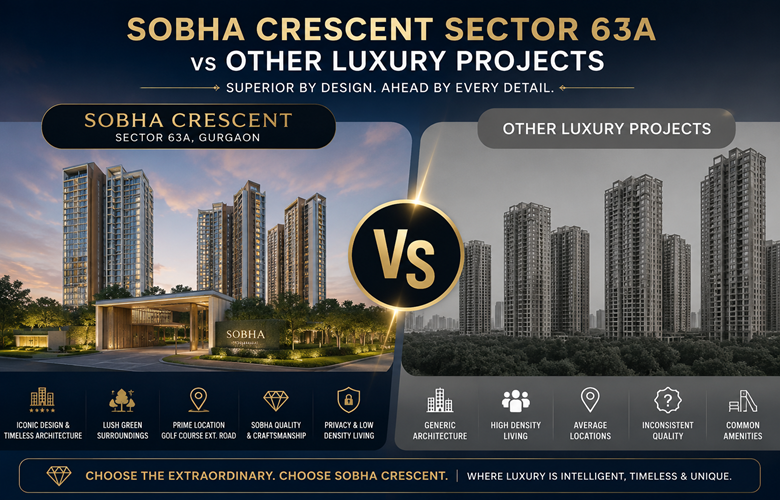
Sobha Crescent Sector 63A Gurgaon stands apart because Sobha Limited builds it almost entirely in-house, with concrete, glazing, joinery, and finishes all made by Sobha, not sub-contracted. On Golf Course Extension Road, where most towers outsource construction, that in-house model is why Sobha homes have historically resold 10-15% above comparable local-builder stock.
- RERA (Phase 1): HARERA GGM/1054/786/2026/26, verify current status on haryanarera.gov.in.
- Homes: 3 & 4 BHK, 2,277–2,966 sq.ft. RERA carpet; from ₹5.69 Cr (₹25,000/sq.ft. carpet).
- The real difference: fully in-house (backward-integrated) construction, rare among GCER competitors.
- Layout: 100% corner units, 4 homes per floor across two G+40 towers (Phase 1: 336 homes on 4.96 of the 11.99-acre site).
- Possession: RERA-declared 2030; construction-linked plan 25:15:20:20:20.
Six numbers that matter
- GCER average residential rate sat near ₹18,887/sq.ft. in Q1 2026, with premium projects past ₹22,821/sq.ft. (MagicBricks Research).
- Delhi-NCR held close to 90% of India’s luxury home sales in 2025, even after an 8% YoY dip in volumes (Anarock).
- Homes above ₹1 crore made up 50% of sales across India’s top 8 cities in 2025, up 14% YoY (Knight Frank India).
- Sobha’s in-house divisions cover 62% of its construction cost base: design, concrete, glazing, MEP, joinery.
- Sobha resale premium runs 10-15% above comparable local-builder stock, tracked across its delivered projects.
- Industry estimates put 2026 appreciation on GCER at 10-15%, with rental yields of 3–4.7%.
The Golf Course Extension Road problem: everyone is selling the same three things
Drive the 8.5-km stretch of Golf Course Extension Road today and you pass a wall of cranes. DLF, Oberoi, Birla, M3M, Godrej, Emaar, Adani, they are all here, and they are all pitching the same buyer the same story. The address. The clubhouse. The brand name on the gate. Read three project brochures back to back, and you could swap the adjectives without anyone noticing.
That sameness is a real problem for a five-crore buyer. When the corridor jumped from roughly ₹8,800/sq.ft. in 2019 to well past ₹20,000/sq.ft. in 2024-25, the differences that used to justify a price gap location, connectivity, a big pool became table stakes. Every serious launch has them now.
So the honest question is not “Is Sobha Crescent nice?” Every project on this road is nice. The question is: what does Sobha Crescent do that the tower next door cannot copy by the next quarter? There are three answers, and only one of them is on the brochure.
Sobha builds Crescent in-house, and that shows up years after you get the keys
Here is the part most buyers skip. Almost every developer on Golf Course Extension Road is, at heart, a project manager. They buy the land, hire an architect, and then sub-contract the actual building concrete to one firm, glazing to another, joinery and fit-out to a third. Quality drifts wherever those sub-contractors drift.
Sobha does not work that way. Since 1995, Sobha Limited has run a backward-integrated model: it designs, engineers, and manufactures a large share of what goes into its buildings itself. In-house concrete. In-house glazing and metalwork. In-house woodwork and interiors. In-house MEP. Industry profiles put roughly 62% of Sobha’s construction cost base inside its own divisions, a level no other listed Indian developer of this scale matches.
Why should a homebuyer care about a supply-chain decision? Because it changes two things you feel long after possession: finish consistency and delivery risk. When one company controls the material and the labour, the joint between the window and the wall is held to one standard, not three. And in 30 years in India, Sobha has not abandoned a single project a record that matters when you are handing over money against a 2030 handover.
This is the reason the resale numbers hold up. Across Sobha’s delivered stock, homes have tended to sell about 10-15% higher than comparable apartments from local or Tier-2 builders in the same micro-market. That gap is not brand sentiment alone; it is what buyers pay for a home that still feels tight and well-finished a decade in.
What “in-house” actually covers
| Build stage | Typical GCER project | Sobha Crescent |
|---|---|---|
| Design & architecture | Outsourced to a design firm | In-house design teams |
| Concrete & structure | Third-party contractor | Sobha concrete / precast |
| Glazing & metalwork | Vendor-supplied | Sobha in-house division |
| Joinery & interiors | Sub-contracted fit-out | Sobha Interiors |
| MEP services | Separate contractor | In-house MEP |
| Delivery accountability | Split across vendors | Single owner, end to end |
Source: Sobha Limited (sobha.com) backward-integration disclosures; independent developer profiles, 2026.
Difference #2: 100% corner-unit floor plate, with only 4 homes per floor
Most towers on this corridor pack six to ten flats around a central core. Some of those homes face a wall. Some look straight into a neighbour’s living room. Sobha Crescent takes a different call.
Phase 1 comprises two G+40 towers, with 4 residences per floor, each in a corner unit. Each home is oriented to avoid direct overlooking, so you get cross-ventilation on more than one side, more daylight, and Aravalli-facing balconies from the higher floors. On a 11.99-acre site carrying only about 336 homes in this phase, the density stays low by design, not by marketing.
It is a quieter differentiator than a rooftop infinity pool, but it is the kind of thing buyers notice on the second site visit, when they stop counting amenities and start standing in the actual room.
Difference #3: The price gap you are actually paying for
Sobha Crescent opens at roughly ₹25,000/sq.ft. on RERA carpet, from about ₹5.69 crore for a 3 BHK. That is meaningfully below the corridor’s new pricing ceiling. Here is how it lines up against the launches it competes with:
| Project (Sector) | Indicative rate | Entry / config | Standout point |
|---|---|---|---|
| Sobha Crescent (63A) | ₹25,000/sq.ft | From ₹5.69 Cr, 3&4 BHK | Fully in-house build; 100% corner units |
| Oberoi 360 North (58) | ₹45,000/sq.ft | 450 units, large-format | Corridor price ceiling; 2 lakh sq.ft club |
| Birla Arika (63A/58) | ₹20,000–30,000/sq.ft | 500 homes, 38 units/acre | 75% open space, IGBC Gold |
| DLF The Arbour (63) | From ₹8.3 Cr (4 BHK) | 25 acres, 85% green | 2 flats per core, low density |
| Godrej Sector 63A | ₹22,000–25,000/sq.ft | 600-800 units (est.) | Godrej brand, ₹4,500 Cr bet |
The read is simple. If your priority is the lowest possible density, DLF The Arbour and Oberoi push further and charge for it. If it is brand-name prestige at the top of the market, Oberoi sets the ceiling. Sobha Crescent’s case is narrower and sharper: a lower entry point than the ultra-luxe launches, paired with a build model none of its neighbours can match this year.
What the numbers say about Sobha Crescent as an investment
Zoom out to the corridor, and the demand picture is unusually clear. Golf Course Extension Road recorded one of NCR’s sharpest jumps in transaction value between 2024 and 2025, and the wider luxury shift is national: Anarock reported that more than a fifth of new supply in 2025 was priced above ₹2.5 crore, and Delhi-NCR held close to 90% of India’s luxury home sales. Knight Frank’s 2025 data shows ₹1-crore-plus homes now make up roughly half of all sales in the top eight cities.
For Sobha Crescent specifically, three things line up: a supply-constrained corridor with 10-15% forecast appreciation for 2026, rental yields of 3-4.7% driven by nearby corporate demand, and a construction-linked payment plan (25:15:20:20:20) that keeps most of your outlay tied to visible progress rather than upfront cash.
“On this corridor, most buyers are choosing between addresses. The buyers who do best are choosing between builders. Address you can copy; a 30-year in-house build record you cannot.”
A Gurgaon-based couple comparing a 3 BHK here against a similarly priced tower two sectors away kept circling back to one thing on their second visit, not the clubhouse, but the joinery. That instinct, a quality you can feel in the room, is exactly what the in-house model is built to deliver.
What we are seeing on the ground in Sector 63A
What we can say from the corridor itself: the buyer conversation at the ₹5-7.5 crore band has changed. Two years ago the first question was “how much per square foot?” Now it is “who is actually building this, and have they delivered before?” That shift plays directly to Sobha’s hand. When we walk buyers through the difference between an outsourced build and an in-house one, the ones planning to actually live in the home, not flip it in three years, tend to lean toward Crescent.
We also flag the honest caveats. This is an under-construction launch with a 2030 handover, so it suits patient capital, not a quick exit. And the corridor has run hard; a chunk of Sector 63A’s early appreciation is already priced in. None of that is a reason to avoid the project. It is a reason to buy it for the right horizon.
Final Thoughts on Sobha Crescent
Strip away the brochure language and Sobha Crescent’s case comes down to a handful of facts you can act on:
- It is built in-house. Sobha makes 62% of the build itself the reason its homes resell 10-15% higher than local-builder stock.
- The layout is scarce. 100% corner units, four per floor, on a low-density 11.99-acre site.
- The entry is below the ceiling. ₹25,000/sq.ft. from ₹5.69 Cr, under the corridor’s top-end launches.
- It is a 2030 play. An under-construction asset for patient buyers, staged on a 25:15:20:20:20 plan.
If that horizon fits, the next step is a site visit stand in the sample home and judge the finish yourself. You can explore floor plans and current pricing on the Sobha Crescent Sector 63A, and verify the registration on haryanarera.gov.in before you commit.
Read more: Sector 63A vs Sector 62 Gurgaon
Frequently asked questions
What makes Sobha Crescent Sector 63A different from other luxury projects?
Sobha Crescent is built almost entirely in-house by Sobha Limited concrete, glazing, joinery and finishes are made in Sobha’s own factories rather than sub-contracted. Most Golf Course Extension Road towers outsource this work. That in-house model, plus a 100% corner-unit floor plate with four homes per floor, is what sets Crescent apart on delivery certainty and finish.
What is the price of Sobha Crescent Sector 63A Gurgaon?
Sobha Crescent starts from about ₹5.69 crore for a 3 BHK, which works out to roughly ₹25,000 per sq.ft. on RERA carpet area at launch. Four-bedroom homes are priced higher by size and floor. These figures exclude PLC, GST and registration. Prices are indicative always confirm the current rate card directly with Sobha before booking.
When is possession of Sobha Crescent Sector 63A?
Sobha Crescent’s RERA-declared possession is targeted around 2030, with Phase 1 already registered and site work underway. Because it is an under-construction launch, your money is staged through a 25:15:20:20:20 construction-linked plan, so most payments fall due only as milestones are completed. Confirm the exact handover date on the HARERA portal before you commit.
How does Sobha Crescent compare with other Golf Course Extension Road projects?
On price, Sobha Crescent’s ₹25,000 per sq.ft. Entry is below top-end launches like Oberoi Three Sixty North, which is ₹35,000 per sq.ft. Against Birla, DLF and Godrej neighbours, Crescent’s edge is Sobha’s in-house build chain, which most competitors sub-contract. You trade the very lowest density for stronger finish control and a documented resale premium.
What is the RERA number of Sobha Crescent Sector 63A?
Sobha Crescent Phase 1 is registered under Haryana RERA as GGM/1054/786/2026/26. This means the project is legally filed with the regulator, with declared carpet areas, timelines and buyer protections. You can verify the registration, sanctioned plans, and any complaints yourself on the official haryanarera.gov.in portal. Do this before signing any booking or payment document.
Is Sobha Crescent a good option for NRI buyers?
Sobha Crescent suits NRI buyers because Haryana RERA registration and Sobha’s globally recognised brand shorten documentation and due-diligence cycles. The staged 25:15:20: 20:20 payment plan lets you fund purchases as construction progresses. You will still need to follow FEMA rules and route payments through NRE or NRO accounts, so confirm repatriation and TDS details with a qualified advisor first.
How do I verify Sobha Crescent’s details before booking?
Start on haryanarera.gov.in and search the registration number GGM/1054/786/2026/26 to check the sanctioned plan, carpet areas and declared possession date. Cross-check the price on Sobha’s official channel, not on third-party sheets. Ask for the payment schedule in writing, and book a site visit to see the sample layout, tower positioning, and actual construction stage yourself.
Is Sobha Crescent Sector 63A a good investment in 2026?
Sobha Crescent sits on Golf Course Extension Road, where industry estimates put 2026 appreciation near 10-15% and rental yields between 3% and 4.7%. Sobha homes have historically resold about 10-15% above comparable local-builder stock. As an under-construction asset with a 2030 handover, it suits patient buyers, not short-term flippers. Match it to your own holding horizon.
