

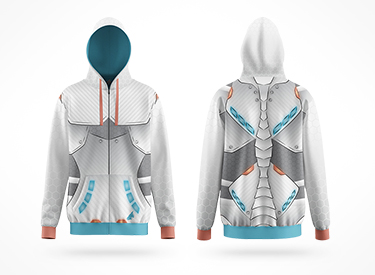
When your brand artwork includes gradients, photographic elements, or a wide range of colors, standard spot color printing may not be enough. That’s where simulated process screen printing comes in.
This technique allows printers to reproduce detailed, full-color artwork on garments using a limited number of ink colors, typically six to twelve. Instead of printing each color as a solid block, simulated process printing uses halftone dots and layered colors to create the illusion of smooth gradients and color transitions. The result is a print that looks far more detailed than traditional spot color work, without requiring a separate screen for every shade in your design.
How It Works
Simulated process printing starts with separating your artwork into individual color channels. Each channel is converted into a halftone pattern, which determines how much ink is laid down in each area. When printed in sequence, these halftone layers blend visually to create depth, shading, and a broader color range than the actual number of inks used.
This method works especially well on dark garments. Unlike CMYK process printing, which relies on the white of the paper or fabric to create lighter tones, simulated process printing uses an underbase layer (usually white ink) to make colors pop on black, navy, or other dark substrates. This makes it a strong choice for brands producing merchandise, retail apparel, or promotional pieces on darker colorways.
When Brands Should Use It
Not every print job requires a simulated process. If your logo is one or two solid colors, spot color printing will be faster and more cost-effective. But when your artwork includes any of the following, a simulated process is worth considering:
- Photographic images or realistic illustrations.
- Logos with gradients, shadows, or blended tones.
- Artwork with more than six colors.
- Designs intended for dark-colored garments.
For at-scale production, custom screen printing for brands that include simulated process capabilities opens up more creative possibilities. You’re not limited to flat, blocky graphics. You can reproduce the full detail of your artwork without compromising on print quality.
What to Look for in a Production Partner
When considering a simulated process for your next production run, keep these factors in mind:
- Color separation experience. Poor separations lead to muddy prints, visible dot patterns, or colors that don’t match your original artwork. A skilled team will dial in the correct mesh counts, ink densities, and print sequences.
- Turnaround time and minimums. Simulated process printing requires more setup than basic spot color work, so it’s best suited for bulk orders where the added prep time is spread across a larger run. Most production partners position this as a service for brands ordering at volume, not one-offs or small batches.
- Ink options. Simulated process prints typically use plastisol inks, but water-based and discharge inks can also be used, depending on the garment and desired finish. Water-based inks soak into the fabric for a softer hand feel. Discharge inks remove the garment dye and replace it with your print color, creating a no-feel finish on dark tees. Puff ink is also available for raised texture effects.
Who Benefits Most
Custom screen printing for brands that need detailed, full-color artwork on apparel will get the most value from the simulated process. This includes merchandise programs, retail apparel lines, event giveaways, and promotional campaigns where print quality matters.
Brands that have invested in detailed artwork, whether it’s an illustrated mascot, a photographic print, or a logo with complex shading, should not have to simplify their designs just to fit the limitations of spot color printing. Simulated process screen printing bridges that gap, giving you the ability to reproduce your artwork as intended without moving to more expensive or less durable print methods.
Final Considerations
Simulated process is not the right fit for every project. Simple logos and single-color designs are better served by spot color printing. But when your artwork demands more, and you’re ordering in bulk quantities, simulated process screen printing delivers a level of detail that standard methods cannot match.
If you’re planning a production run and wondering which print method to use, start with your artwork. Look at the color count, the level of detail, and the garment colors you’re printing on. If the job calls for gradients, shading, or photographic elements on dark apparel, a simulated process is likely your best path forward.
