

Most people dismiss eye discomfort as tiredness, a side effect of a long workday, or a late night. Sometimes, that is all it is. Other times, the eyes are trying to communicate something worth listening to. Whether the discomfort arrives as a dull ache, a gritty sensation, or a pressure that seems to sit just behind the socket, your eyes deserve more than a blink-and-move-on response.
Eye health is rarely treated with the urgency it deserves, even as screen exposure, environmental stressors, and sedentary routines continue to place real strain on our visual system. Understanding what your eyes are experiencing and why is the first step toward meaningful relief.
The Eyes as a System, Not Just a Sense Organ
Before diving into symptoms, let’s shift the perspective. Eyes are not isolated organs. They are richly connected to the nervous system, the sinuses, the vascular system, and even dental structures. This is why ocular discomfort often has origins that are not strictly “in the eye.”
The eyes function as one of the most information-dense windows into your overall health, detecting signs of systemic conditions long before other symptoms appear. Advanced diagnostic centers today use retinal imaging and vascular assessment to identify early markers of cardiovascular, neurological, and metabolic conditions. That context is worth holding on to as we explore what discomfort in and around the eyes may indicate.
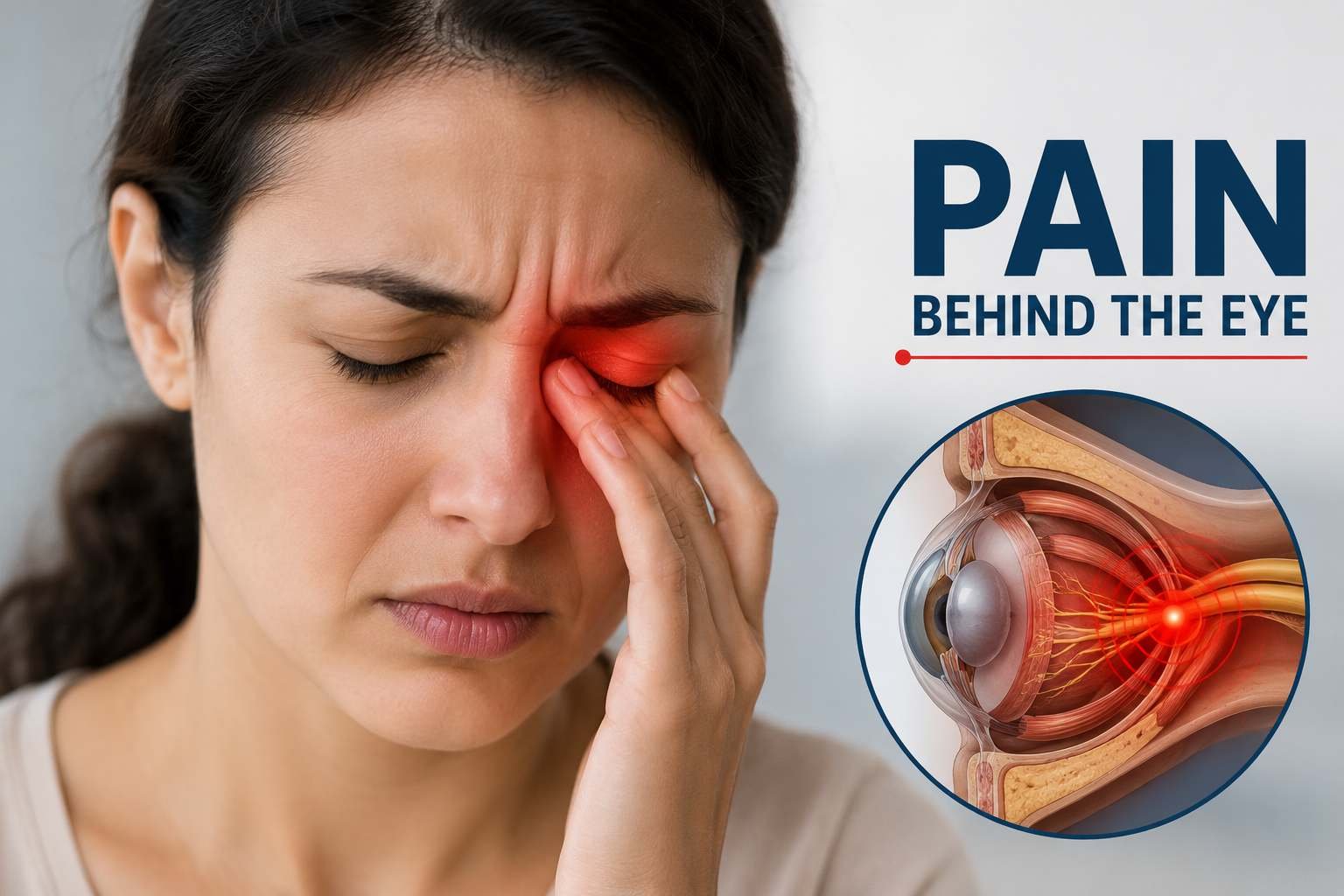
Understanding Pain Behind the Eye
Pain behind the eye is a symptom, not a diagnosis. The same sensation, pressure, aching, sharp stabbing, or dull throbbing, can arise from several distinct causes. Identifying the right one requires looking at accompanying symptoms, duration, and pattern.
Common Causes
- Eye Strain and Digital Fatigue: Screen use has reshaped how our eyes work. Extended screen time reduces blink frequency, fatigues the ciliary muscles, and creates sustained tension that often manifests as pain behind the eye. The discomfort tends to build over the course of the day and eases with rest.
- Tension Headaches: Tension headaches are among the most common triggers of discomfort in and around the eyes. The pressure typically presents bilaterally — behind both eyes — and is often tied to stress, posture, or prolonged concentration. Managing screen ergonomics, taking regular breaks, and addressing postural habits significantly reduces recurrence.
- Sinusitis: Inflammation of the sinus cavities creates direct pressure on the structures surrounding the eyes. This pressure-type pain behind the eye often worsens when bending forward and is accompanied by nasal congestion or facial tenderness. It typically resolves once the underlying infection or inflammation is treated.
- Migraine: Migraine is more than a headache. The condition often includes intense pain concentrated around or behind one eye, sometimes accompanied by light sensitivity, nausea, and visual disturbances. According to the Migraine Research Foundation, approximately 39 million people in the United States alone experience migraines, many of which directly affect the area around and behind the eyes.
- Glaucoma: In the acute, closed-angle form, glaucoma presents with sudden, severe eye pain, often accompanied by headache, blurred vision, nausea, and a dilated pupil. This is a medical emergency. Elevated intraocular pressure rapidly damages the optic nerve, and a delay in treatment risks permanent vision loss.
- Optic Neuritis: This is an inflammation of the optic nerve — the cable connecting the eye to the brain. Pain behind the eye, particularly during eye movement, paired with temporary vision loss or changes in color perception, is characteristic. Optic neuritis is frequently associated with multiple sclerosis and warrants prompt neurological evaluation.
- When to Seek Immediate Care: Seek emergency attention if pain behind the eye is sudden and severe, or if it accompanies blurred or double vision, nausea, vomiting, eye redness, fever, or any neurological changes. Persistent or recurring discomfort, even when mild, also warrants a formal eye examination rather than self-management.
Dry, Irritated Eyes: More Than a Minor Inconvenience
Dry irritated eyes are one of the most reported ocular complaints globally. The National Eye Institute notes that nearly 16.4 million Americans have a diagnosed dry eye condition — a number that almost certainly understates the true prevalence, given how often the condition goes undiagnosed.
What Causes Dry, Irritated Eyes?
The tear film is a complex, multi-layered structure. Any disruption to its composition, whether in the aqueous, lipid, or mucin layer, results in instability and evaporation. When the tear film breaks down faster than it is replenished, the ocular surface becomes exposed, inflamed, and uncomfortable. Reasons.
- Digital Devices: Prolonged screen use dramatically reduces blink rate. Research shows that blink frequency drops by up to 60% when focused on a screen. Incomplete blinks compound the problem, as each partial blink fails to spread the tear film evenly. The result: dry irritated eyes that sting, blur, and fatigue easily.
- Environmental Factors: Air conditioning, central heating, low humidity environments, wind, and dust all accelerate tear evaporation. For those in climate-controlled offices or at high altitudes, the cumulative effect on the ocular surface is significant.
- Contact Lens Wear: Extended or improper contact lens use disrupts tear distribution and oxygen supply to the cornea. Wearers are significantly more prone to dry irritated eyes, particularly in environments that already challenge tear stability.
- Meibomian Gland Dysfunction (MGD) The meibomian glands, located along the eyelid margins, secrete the lipid layer of the tear film that prevents evaporation. When these glands become blocked or dysfunctional, a condition more common than widely appreciated, the lipid layer thins, and tears evaporate rapidly. MGD is now recognized as the leading cause of evaporative dry eye disease.
- Aging and Hormonal Changes: Tear production naturally declines with age. Women undergoing menopause experience significant hormonal shifts that directly affect meibomian gland function and aqueous tear secretion. This makes post-menopausal women a particularly high-risk group for chronic dry eye symptoms.
Symptoms That Go Beyond Dryness
Dry irritated eyes do not always feel dry. Paradoxically, many patients experience excessive tearing, the eye’s reflex response to irritation. Other symptoms include a gritty or foreign-body sensation, burning, redness, light sensitivity, fluctuating blurred vision with blinking, and difficulty wearing contact lenses. Persistent inflammation on the ocular surface, if untreated, can also contribute to pain behind the eye, creating a symptomatic overlap that requires careful clinical assessment.
Practical Steps You Can Take Right Now
Lifestyle adjustments make a measurable difference when the root cause is environmental or behavioral.
- Follow the 20-20-20 Rule. Every 20 minutes, look at something 20 feet away for at least 20 seconds. This reduces ciliary muscle fatigue and allows the tear film to stabilize. It is a small habit with a substantive impact on both eye strain and dry irritated eyes.
- Audit Your Environment Position screens slightly below eye level to reduce surface exposure. Adjust air vents so they do not blow directly toward your face. Use a humidifier in dry indoor spaces. These environmental tweaks reduce evaporative stress on the tear film throughout the day.
- Blink Intentionally Sounds obvious, yet most people drastically under-blink during concentrated tasks. Making a conscious effort to blink fully and regularly while using a screen restores tear film integrity and reduces irritation.
- Prioritize Sleep and Hydration. The ocular surface replenishes during sleep. Insufficient rest and inadequate hydration both impair tear production and surface healing. These foundational health practices carry direct ophthalmic benefit.
- Use Preservative-Free Lubricating Drops. Over-the-counter artificial tears provide symptomatic relief and surface protection for mild-to-moderate dry eye. Preservative-free formulations are preferable for frequent use, as preservatives themselves can cause surface irritation over time.
When Self-Care Is Not Enough
Lifestyle adjustments address contributing factors; they do not replace clinical diagnosis. If dry irritated eyes persist despite home management, or if pain behind the eye recurs or intensifies, a comprehensive ophthalmological evaluation is the appropriate next step.
Modern diagnostic tools, including tear film analysis, meibography to assess meibomian gland structure, optical coherence tomography, and wavefront analysis, allow clinicians to identify the precise cause of discomfort and build a targeted treatment plan. Advanced centers today also assess systemic markers, recognizing that ocular symptoms are frequently the earliest signal of broader health changes.
Ready to stop managing symptoms and start understanding your eyes? A comprehensive eye examination with an experienced specialist gives you clarity not just about what is causing your discomfort, but about your overall eye health trajectory. Book your consultation today and take the first step toward genuine, lasting relief.