

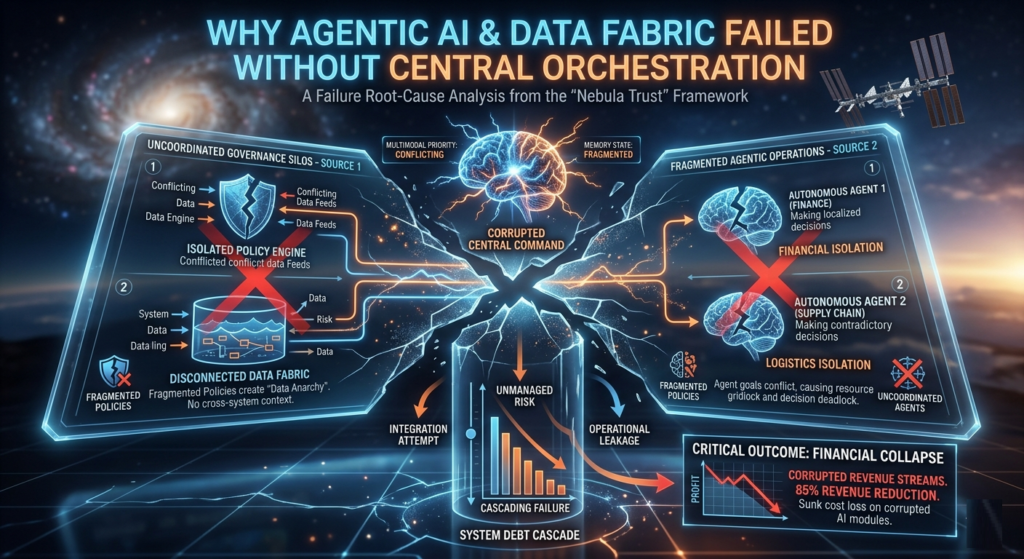
Every company’s leaders have seen the presentation by now. It is always filled with numbers and bold statements. They show a plan that’s full of artificial intelligence projects and they promise that this will be the year when everything gets better. Then six months go by. Half of those artificial intelligence projects are quietly stopped. Nobody really knows who gave the okay for the customer service chatbot that started causing problems and the artificial intelligence transformation looks like it is a very expensive test.
This isn’t a talent problem. It isn’t even really a technology problem anymore. The uncomfortable truth that more and more CIOs, CISOs, and boards are waking up to is this: AI transformation is a problem of governance, not a problem of models, computers, or ambition.
The numbers show that AI is a deal. Companies are going to spend over $665 billion on AI by 2026.. Many AI projects do not give companies the results they want. In fact some studies say that over 40% of AI projects started in the year are abandoned. The AI technology itself usually works. The problem is how companies use it. They need to figure out who makes decisions, who takes risks and who is responsible when AI does something.
The Real Reason AI Projects Stall (It’s Not the Algorithm)
Walk into any organization that is in the middle of implementing AI and you will see the same thing. A project gets approved quickly because a senior person liked what they saw in a demo. The AI model works well in testing. Then it goes live, starts handling customer data, makes decisions that affect things like pricing or hiring or support tickets and suddenly everyone is wondering who is actually in charge of this thing.
There is a gap between putting a new capability into use and making sure it is properly managed. This is where many efforts to transform a company quietly fail. It is not usually a failure. It is like a slow death from many unanswered questions. For example, who gets to approve changes to the AI model? Who checks to make sure the AI is not biased? Who is responsible when the AI does something that a human would have questioned?
Company leaders are starting to notice this problem. Surveys show that only a small number of CEOs take responsibility for what their AI systems do. Fewer companies have formal structures in place to oversee AI. At the time AI systems that make decisions about things, like credit, hiring and customer interactions are becoming more autonomous. The problem is that AI capabilities are advancing quickly. The structures to govern them are not keeping up. This is why many projects to transform a company stall out at the pilot stage.
Why “AI Transformation Is a Problem of Governance” Isn’t Just a Catchy Line
It is tempting to think of the phrase governance as something that’s not really important but take a moment to think about what it really means. Governance is not something that you add to an Artificial Intelligence project after it is already done. It is the system that Artificial Intelligence uses to operate. Without governance you do not have a controlled way of introducing Artificial Intelligence to the public. You have an experiment that is moving quickly and has consequences.
Here are some things that can go wrong when governance is not taken seriously:
Ownership of Artificial Intelligence becomes unclear. A team builds a model another team puts it into use. The team that uses it does not ask any tough questions about how it works. When something goes wrong each team blames the teams.
The level of risk that the company is willing to take is never decided. Nobody decides ahead of time how much error or bias is acceptable for an use of the Artificial Intelligence so every time something goes wrong it becomes a big problem that has to be solved quickly instead of a planned response to a known risk.
Monitoring Artificial Intelligence is not done regularly. Artificial Intelligence models change over time. They learn things and their results change in ways that can not be found with just one review. Without oversight a company can be using a system that has become unreliable for a long time before anyone notices.
Artificial Intelligence that is not approved starts to be used. When the official governance rules are too slow or too restrictive, employees start to use tools that are not approved because the approved tools are too hard to use. Which means the company is now using two Artificial Intelligence systems, one of which it does not even know about.
None of these problems are caused by Artificial Intelligence not working well. They are caused by the way the company is organized. This is why companies that have access to the Artificial Intelligence models, the same computer power and similar budgets can have very different results, from using Artificial Intelligence. The thing that makes the difference is not the Artificial Intelligence itself it is the support system that is built around Artificial Intelligence.
Agentic AI Raises the Stakes – and Lowers the Margin for Error
If people in charge thought they could ignore the rules when artificial intelligence was a computer program that talked to people or suggested things, they start to think it is necessary when artificial intelligence actually does things on its own. That is the world that artificial intelligence that can act on its own has brought companies into. These systems do not just give an answer for a person to check they do things by themselves: they start transactions, send cases to someone who can help get into accounts and finish all the work from start to finish.
This ability to act on its own is exactly what makes artificial intelligence that can act on its own so useful and exactly what makes it so bad if the rules are not strong. If a computer program that can only do one thing at a time makes a mistake a person will catch it when they check the answer.. If artificial intelligence that can act on its own makes a mistake it can do many things wrong without anyone noticing and by the time someone sees what is wrong the artificial intelligence may have already affected many accounts, transactions or decisions.
This is precisely why the conversation around agentic AI Pindrop Anonybit has become such a useful real-world case study for what mature governance actually looks like in practice. Picture a contact center handling a wire transfer request. A fraud ring deploys a synthetic voice clone to impersonate a legitimate customer. Pindrop’s voice intelligence analyzes the live audio against more than a thousand acoustic signals and flags it as synthetic within seconds. An agentic AI layer reads that signal alongside session metadata and behavioral history, and – without waiting for a slow human review cycle – escalates the risk level automatically. Anonybit’s decentralized biometric verification then confirms, cryptographically, that no legitimate match exists for that caller, without ever storing a centralized biometric record that could become a single point of catastrophic failure.
The reason this stack is worth looking at is not just because it can prevent fraud. It is because of the way it is governed. Each part of the stack has a job. Every decision that is made is the responsibility of someone or something. The part of the stack that can act on its operates within boundaries that are set by checks that verify people’s identities while keeping their information private. This is not like a box that can make decisions without being watched.
Now people are trying to commit fraud over the phone about every 46 seconds.. The number of attacks that use fake audio and video has gone up by more than 1,000 percent in the last year. A system like this can only work when it is used by a lot of people because it was designed with governance from the beginning. It was not just added on after something went wrong.
This is what people, in charge of companies, should learn from this. Even if preventing fraud is not what they are trying to do. If you use intelligence that can act on its own without a good system of governance then you are giving it the power to make decisions without being held accountable.. If you use artificial intelligence that can act on its own with a good system of governance then you have a system that is fair and transparent and that handles people’s private information in a way that is safe. This is how you can use intelligence in a way that is safe and responsible.
What Mature AI Governance Actually Looks Like
Forget those generic ethics guides that people write and then never look again. Good governance, the kind that prevents problems with AI systems usually has some key features.
There is a person in charge of every AI system, not a group of people who share the responsibility so much that nobody is really in charge. There is a record of who has the authority to make decisions. When an AI system can act on its own someone specifically said it was okay and can explain why. The AI system is monitored all the time from the beginning to check for bias, errors and to make sure we can understand what it is doing. This is better than checking it once a year because that information is old news after a month. There is a plan for what to do when an AI system does something unexpected so we can respond quickly and follow a set procedure instead of just making it up as we go.. We think about what the rules and regulations are when we are designing the AI system, not just after we have to because of a deadline. This is especially important now that laws like the EU AI Act have real penalties for breaking them.
Notice what is not on this list: we do not talk about which AI model to use, which company to buy it from or how much computer power we need. Governance is about how the organization’s set up, not about the technical details. That is why people often skip it. It is harder to put on a schedule than “have an AI assistant ready by the end of the summer” and it does not look as cool in a demo.. It is what makes the difference between an AI project that works well and one that becomes a big problem that the board of directors has to deal with. AI systems need governance to work safely. Good governance of AI systems is what prevents problems.
Building AI Transformation the Right Way – Governance First
This does not mean that we should not move forward with Artificial Intelligence. It means we should not move forward with Artificial Intelligence without a plan. The companies that are really succeeding with Artificial Intelligence now are not necessarily using more complex models than their competitors. They are using the models but they have a system in place that can catch problems early, assign responsibility and change policies as the technology changes.
This is where Mobcoder Artificial Intelligence comes in. They work with companies to fix this issue. They do not see rules and regulations as something that slows down progress. As the base that makes progress last. This means they help teams figure out who is in charge before they start using Artificial Intelligence built in a way to monitor the systems from the beginning and design workflows that have accountability built in from the start. Checking identities, detecting fraud and automated customer interactions.
If your Artificial Intelligence project is not moving forward the solution is usually not to get a model. The solution is usually to answer a question: who is really in charge of Artificial Intelligence and how do we know if something is going wrong before it becomes a big problem. Mobcoder Artificial Intelligence helps companies answer this question and make their Artificial Intelligence projects successful.
Frequently Asked Questions
1. Why do most AI transformation projects fail to scale beyond a pilot?
Most stall because no one defined ownership, risk tolerance, or monitoring before deployment. The model usually works fine in testing – it’s the lack of organizational structure around it that causes things to break once it touches real users and real data.
2. What does it mean when people say “AI transformation is a problem of governance”?
It means the bottleneck in most failed AI initiatives isn’t the technology itself, but the absence of clear accountability, oversight, and decision-making structure around how that technology gets used, monitored, and corrected when it goes wrong.
3. How is agentic AI different from traditional AI tools in terms of risk?
Traditional AI tools typically generate suggestions for a human to review before anything happens. Agentic AI takes multi-step actions autonomously, which means an error can compound across several actions before a human ever notices, making strong oversight far more critical.
4. What can enterprises learn from the agentic AI, Pindrop, and Anonybit approach to fraud prevention?
That approach pairs autonomous decision-making with layered, verifiable identity checks and privacy-preserving biometric data handling. The takeaway for any industry is that autonomy works best when it operates inside clearly governed boundaries, not as an unsupervised black box.
5. Who should own AI governance inside an organization?
Ideally, a named executive or governance lead per high-impact AI system, with documented sign-off authority – not a vague committee. Diffused ownership is one of the most common reasons accountability breaks down when something goes wrong.
6. Does AI governance slow down innovation?
Not when it’s designed well. Governance built in from the start tends to accelerate safe deployment, because teams aren’t stuck firefighting unexpected incidents or retrofitting compliance under regulatory deadline pressure later on.
7. What industries are most affected by weak AI governance right now?
Financial services, healthcare, contact centers, and any customer-facing function using autonomous agents are seeing the highest exposure, largely because the cost of an unmonitored error (fraud, compliance violations, biased decisions) is immediate and measurable.
8. How does shadow AI relate to governance failure?
When official AI tools create more friction than value, employees often turn to unauthorized tools instead, creating a parallel, invisible AI ecosystem the organization has no oversight over. That’s usually a sign governance design needs rethinking, not stricter enforcement.
9. What role does monitoring play in AI governance?
A major one. AI models drift and retrain over time, so a one-time audit isn’t enough. Continuous monitoring for bias, accuracy, and explainability is what catches problems while they’re still small, rather than after they’ve affected real users.
10. How can a company like Mobcoder AI help with governance-first AI transformation?
Mobcoder AI works with enterprise teams to build AI systems where ownership, monitoring, and accountability are designed in from the start – across use cases ranging from agentic workflows to identity verification – so transformation efforts scale safely instead of stalling at the pilot stage.
