

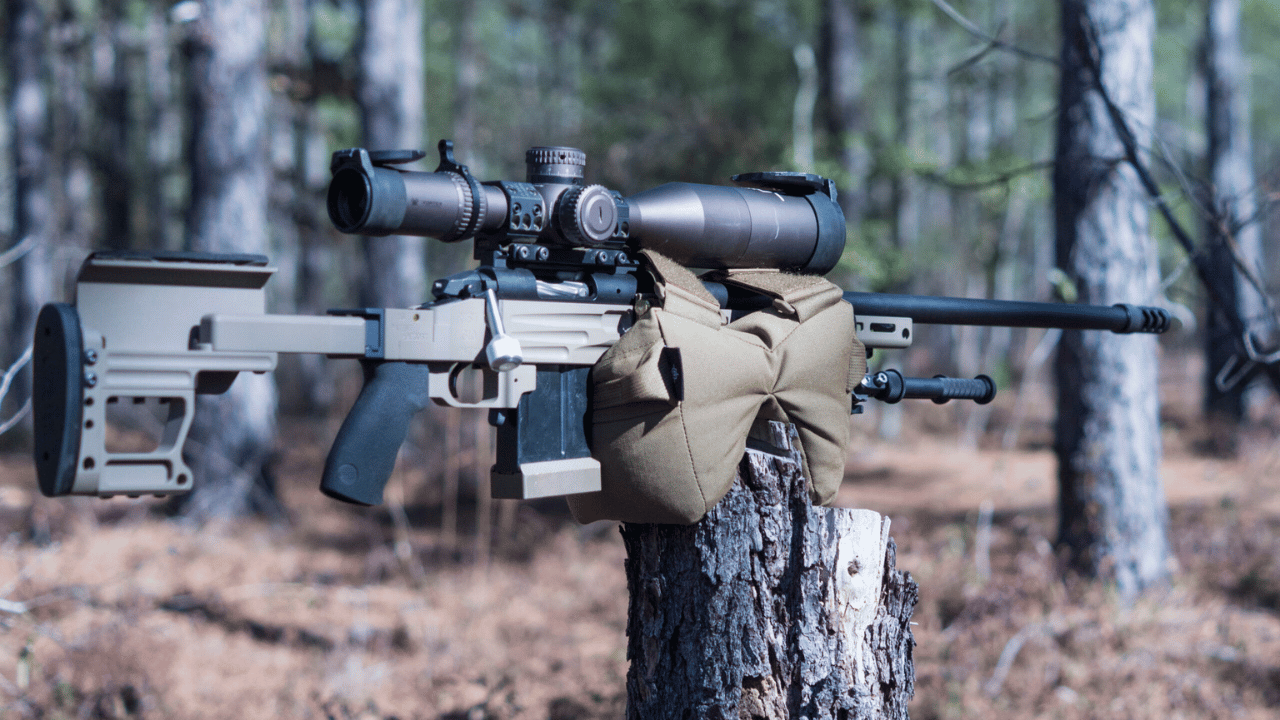
Canadian shooters regularly spend $1,000–$2,000 upgrading their scope in search of better long-range accuracy. The scope matters, but it is rarely the limiting factor. In most cases, the bottleneck is the support system — specifically, the shooting bag setup. A $200 scope on a properly supported rifle will outperform a $1,500 scope on a poorly supported one at long range. Understanding why changes how you invest in your accuracy system.
The Physics of Long-Range Shooting Support
At 500 metres, a 1mm movement of the muzzle at the moment of firing translates to approximately 5 centimetres of impact point shift. Human tremor at rest produces oscillations of 2–4mm at the muzzle of a free-held rifle. This means even a rested, experienced shooter generates 10–20 cm of potential dispersion at 500 metres from hand tremor alone — before wind, trigger, and ammunition variables are added.
A proper shooting bag setup eliminates hand tremor from the equation entirely. The rifle rests on a stable surface, held in position by gravity and bag friction rather than muscle tension. This is why competitive benchrest shooters shoot sub-quarter-MOA groups that are mechanically impossible to achieve from an unsupported hold.
The Correct Two-Bag Setup for Bolt Action Rifle Shooting
Front Bag Placement
Position the front shooting bag under the forend of your bolt action rifle as far forward as comfortable — typically at the midpoint of the forend. The rifle should rest in the bag’s channel naturally, with the action level and the crosshair on target without muscle assistance. If the rifle naturally points above or below the target, adjust bag firmness rather than applying muscle pressure to correct the elevation.
Rear Bag Placement and the Squeeze Technique
The rear bag sits under the buttstock. Your support hand grips the bag — not the stock — and fine-tunes elevation by squeezing the bag body. A gentle squeeze raises the muzzle; releasing the squeeze lowers it. This squeeze technique is the standard elevation adjustment method for all supported precision shooting and produces far more consistent results than adjusting the front bag between shots.
Common Bag Setup Mistakes That Kill Long-Range Accuracy
- Gripping the pistol grip tightly — creates tension that moves the rifle at trigger break
- Bag too firm — rifle cannot settle naturally and creates pressure-induced POI shifts
- Rear bag too far back — insufficient elevation control range
- Front bag not centred — rifle cants sideways affecting windage
- Shooting without a rear bag — vertical stringing is almost inevitable
What Scope Upgrades Actually Help vs What Bags Solve
- Groups are vertically strung → Rear bag problem, not scope
- Scope is hard to see at max magnification → Scope quality issue
- Zero shifts between sessions → Check action screws and rings before blaming scope
- Groups are consistent but centered wrong → Scope adjustment issue
- Groups open at long range but tight at 100m → Likely ammunition + wind, not scope
Conclusion
Before your next scope upgrade, invest in quality shooting bags and learn to use them correctly. The accuracy improvement from proper bag technique exceeds what most scope upgrades deliver for the average Canadian shooter. Only when your bag setup is dialled in and your technique is consistent does an optics upgrade become the next meaningful accuracy investment.
