

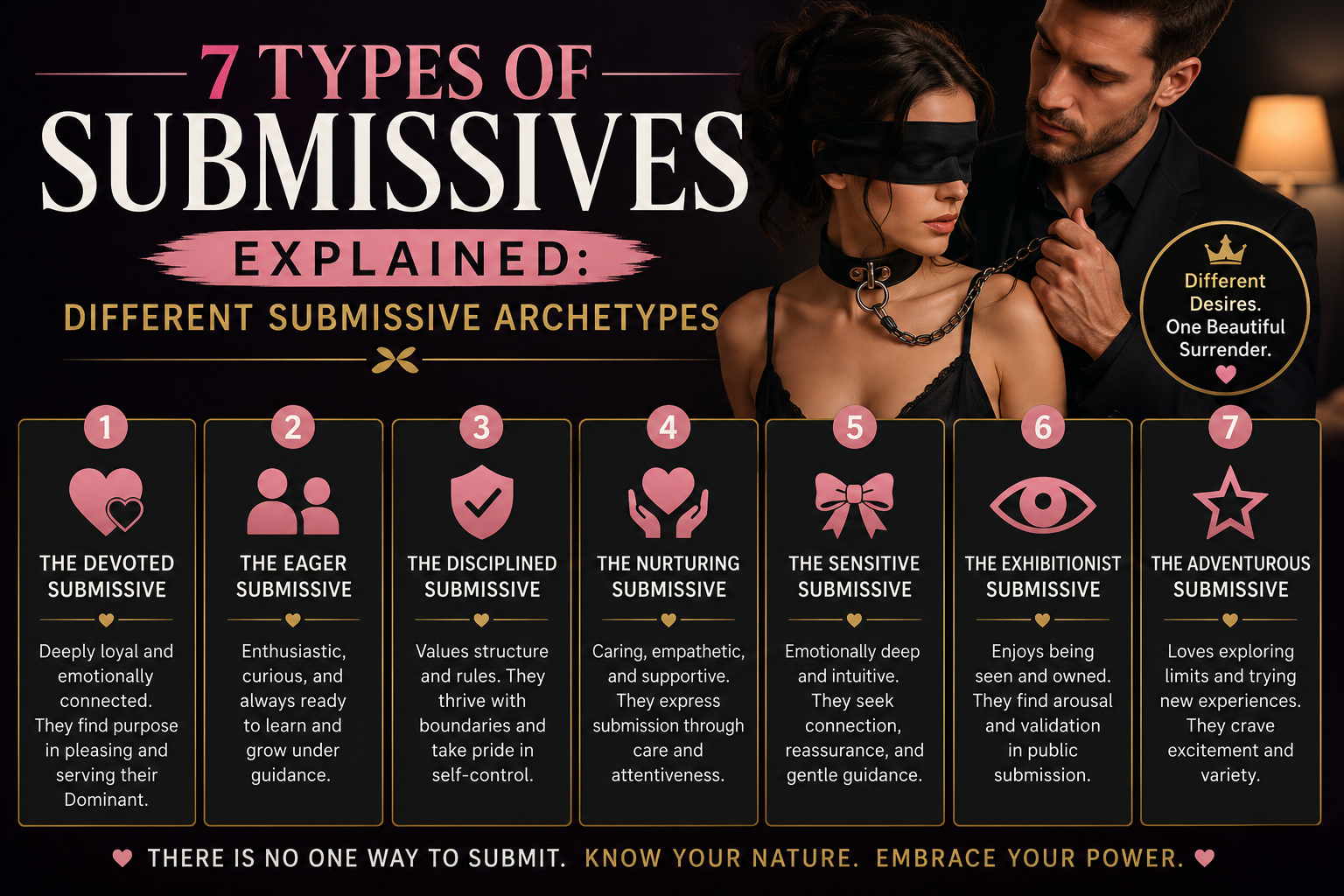
Understanding the types of submissives is one of the most common questions people ask when exploring power dynamics, BDSM, or relationship roles. Not every submissive is the same. Some enjoy serving, others enjoy playful resistance, while some seek emotional guidance and structure.
Learning the different types of submissives can help you communicate boundaries, understand compatibility, and choose dynamics that feel safe and fulfilling.
What Does “Submissive” Mean?
A submissive is a person who willingly gives a degree of control, authority, or decision-making to a dominant partner within agreed boundaries. Submission is consensual, negotiated, and based on trust.
Important: Being submissive does not mean being weak, passive, or lacking independence. Many submissive people are highly confident in everyday life.
The 7 Types of Submissives
These 7 types of submissives are commonly discussed in BDSM communities and relationship education. A person may identify with one category or a blend of several.
1. Service Submissive
Service-oriented submission
A service submissive finds satisfaction in helping, supporting, and making their partner’s life easier.
Common traits
- Enjoys acts of service
- Takes pride in reliability
- Focuses on practical care
- Often values structure and routine
Examples
- Preparing meals
- Organizing tasks
- Assisting with daily responsibilities
- Anticipating a partner’s needs
This is one of the most recognized submissive archetypes because the motivation is often service rather than punishment or control.
2. Brat Submissive
Brat submission
A brat submissive playfully challenges authority. They may tease, argue, or break small rules to create interaction and attention.
Common traits
- Playful resistance
- Enjoys banter
- Seeks engagement from the dominant
- Often energetic and expressive
Important distinction
A brat is not simply disobedient. The behavior is usually part of a consensual dynamic where both partners enjoy the chase, correction, or playful tension.
This is currently one of the most searched submissive types online.
3. Slave Submissive
Slave dynamic
A slave-oriented submissive may desire a deeper power exchange with clearly defined authority and responsibility.
Common traits
- Strong commitment to the dynamic
- Preference for explicit rules
- High value on obedience
- Often interested in long-term structure
Key note
Healthy slave dynamics require extensive negotiation, informed consent, and ongoing communication. They are not the same as real-world coercion or ownership.
4. Pet Submissive
Pet play
A pet submissive engages in pet play or animal-inspired role dynamics.
Common traits
- Enjoys roleplay and symbolism
- Finds comfort in nonverbal interaction
- May use collars, names, or pet behaviors
- Often values affection and playfulness
Examples
- Puppy play
- Kitten play
- Pony play
- Other consensual pet role dynamics
This falls under the broader category of types of submissive personalities that emphasize identity, play, and emotional expression.
5. Masochistic Submissive
Masochism
A masochistic submissive enjoys receiving consensual pain, intensity, or physical sensation as part of a negotiated scene.
Common traits
- Enjoys impact play or sensation play
- Seeks endorphin release
- Often separates pain from harm
- Values safety protocols
Important distinction
Not all submissives are masochists, and not all masochists are submissive. These are separate preferences that may overlap.
6. Little or Care-Seeking Submissive
Age regression and little dynamics
This submissive type seeks nurturing, protection, reassurance, or a caregiving dynamic.
Common traits
- Desires emotional safety
- Enjoys comfort rituals
- Values guidance and reassurance
- May engage in age-regression roleplay
What people misunderstand
This dynamic is usually about care, comfort, and emotional connection, not actual childhood relationships.
7. Emotional or Devotional Submissive
Devotional submission
An emotional submissive is primarily motivated by connection, trust, and devotion rather than specific activities.
Common traits
- Deep emotional investment
- Strong focus on intimacy
- Enjoys feeling chosen and valued
- Often prioritizes communication over physical play
This is one of the most overlooked different types of submissives, yet it is extremely common in long-term power exchange relationships.
Quick Comparison of Submissive Types
| Submissive Type | Primary Motivation |
|---|---|
| Service | Helping and supporting |
| Brat | Playful challenge and attention |
| Slave | Deep structure and obedience |
| Pet | Roleplay and affection |
| Masochistic | Sensation and intensity |
| Little/Care-Seeking | Nurturing and protection |
| Emotional/Devotional | Trust and emotional connection |
Can Someone Be More Than One Type?
Yes. Most people are not limited to a single category.
For example, someone might be:
- A service submissive in daily life
- A brat during playful scenes
- An emotional submissive in their romantic relationship
Think of these categories as submissive archetypes, not rigid labels.
Types of Submissive Personalities
Beyond BDSM roles, psychologists and educators sometimes describe broader types of submissive personalities based on motivation.
The Helper
Gains fulfillment from caring for others.
The Seeker
Looks for guidance, mentorship, and direction.
The Rebel
Enjoys testing limits and creating playful tension.
The Devotee
Values loyalty, attachment, and emotional surrender.
The Explorer
Enjoys experimentation and discovering new dynamics.
These personality patterns can exist both inside and outside BDSM contexts.
How to Discover Your Submissive Type
Ask yourself these questions:
- Do I enjoy helping my partner?
- Do I enjoy being challenged or corrected?
- Am I drawn to rules and structure?
- Do I seek care, comfort, or protection?
- Is my interest mainly physical, emotional, or playful?
Your answers often reveal which submissive types resonate most strongly.
Healthy Submission vs. Unhealthy Control
Understanding the different types of submissives is only useful when paired with healthy relationship practices.
Healthy dynamics include
- Clear consent
- Negotiated boundaries
- Safe words or stop signals
- Mutual respect
- Aftercare
- The ability to withdraw consent at any time
Red flags include
- Pressure to participate
- Isolation from friends or family
- Ignoring boundaries
- Punishment without consent
- Financial or emotional coercion
- Using “dominance” to justify abuse
A real dominant respects a submissive’s autonomy.
Are These Types Scientifically Proven?
No. The 7 types of submissives are community-based classifications, not official psychological diagnoses. They are useful for discussion, self-reflection, and communication, but human personalities are far more complex than any single label.
Final Thoughts
The world of types of submissives is much broader than the stereotype of a quiet, obedient partner. From the service submissive who thrives on helping, to the brat who enjoys playful resistance, to the emotional submissive who seeks deep connection, each archetype reflects a different motivation for consensual submission.
The most important takeaway is that submission is personal. Many people blend multiple submissive archetypes, and preferences can evolve over time. Whether you are exploring BDSM for the first time or trying to understand your own submissive personality type, open communication, consent, and self-awareness matter far more than fitting perfectly into one category.
Read More Blogs on Gettonews.com
