

The global manufacturing landscape is changing rapidly. Consumer demands shift overnight. Supply chains face constant disruptions. Raw material costs fluctuate unpredictably. To survive, factories must adapt immediately.
Traditional Manufacturing Execution Systems (MES) often fail in this new environment. Monolithic legacy systems act like concrete molds. They are rigid, expensive to alter, and slow to deploy.
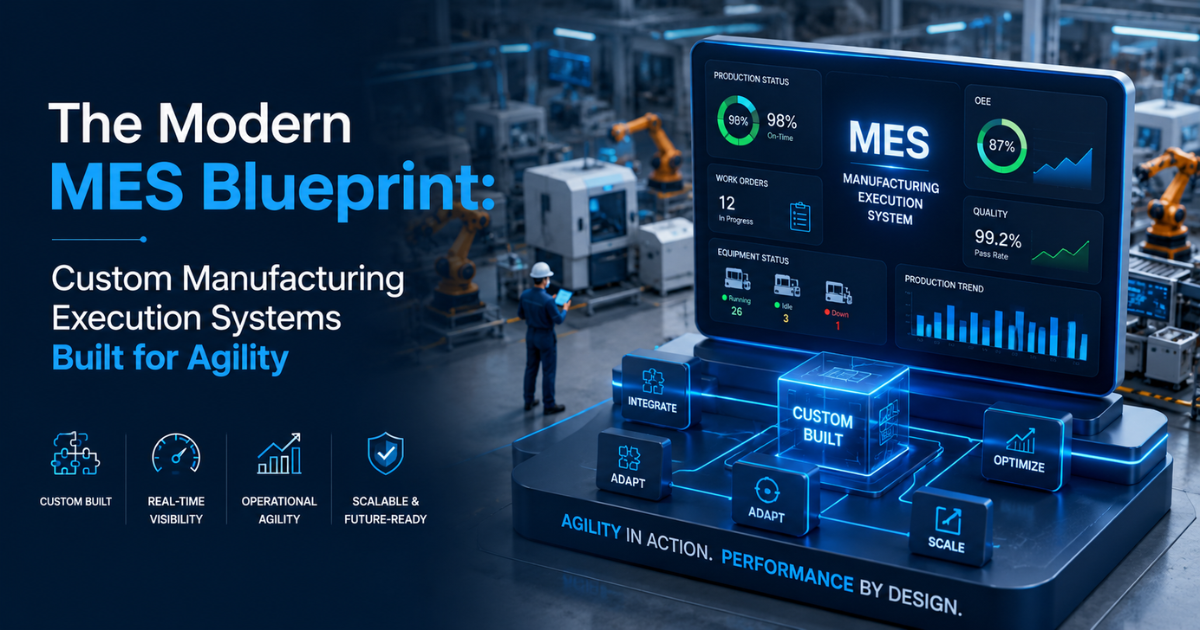
Forward-thinking industrial leaders are shifting their strategy. They choose custom Manufacturing Software Development to build agile, modular MES architectures. This blueprint explores how custom systems drive modern factory floors.
The Failure of Monolithic Legacy Systems
For decades, off-the-shelf MES software served as the standard factory backbone. These systems tracked production, gathered data, and managed work-in-progress (WIP). However, commercial off-the-shelf (COTS) software has a major flaw. It forces your factory to follow its rigid codebase.
1. The Cost of Inflexibility
Monolithic systems bundle all features into one large application. If you change one machine process, the whole software system requires a rewrite. Gartner reports that legacy software updates cost manufacturers billions annually in downtime alone.
2. Data Silos and Poor Integration
Most legacy systems use closed databases. They do not talk easily to modern IoT sensors or cloud platforms. Data gets trapped. Production managers cannot see real-time bottlenecks.
3. High Total Cost of Ownership (TCO)
Off-the-shelf software requires expensive user licenses. Manufacturers also pay heavy fees for custom integration consultants. Over five years, a rigid COTS system often costs more than a tailored solution.
Why Agility Defines Modern Manufacturing
Modern manufacturing requires speed and flexibility. High-mix, low-volume (HMLV) production is becoming the industry norm. Factories must switch assembly lines quickly to handle different product variants.
Agility means your software adapts to your floor plan instantly. A modern MES must process data in milliseconds. It must connect the factory floor directly to business offices.
According to Mckinsey, agile manufacturers improve operational efficiency by 30%. They also boost product quality by 20%. You cannot achieve these metrics using static, decade-old software architectures. You need dynamic digital tools built for change.
Core Pillars of a Custom MES Blueprint
A modern MES does not rely on a single central server. It uses a distributed, microservices-driven framework. A professional Manufacturing Software Development Company designs this architecture using four core pillars.
1. Microservices Architecture
Microservices break the MES into small, independent programs. One microservice handles tool tracking. Another service manages quality control. A third service controls scheduling.
[Shop Floor Devices] —> [API Gateway] —> [Scheduling Microservice]
—> [Quality Microservice]
—> [Asset Tracking Microservice]
If the scheduling service fails, production does not stop. The quality and tracking modules keep running. Developers can update a single microservice in hours without stopping the entire plant.
2. Edge Computing Integration
Modern factories generate terabytes of data every day. Sending all this data to the cloud creates lag. Edge computing solves this problem.
Small computers sit directly next to the factory machines. They filter and process data locally. The edge system sends only critical alerts to the central MES. This reduces network bandwidth needs by up to 70%.
3. Open APIs and Interoperability
An agile MES connects to everything. It uses open Application Programming Interfaces (APIs). These APIs allow the MES to talk directly to your ERP, CRM, and PLM software.
It breaks down walls between departments. When a sales rep enters an order, the MES schedules production immediately. No manual data entry is required.
4. Event-Driven Data Pipelines
Old systems pull data every hour. Modern systems use event-driven architecture. Every machine cycle, sensor reading, or material move triggers an event. The MES responds to these events instantly. Managers see actual factory conditions as they happen.
Architectural Comparison: Legacy vs. Custom Agile MES
The table below highlights the technical differences between traditional software and custom agile systems.
| Feature | Legacy Monolithic MES | Custom Agile MES |
| Architecture | Single tightly-coupled codebase | Modular microservices |
| Data Processing | Batch processing (hourly/daily) | Real-time event-driven pipelines |
| Deployment Time | 12 to 18 months | 3 to 6 months (phased) |
| Integration | Difficult, requires middleware | Native via open APIs and MQTT |
| Downtime for Updates | High (requires system shutdown) | Zero (hot-swappable modules) |
| Scalability | Expensive hardware upgrades | Flexible cloud or edge scaling |
Key Modules of a Custom MES
An agile MES system contains specific modules tailored to your operations. A dedicated Manufacturing Software Development Company customizes these components for maximum floor efficiency.
1. Dynamic Scheduling Engine
Static schedules ruin factory productivity. When a machine breaks, the schedule must change. A dynamic scheduling module uses algorithms to reroute production. It checks current material levels, worker availability, and machine status. It then creates the most efficient path forward.
2. Real-Time OEE Tracking
Overall Equipment Effectiveness (OEE) measures machine availability, performance, and quality. Custom MES platforms calculate OEE continuously.
$$OEE = \text{Availability} \times \text{Performance} \times \text{Quality}$$
If a machine slows down by 5%, the system flags it. Maintenance teams fix the issue before the machine breaks completely.
3. Digital Work Instructions
Paper manuals get dirty, lost, or outdated. An agile MES delivers digital work instructions to terminal screens. Technicians see exact steps for the specific product variant on their line. The system can display 3D models or short video guides to reduce human error.
4. Automated Quality Assurance (QA)
Custom software connects directly to digital calipers, scales, and vision cameras. It records quality metrics automatically during production. If a part deviates from blueprints, the MES stops the conveyor line. This stops scrap production immediately.
Technical Stack for Agile MES Development
Building an agile MES requires modern, robust software technologies. The stack must handle heavy data loads and remain secure.
1. Backend and APIs
- Go (Golang) or Node.js: These languages handle thousands of concurrent data requests efficiently.
- Python: Ideal for building predictive maintenance modules and data analysis tools.
2. Frontend and User Interfaces
- React or Vue.js: These frameworks create fast, responsive user interfaces for tablets, monitors, and rugged floor devices.
- WebSockets: Essential for pushing real-time data to factory dashboards without refreshing pages.
3. Databases and Storage
- Time-Series Databases (InfluxDB / TimescaleDB): Optimized for storing continuous streams of machine sensor data.
- PostgreSQL: Handles structured relational data like user roles, work orders, and inventory lists.
Real-World Example: Automotive Component Manufacturing
Consider a Tier-1 automotive parts manufacturer. They produced 40 different brake assemblies on three production lines. They used a legacy MES that required manual scheduling updates. A single schedule change took four hours.
The manufacturer hired an expert software team for custom Manufacturing Software Development. The team built a microservices-based MES. They integrated the new system with the factory’s existing Allen-Bradley PLCs.
The Results
- Setup Time Reduction: Line changeover times dropped from 45 minutes to 12 minutes.
- Data Accuracy: Manual data entry errors decreased by 94%.
- Scrap Reduction: Real-time camera integration cut material scrap by 18% in the first quarter.
Steps to Implement a Custom MES Blueprint
Transitioning to a custom MES requires a step-by-step plan. Do not try to replace your entire system at once. Use a phased implementation strategy.
Phase 1: Audit Your Current Floor
Map your existing data sources. Identify every PLC, CNC machine, and legacy database. Find out where data bottlenecks happen most often.
Phase 2: Build a Minimum Viable Product (MVP)
Start with one critical module. For example, build a custom OEE tracking module for your slowest production line. Test it thoroughly with your operators.
Phase 3: Connect Core Business Software
Link your new MES module to your ERP system. Ensure data flows smoothly between the floor and your accounting department.
Phase 4: Scale Across the Enterprise
Once the MVP succeeds, deploy additional modules like quality control or asset tracking. Roll the software out to other production lines and factory locations.
Overcoming Implementation Challenges
Custom software projects require careful management. Watch out for these common industrial tech pitfalls.
1. Resistance from Floor Staff
Operators dislike complicated technology. Involve your shop floor workers early in the design process. Keep user interfaces simple, clean, and intuitive.
2. Cybersecurity Threats
Connected factories face cyber risks. Secure your custom MES with end-to-end encryption. Use role-based access control (RBAC) to restrict system modifications.
3. Data Standardization
Different machines speak different languages. Use industry standard protocols like OPC-UA or MQTT. These protocols translate diverse machine data into a single clean format.
The Strategic Value of Owning Your Code
When you buy off-the-shelf software, you rent your operations system. When you build custom software, you own a valuable business asset.
Custom software gives your factory a distinct competitive advantage. You can alter your production processes faster than your competitors. You do not wait for a commercial vendor to release an update. Your internal team or development partner adjusts the code instantly.
Agility is no longer optional for modern manufacturers. It is a strict requirement for market survival. A modular, custom MES provides the speed, connectivity, and flexibility that modern factories need. Partner with a trusted Manufacturing Software Development Company to build your blueprint today.
Conclusion
The shift toward custom factory software marks a major turning point for modern industry. Rigid, one-size-fits-all platforms no longer meet the demands of volatile global markets. Manufacturers must pivot quickly, track data instantly, and eliminate operational waste to remain profitable.
Investing in tailored Manufacturing Software Development allows you to build a system around your specific operational workflows. This modular approach protects your facility from unexpected downtime and expensive vendor lock-ins. It turns your execution software into a scalable asset that grows alongside your factory.
