

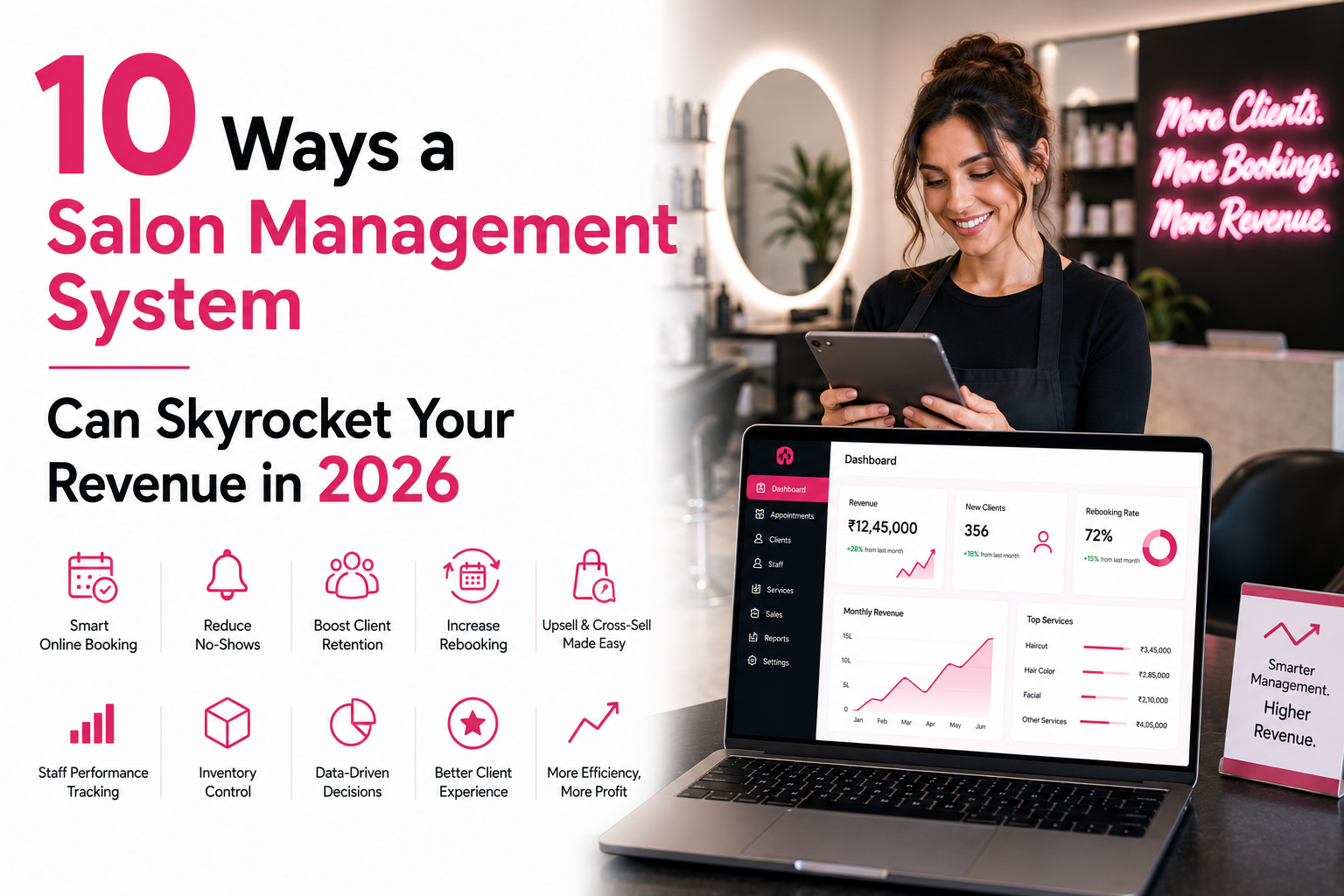
Most salon owners don’t lose money because their stylists aren’t skilled. They lose it in the gaps — the double-booked chair, the no-show that leaves 45 minutes empty, the retail product nobody remembered to recommend. Those gaps are quiet, but they add up fast.
In 2026, the salons pulling ahead aren’t necessarily the ones with the best haircuts. They’re the ones that plugged those gaps with software. Here are 10 concrete ways a management system pays for itself, plus a few honest notes on where it can’t do the work for you.
1. It Kills the No-Show Problem
No-shows are the silent revenue killer in this industry. Industry estimates put no-show rates at 10-20% for salons without automated reminders — that’s one in every five to ten appointments just gone.
Automated SMS and email reminders, sent 24 hours and again 2 hours before the appointment, typically cut that rate in half. Some systems also let you charge a deposit automatically if a client cancels late. That single feature alone can recover thousands of dollars a month for a mid-sized salon.
2. Smarter Scheduling Means More Chair Time
Manual booking books around gut feeling. Software books around actual chair availability, service duration, and staff skill match. A well-configured system can shave dead time between appointments down to near zero, which means more clients seen per stylist per day without anyone working longer hours.
This is one of the core promises of any real Salon Business Growth Platform — it’s not just about looking organized, it’s about squeezing more billable hours out of the same eight-hour shift.
3. Retail Sales Go Up When the System Prompts It
Stylists get busy. They forget to mention the toner, the serum, the at-home treatment that would double the client’s spend. A good POS-integrated system nudges front-desk staff and stylists with product suggestions tied to the service just performed.
Salons that add structured retail prompts at checkout commonly see retail revenue climb 15-25% within a few months — no new inventory, no new marketing spend, just better follow-through at the point of sale.
4. Client History Turns Into Upsell Opportunities
When a system remembers that a client gets color touch-ups every 6 weeks, or that she mentioned wanting to try a keratin treatment last visit, your staff can act on that instead of hoping they remember. That’s the difference between generic service and a personalized recommendation — and personalized recommendations convert.
5. Loyalty Programs Run Themselves
Manually tracking points or visit counts on a spreadsheet is a losing game — it either doesn’t happen consistently or it eats staff time that should go toward clients. Automated loyalty tracking rewards repeat visits without anyone lifting a finger, and repeat clients spend more over time than one-off bookings ever will.
6. Online Booking Captures Revenue You’d Otherwise Miss
A chunk of your potential clients are browsing at 11pm on a Tuesday, not during business hours when your phone is staffed. If they can’t book right then, many just book somewhere else. A 24/7 online booking page tied into your calendar captures that demand instead of losing it to a competitor’s website.
7. Inventory Management Stops the “We’re Out of That” Moment
Running out of a popular product mid-service, or discovering a color line is depleted the morning of a big appointment, costs sales and trust. Automated low-stock alerts and reorder triggers mean you’re rarely caught flat-footed, and you’re not tying up cash in overstocked shelves either.
8. Data Shows You Which Services Actually Make Money
Without reporting, it’s easy to assume your busiest service is your most profitable one. Often it isn’t — after product cost and stylist time, a “quick” service can eat more margin than a premium one. A system that breaks down revenue by service, stylist, and time slot lets you actually price and staff based on facts instead of assumptions.
This kind of visibility is exactly what separates a booking calendar from real Salon Software Growth Strategies — the data has to turn into decisions, or it’s just a report nobody reads.
9. Staff Commission Tracking Reduces Disputes and Boosts Motivation
Confusing or manual commission calculations breed resentment, and resentful stylists don’t upsell. Transparent, automatic commission tracking — visible to staff in real time — tends to increase motivation to hit retail and service targets, because the reward is clear and immediate rather than a mystery number on payday.
10. Multi-Location Owners Get One Dashboard Instead of Ten Headaches
If you run more than one location, chasing down numbers from separate spreadsheets or disconnected systems is its own tax on your time. A unified dashboard across locations lets you compare performance, shift staff or inventory where needed, and make decisions in minutes instead of days.
The Honest Caveat
None of this replaces good service or a talented team. Software amplifies what’s already working and exposes what isn’t — it won’t fix a genuinely bad client experience, and it won’t make an undertrained stylist suddenly great at color correction. What it will do is stop the leaks: the missed reminder, the forgotten upsell, the empty chair that should have been booked.
That’s really the whole pitch behind a platform like Salon100x — not magic, just fewer gaps between the value you’re capable of delivering and the revenue you actually collect for it.
Getting Started
If you’re still running your salon on a paper book or a generic calendar app, the jump to a dedicated system is usually the single highest-ROI change you can make this year. Start with the basics — automated reminders and online booking — then layer in reporting and loyalty tools once the fundamentals are running smoothly.
FAQ
How much revenue increase can I realistically expect from a salon management system?
Most salons see gains in the 15-30% range within the first six months, driven mainly by reduced no-shows and increased retail attach rate. Results vary based on how consistently staff use the tools.
Is a salon management system worth it for a single-chair or small salon?
Yes, often more so — a solo operator loses proportionally more from a single no-show or forgotten reminder, since there’s no other chair to absorb the gap.
Do clients actually prefer booking online over calling?
A large share do, especially younger clients, and offering both options rather than forcing a choice tends to capture the widest range of preferences.
