

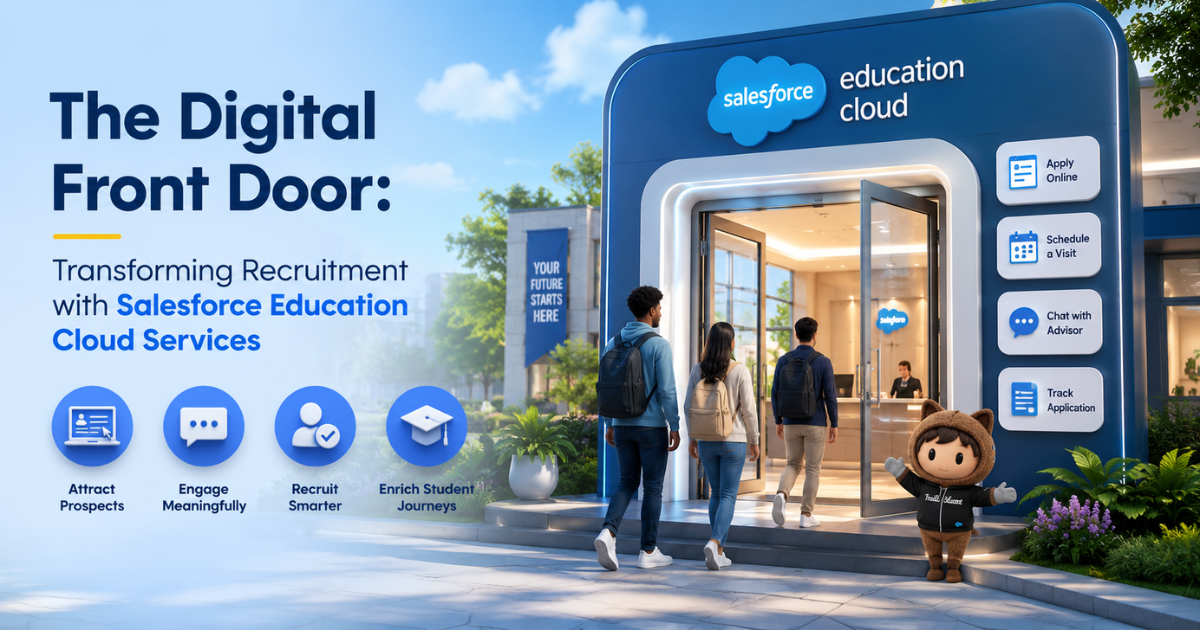
Higher education institutions face an increasingly competitive enrollment landscape. Traditional recruitment approaches often rely on disconnected databases, rigid application portals, and slow manual processes. These technical limitations create friction for prospective students who expect immediate, personalized digital interactions.
Modern universities require an integrated portal to capture student interest early, guide applicants through complex submissions, and accelerate decision timelines. This entry point is known as the digital front door.
Building a modern recruitment engine requires replacing legacy systems with a unified cloud data model. Specialized Salesforce Education Cloud Consulting partners give institutions the technical path to implement these modern systems safely. This explains how Salesforce Education Cloud Consulting Services convert traditional recruitment processes into responsive, scalable digital experiences.
The Technology Gap in Legacy Student Recruitment
Many higher education IT departments manage recruitment using multiple disconnected systems. Staff use one platform for email marketing, a separate database for vendor prospect lists, and an old student information system (SIS) to process applications.
This fragmented setup creates significant technical challenges:
- Batch Update Delays: Moving information between marketing tools and admissions databases using nightly batch scripts creates major data delays. Staff cannot respond instantly to prospective student inquiries.
- Disconnected Systems: When application portals do not connect to the central customer relationship management (CRM) platform, recruiters lose visibility into student interactions. They cannot track where an applicant gets stuck in the submission funnel.
- High Development Overhead: Maintaining custom code for older application web forms consumes valuable IT resources. Making simple updates to program requirements or application fields requires extensive developer support.
Data shows the real-world impact of these integration challenges. The 2026 Salesforce Connectivity Benchmark Report notes that 95% of enterprise IT departments face significant integration obstacles when using disconnected systems.
Furthermore, data from the total economic impact studies show that modernizing these recruitment platforms can drive a 5.5% average increase in enrollment yield. This improvement occurs because institutions can engage prospective students much faster than competitors using legacy systems.
Pillars of Modern Recruitment Architecture
The current version of Salesforce Education Cloud runs directly on the core Salesforce platform. It uses a standard education data foundation instead of relying on older managed packages. This native design ensures immediate data availability across recruitment, admissions, and student success teams.
Consultants focus on four main components to build an effective digital front door.
1. Unified Omnistudio Forms
Older application forms use hardcoded HTML and custom backend scripts. Education Cloud uses Omnistudio to create flexible, guided forms without complex coding.
- Dynamic Omniscripts: Developers build interactive forms that adjust fields automatically based on student inputs. For instance, if an applicant selects an international address, the form updates to display passport and visa document upload fields.
- Flexcards: Recruiters use compact UI components to view key prospect data points instantly, such as high school transcripts, event attendance, and recent text messages, within a single dashboard.
- Data Raptors: These efficient mapping services handle background data transfers. They read and write information directly to core objects without causing page lag.
2. Digital Portals via Experience Cloud
The digital front door needs a secure portal where applicants can track their status independently. Experience Cloud provides this authenticated workspace.
- Personalized Checklists: Portals display tailored document checklists. Students can see exactly which items are missing, such as recommendation letters or test scores, in real time.
- Self-Service Interactivity: Applicants can schedule campus tours, book advisor interviews, or text admissions staff directly through the portal interface.
- Responsive Mobile Design: The portal layout adapts automatically to mobile devices, ensuring a smooth experience for students completing tasks on smartphones.
3. Automated Business Rules Engine
Processing thousands of applications requires automated validation logic. The Business Rules Engine allows institutions to automate complex admissions decisions without writing custom Apex code.
This setup allows admissions managers to update scoring criteria or routing logic directly through a visual interface. They no longer need to wait for a software developer to modify backend code during busy application cycles.
4. Advanced Actionable Lists
Recruitment teams must prioritize high-value prospects systematically instead of scrolling through unstructured spreadsheets. Actionable Lists allow coordinators to segment prospect data using live criteria.
- Dynamic Prioritization: The system updates lists automatically when a prospect completes an action, such as opening an email or attending a virtual webinar.
- Integrated Communication Paths: Recruiters can launch phone calls or send text messages directly from their console dashboard, which logs every interaction automatically.
- Performance Insights: Leadership can track team outreach volume and conversion success metrics across different recruitment territories in real time.
Overcoming Critical Implementation Challenges
Transitioning an entire university to a native cloud architecture introduces distinct technical challenges. Experienced consulting teams use structured governance practices to address these typical deployment obstacles.
1. Managing Large Inbound Data Imports
Institutions frequently import large student prospect lists from testing services or central application systems like the Common App. Ingesting raw, unverified data can create duplicate records and degrade system performance.
Consultants resolve this problem by setting up the Data Processing Engine (DPE) to clean and validate information before saving it to the database. The system uses strict matching rules, checking unique identifier combinations like names, emails, and birthdays, to merge duplicate records automatically. This process keeps the data foundation clean and reliable.
2. Minimizing System Performance Latency
Running complex data routing rules and updating application statuses simultaneously can strain platform resources during peak application deadlines. This performance strain can slow down system responsiveness for internal staff.
Technical architects prevent performance drops by scheduling heavy data calculations to run during off-peak hours. They configure real-time triggers only for critical customer-facing actions, such as sending application confirmation emails. This balanced design ensures fast page loads for internal staff and external applicants.
Real-World Case Study: Public University Deployment
Consider a large public university that manages an annual pool of over 30,000 undergraduate applicants.
Legacy Operational Environment
The institution used an old, custom-built application system that ran separate from their marketing software. The systems synchronized data using batch transfers every 24 hours.
Applicants had to call the admissions office directly to confirm if the university received their transcripts. This high volume of inquiries created a massive support backlog, delaying application review timelines by several weeks.
Technical Rebuilding Phase
The university partnered with a certified Salesforce Education Cloud Consulting Services provider to overhaul their technology infrastructure.
- Portal Deployment: The implementation team built a modern applicant portal using Experience Cloud and Omnistudio. This interface allows students to upload documents directly from their mobile devices.
- Core Data Integration: Consultants mapped the school’s existing student information data points into the native Salesforce education architecture, eliminating the 24-hour sync delay.
- Automated Document Tracking: The team configured automated document checklists. The system updates the applicant’s portal status the moment a staff member scans a received transcript.
- Territory Routing Automation: The technical team used the Business Rules Engine to route submitted applications to regional review teams automatically based on the applicant’s high school location.
Institutional Performance Results
The new system transformed the university’s admissions operations. Inbound status calls dropped by 40% because applicants could track their document updates directly within the online portal.
Admissions staff cut their application processing time in half, sending out acceptance letters weeks faster than previous cycles. This improved operational efficiency helped the university achieve a 6% increase in their total enrollment yield.
Adapting Recruitment Platforms for Autonomous AI
- The rapid advancement of artificial intelligence is changing how universities interact with prospective students. Modern institutions are moving from simple informational web pages to interactive platforms that use autonomous digital assistants.
- Industry trends highlight this shift. The 2026 Salesforce Ecosystem Job Trends Report indicates that 88% of enterprises are actively deploying autonomous systems to manage repetitive customer inquiries.
- Consultants deploy autonomous tools like Agentforce directly within the Education Cloud framework. These assistants connect to the secure institutional database, allowing them to answer specific student queries accurately instead of generating generic responses.
- An assistant can look up specific program deadlines, verify prerequisite coursework, or guide a student through a complex application step. This immediate, automated support helps universities keep prospects engaged throughout the enrollment journey.
Conclusion
Building a digital front door is a critical step for higher education institutions looking to improve their student recruitment and admissions processes. Legacy, siloed systems create communication gaps and administrative delays that can cause universities to lose top talent to faster competitors.
By implementing Salesforce Education Cloud, institutions unify their data and automation tools onto a single platform. This architecture allows schools to deploy guided application forms, offer self-service tracking portals, and launch responsive AI tools.Partnering with certified Salesforce Education Cloud Consulting teams ensures that universities design a stable, scalable system. This modern infrastructure reduces operational friction for admissions staff and delivers the responsive digital experience that modern applicants expect.
