

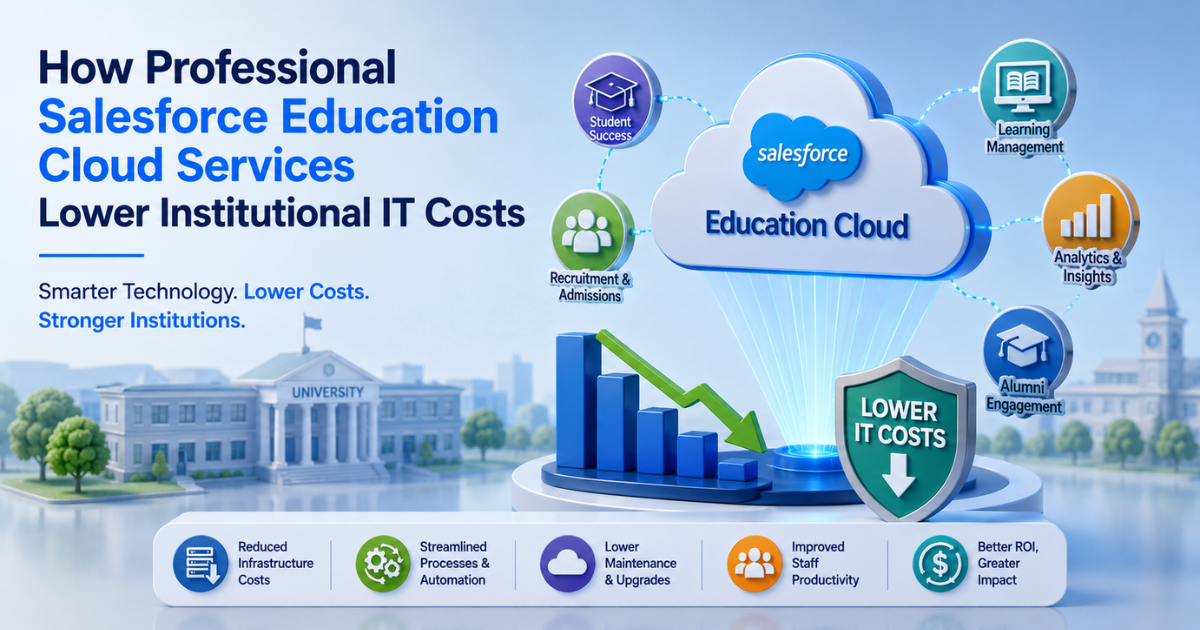
Higher education institutions face severe budget constraints. Legacy campus infrastructures rely on dozens of disconnected software tools. These systems manage independent processes like recruitment, enrollment, student advising, and alumni fundraising.
Maintaining this disjointed approach creates massive financial burdens for university technology departments. IT staff spend considerable time building manual integrations, managing multiple vendor renewals, and patching outdated security vulnerabilities.
Independent market studies highlight the scale of this technological problem. A commissioned Forrester Consulting study on the total economic impact of the platform revealed significant advantages. Higher education institutions achieved an average of $2.4 million in legacy environment cost savings after consolidation.
Enlisting professional Salesforce Education Cloud Consulting allows universities to reconstruct their digital architecture safely. This guide analyzes how specialized implementation practices eliminate systemic tech waste, lower operational overhead, and reduce institutional IT expenditures.
Technical Consolidation of Isolated Campus Applications
The primary cause of high IT spending in academia is application sprawl. Separate departments purchase specialized software tools without consulting central IT teams.
1. The Financial Cost of Software Fragmentation
The admissions office might use a specific lead-tracking database. Simultaneously, the student advising division records counseling notes in a completely different application. The alumni relations office runs its fundraising campaigns on an isolated database.
This model requires paying for individual license pools, distinct hosting fees, and separate support contracts.
2. System Consolidation via the Unified Data Model
Experienced engineers use Salesforce Education Cloud Consulting Services to merge these disparate systems into a single platform. The platform utilizes an education-specific data model built on standard objects.
The system replaces independent user databases with a comprehensive schema. Key objects manage structural relationships smoothly:
- ProgramEnrollment: Tracks academic registration pathways.
- CourseConnection: Records individual student class interactions.
- Affiliation: Maps student relationships to campus athletic groups, clubs, or academic departments.
Consolidating these tools onto a single system allows universities to retire old servers. It reduces software renewals and removes vendor communication bottlenecks.
Reducing Integration Complexity and Custom Code Maintenance
Siloed database applications must share student information to remain useful. For example, admissions files must move into student records when a prospect enrolls.
1. The Failure Point of Point-to-Point Integrations
To share data, internal IT departments build custom, point-to-point integration scripts. These scripts use various technologies, such as custom Python code or batch CSV file transfers.
As a university adds more independent software applications, the integration network becomes complex and fragile.
A minor update to a single third-party application can break these custom connections. This forces internal developers to stop other high-value projects to debug old code.
2. Standardizing Interfaces with Pre-Built Frameworks
Professional consultants solve this issue by using standard api-led integration frameworks. They connect existing student information systems (SIS), like Ellucian Banner or Oracle Peoplesoft, using pre-built integration templates.
These templates map legacy data tables to cloud destinations using standard web APIs. This replacement of custom scripting with managed configurations reduces long-term maintenance costs.
Lowering Operational Overhead Through Automation
Universities handle high volumes of repetitive administrative tasks. Manual data entry consumes valuable staff time and increases error rates.
1. The Cost of Manual Ingestion Processes
Admissions teams often input high school transcripts by hand. Financial aid staff manually cross-reference paper scholarship forms against institutional criteria.
Advisors spend significant time scheduling student appointments via back-and-forth emails. These tasks require substantial labor, forcing universities to scale administrative headcount to manage enrollment growth.
2. Automated Process Orchestration
Specialized consulting teams deploy advanced automation workflows using OmniStudio and Salesforce Flow. These tools automate multi-department tasks without requiring custom code.
For instance, an applicant uploads a digital transcript through a self-service portal. The system parses the document files automatically, populates the student record, and triggers an academic review assignment.
Automating these workflows allows universities to reassign IT personnel to strategic projects rather than simple data entry tasks.
Decreasing Infrastructure Support and Hosting Expenses
On-premise enterprise data centers generate significant direct costs for universities. Hardware depreciation requires expensive physical equipment refreshes every four years.
1. The Hidden Expenses of Local Server Management
Running physical servers requires constant electrical power, high-volume climate control systems, and secure real estate. Furthermore, local database architectures demand manual operating system patching and regular database tuning.
Institutions must maintain specialized network security teams to protect local hardware from distributed denial-of-service (DDoS) attacks.
2. Shifting Expenses to Managed Cloud Services
Transitioning to the cloud removes these physical infrastructure burdens. Salesforce manages the underlying server maintenance, data replication, and security patching automatically.
The platform runs on Hyperforce infrastructure, utilizing global cloud networks. This framework guarantees 99.9% system uptime, reducing institutional data storage costs.
Minimizing Costly Development Through Declarative Architecture
Modifying custom legacy software applications requires specialized programmers. Recruiting and retaining these developers in competitive labor markets strains university budgets.
1. The Problem of Proprietary Code Maintenance
When an institution updates a legacy system, developers write custom code to add features or modify forms. Over time, the software accumulates technical debt.
New IT employees struggle to understand the undocumented code written by previous staff. This lack of transparency leads to slow development cycles and expensive system upgrades.
2. Leveraging Low-Code Declarative Development
The cloud platform prioritizes declarative development tools over custom coding. Non-programmers can adjust system properties using drag-and-drop interfaces.
Administrators use the Lightning App Builder to change user profile layouts, update tracking fields, or alter security routing rules instantly. This declarative framework reduces custom coding requirements by 70%. It allows institutions to maintain their platform using smaller, focused teams.
Mitigating Financial Risks and Cybersecurity Breaches
Educational institutions remain primary targets for malicious cyberattacks. A single data breach can expose sensitive student records, leading to severe financial penalties and reputational damage.
1. The Financial Exposure of Poor Security Compliance
Legacy academic databases lack modern security controls. They often fail to support multi-factor authentication (MFA) or granular role-based security out of the box.
Securing these systems requires purchasing expensive third-party endpoint security software and firewall layers.
2. Deploying the Einstein Trust Layer
Professional consultants implement advanced security frameworks directly within the cloud infrastructure. The platform enforces strict regulatory compliance, including Family Educational Rights and Privacy Act (FERPA) standards.
Consulting services deploy Salesforce Shield to protect sensitive fields automatically. This tool provides advanced cryptographic encryption for data at rest and monitors data access logs in real time.
Additionally, the native Einstein Trust Layer ensures secure artificial intelligence operations. It masks personally identifiable information (PII) before sharing data with external processing engines, protecting institutions from compliance fines.
Maximizing Implementation Success and Project ROI
Deploying an enterprise educational platform requires a clear roadmap. Institutions should follow a structured approach to maximize their technology investments.
1. Run an Architecture Audit Before Deployment
Do not import uncleaned legacy data into the new platform. University databases often contain thousands of duplicate or obsolete student profiles.
Work with consultants to audit and de-duplicate data sources before migration. This practice prevents dirty data from slowing down the new system.
2. Transition in Defined, Phased Waves
Avoid replacing all legacy systems at once. A total rip-and-replace strategy can overwhelm staff and create operational confusion.
Implement the platform in modular, phased waves instead. Focus on the admissions and recruitment modules first to stabilize the enrollment funnel, then expand to student advisory and alumni management tracking.
| Deployment Phase | Core Focus | Technical Component | Expected Timeline |
| Phase 1 | Foundation & Data Ingestion | Data Cloud Data Architecture Setup | Weeks 1–8 |
| Phase 2 | Recruitment & Admissions | OmniStudio & Applicant Portals | Weeks 9–16 |
| Phase 3 | Student Support Hub | Student Success Alerts & Routing | Weeks 17–24 |
| Phase 4 | Advanced AI Operations | Agentforce Autonomous Support | Weeks 25+ |
3. Focus on Platform Governance
Establish an internal center of excellence to manage platform modifications. Train administrators to prioritize declarative configuration tools over custom Apex coding. This governance model prevents new technical debt and keeps maintenance costs low.
Conclusion
Lowering higher education technology costs requires modernizing legacy architectures. Fragmented on-premise software tools strain limited institutional budgets. They require constant custom code integration, manual workarounds, and extensive developer maintenance.
Partnering with certified Salesforce Education Cloud Consulting helps universities resolve these issues safely. This strategic transition replaces fragile, isolated databases with a single, cloud-native platform.
Utilizing expert Salesforce Education Cloud Consulting Services allows institutions to eliminate redundant application fees, automate manual data input, and minimize infrastructure support costs. This modernization strategy reduces total IT expenditures while providing a reliable framework for student success.
