

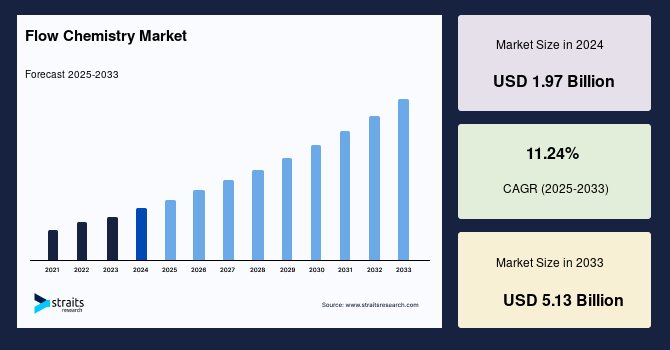
The global Flow Chemistry Market is witnessing significant growth due to increasing demand for efficient chemical manufacturing processes, rising adoption of continuous production technologies, and growing investments in pharmaceutical and specialty chemical industries. According to the latest report by Straits Research, the global flow chemistry market was valued at USD 1.97 billion in 2024 and is projected to grow from USD 2.19 billion in 2025 to reach USD 5.13 billion by 2033, registering a CAGR of 11.24% during the forecast period (2025–2033).
Flow chemistry, also known as continuous flow chemistry, is a process in which chemical reactions are performed in continuously flowing streams rather than traditional batch production methods. The technology offers advantages such as enhanced reaction control, improved safety, higher efficiency, reduced waste generation, and better scalability. These benefits are driving widespread adoption across pharmaceuticals, biotechnology, petrochemicals, chemicals, and research applications.
Market Drivers
One of the primary drivers of the flow chemistry market is the growing demand for efficient and sustainable chemical manufacturing processes. Continuous flow systems enable precise control of reaction parameters, improve product quality, reduce waste generation, and lower operational costs, making them increasingly attractive for industrial-scale production.
Another significant growth factor is the expansion of the pharmaceutical industry. Pharmaceutical manufacturers are increasingly adopting flow chemistry technologies to improve drug synthesis, accelerate process development, enhance product consistency, and comply with stringent regulatory requirements. Flow chemistry plays a vital role in active pharmaceutical ingredient (API) production and drug discovery processes.
The increasing emphasis on green chemistry and sustainable manufacturing practices is also supporting market growth. Flow chemistry reduces solvent consumption, minimizes waste generation, and improves energy efficiency, helping manufacturers achieve environmental sustainability goals.
Technological advancements in microreactors, automation systems, and continuous manufacturing platforms are further accelerating market expansion. These innovations are improving operational efficiency and enabling the production of complex chemical compounds with greater precision and scalability.
Additionally, increasing investments in specialty chemicals, biotechnology, agrochemicals, and petrochemical manufacturing are creating new growth opportunities for flow chemistry solution providers worldwide.
Market Challenges
Despite strong growth prospects, the flow chemistry market faces several challenges. One of the major restraints is the high initial investment required for continuous flow systems, specialized reactors, automation technologies, and process integration infrastructure.
Another challenge is the complexity associated with transitioning from traditional batch processing to continuous manufacturing. Many chemical manufacturers require significant process redesign, workforce training, and infrastructure upgrades to successfully implement flow chemistry technologies.
The market also faces technical challenges related to reactor design, process optimization, and handling complex multiphase reactions, which may limit adoption in certain industrial applications.
Furthermore, limited awareness and lack of technical expertise in some developing regions may hinder market penetration and technology adoption.
Market Segmentation
The flow chemistry market is segmented based on reactor type, application, technology, and region.
By reactor type, the market is categorized into Continuous Stirred Tank Reactor (CSTR), Plug Flow Reactor (PFR), Microreactor, Microwave Systems, and Others. Microreactors account for a significant market share due to their superior heat transfer capabilities, enhanced reaction control, and suitability for high-value chemical synthesis.
Based on application, the market includes Pharmaceutical, Biotechnology Companies, Chemicals, Academia and Research, Food and Beverage Industries, Petrochemicals, Agriculture and Environmental Sector, Nutraceutical Firms, Analytical Laboratories, and Others. The pharmaceutical segment dominates the market owing to increasing adoption of continuous manufacturing processes for APIs and specialty drug production.
By technology, the market is segmented into Gas-Based Flow Chemistry, Photochemistry-Based Flow Chemistry, and Microwave Irradiation-Based Flow Chemistry. Continuous advancements in these technologies are improving process efficiency and expanding application areas.
Regional Insights
North America dominates the global flow chemistry market due to strong pharmaceutical manufacturing capabilities, extensive research and development activities, and increasing adoption of continuous manufacturing technologies. The United States remains the leading contributor owing to significant investments in pharmaceutical innovation and chemical process optimization.
Europe represents a substantial market share supported by stringent environmental regulations, strong focus on sustainable manufacturing, and growing adoption of green chemistry practices. Germany, the United Kingdom, France, and Italy are major contributors to regional growth.
Asia-Pacific is expected to witness the fastest growth during the forecast period. Rapid industrialization, expanding pharmaceutical production, increasing chemical manufacturing activities, and growing investments in research infrastructure across China, India, Japan, South Korea, and Southeast Asia are driving regional market expansion.
Latin America and the Middle East & Africa are emerging markets supported by growing industrial development, increasing chemical production capacities, and rising investments in advanced manufacturing technologies.
Key Players Analysis
The flow chemistry market is highly competitive, with leading companies focusing on continuous manufacturing technologies, reactor innovation, and strategic collaborations to strengthen their market positions.
Major companies operating in the market include Biotage, Lonza, Corning Incorporated, Vapourtec Ltd., Syrris Ltd., Chemtrix BV, CEM Corporation, Uniqsis Ltd., Milestone Srl., ThalesNano Inc., Ehrfeld Mikrotechnik BTS GmbH, and Future Chemistry Holding BV. (
These companies are increasingly investing in advanced reactor technologies, process automation systems, modular manufacturing platforms, and sustainable chemistry solutions to address the growing demand for efficient chemical production processes.
For detailed insights, visit: https://straitsresearch.com/report/flow-chemistry-market
About Us
Straits Research is a leading market research and intelligence organization specializing in analytics, advisory services, and comprehensive market research reports across multiple industries. The company provides actionable business insights and strategic market intelligence to help organizations identify growth opportunities and make informed business decisions.
Contact Us
Email: sales@straitsresearch.com
Tel: +1 646 905 0080 (U.S.), +44 203 695 0070 (U.K.)
