

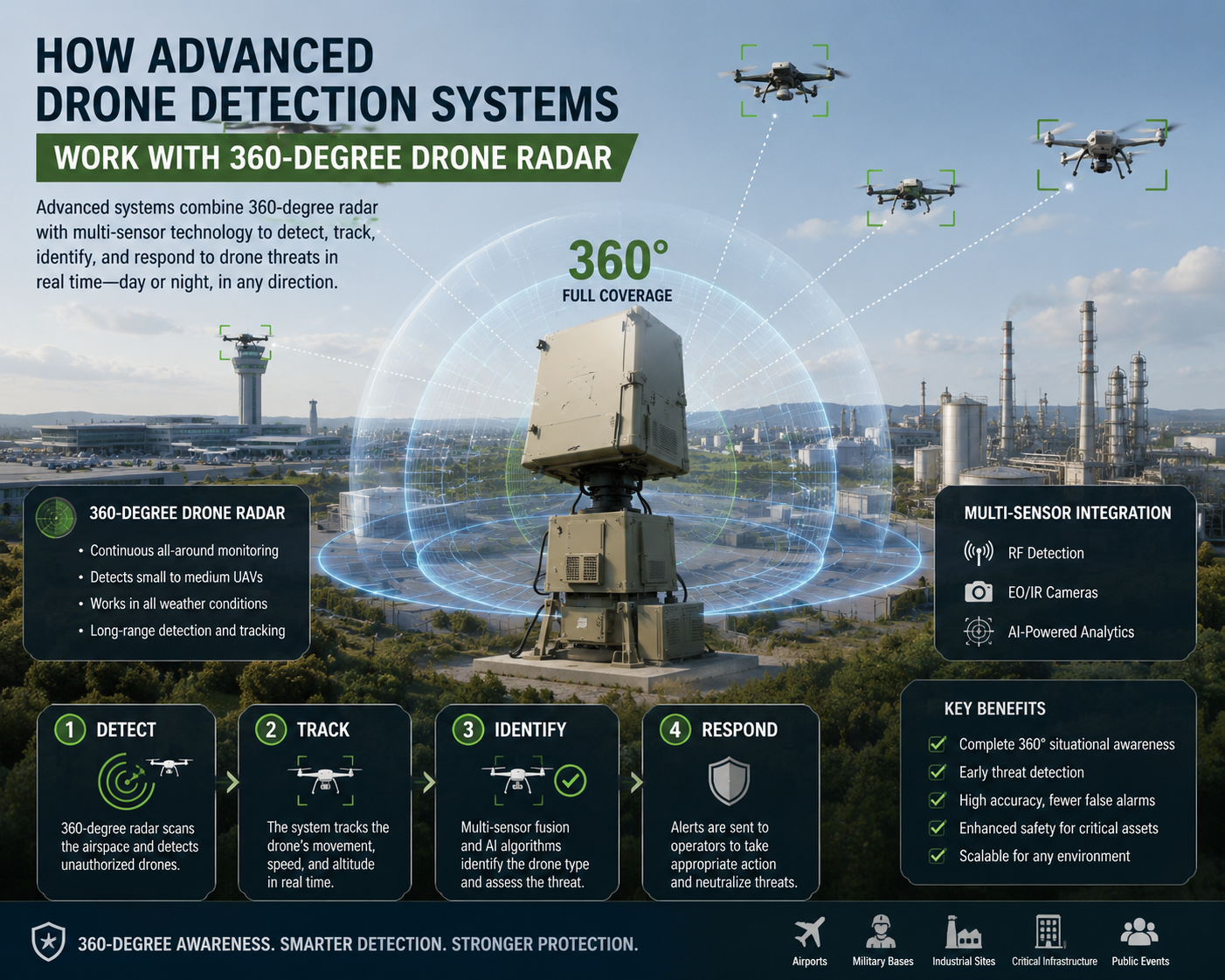
A single unauthorized drone can appear with little warning, making early identification a critical part of airspace security. Modern surveillance no longer depends on a single technology. Instead, advanced drone detection systems combine multiple sensors with uav defense radar to provide continuous awareness across wide areas. This approach helps security teams identify, track, and assess aerial threats before they become serious risks. Understanding how these technologies work together makes it easier to see why layered detection has become the standard for protecting sensitive locations.
Every Direction Counts
Unlike conventional surveillance equipment with limited viewing angles, a 360-degree drone radar continuously scans the surrounding airspace. It searches for moving objects regardless of direction, allowing operators to monitor activity without repositioning equipment.
Its strength comes from constant coverage that can:
- Detect drones approaching from any direction.
- Track multiple aerial targets at the same time.
- Maintain performance during day, night, and challenging weather.
- Reduce blind spots around protected facilities.
When paired with reliable drone detection software, radar data becomes more useful because potential threats can be classified instead of simply identified as moving objects.
Turning Radar Data into Action
A radar return alone doesn’t always provide the full picture. Modern systems combine radar information with technologies such as RF detection, electro-optical cameras, and thermal imaging. Each layer adds another level of verification.
Once an object is detected, the system can:
- Confirm whether the target is a drone.
- Estimate its flight path and speed.
- Distinguish drones from birds or other airborne objects.
- Provide accurate tracking for security personnel.
This layered process allows uav defense radar to support faster and more confident decision-making while reducing unnecessary alarms.
UAV-Defence. Demonstrates this practical approach by integrating radar with complementary sensing technologies, helping organizations build counter-drone systems that suit different operational environments rather than relying on a single detection method.
Built for Complex Airspace
Drone activity continues to increase around airports, industrial facilities, military installations, and public events. Small UAVs often fly at low altitudes, making them difficult to identify without dedicated monitoring equipment.
A combination of drone detection technology and 360-degree radar provides continuous visibility across these challenging environments. Even compact drones can be tracked as they move through complex terrain, allowing security teams to react before an aircraft reaches restricted airspace.
Conclusion
Modern airspace protection depends on accurate uav defense radar working alongside intelligent drone detection technologies rather than operating independently. Continuous radar coverage, combined with sensor verification, creates a more reliable picture of potential aerial threats. As drone activity becomes more common across commercial and critical infrastructure sites, layered detection is becoming an essential part of security planning. Those comparing counter-drone solutions should also review how integrated sensing technologies support faster identification, improved tracking, and more informed operational decisions.
