

Introduction
Forensic laboratories play a critical role in the justice system. The results they produce can influence criminal investigations, court decisions, public safety measures, and even the lives of individuals. When a laboratory reports findings related to DNA analysis, toxicology, fingerprint examination, digital forensics, or trace evidence, accuracy is not simply desirable—it is essential. This is why ISO 17025 Certification has become one of the most respected standards for forensic laboratories around the world.
ISO 17025 Certification demonstrates that a laboratory possesses the technical competence, management systems, and quality controls necessary to produce reliable and consistent results. For forensic laboratories, where legal professionals, judges, investigators, and regulatory authorities may scrutinize every test result, this certification serves as a powerful symbol of credibility and trust.
As forensic science continues to evolve, laboratories face growing pressure to maintain accuracy, transparency, and accountability. Therefore, many organizations are adopting ISO 17025 Certification to strengthen their operations and demonstrate their commitment to excellence. By implementing this internationally recognized standard, forensic laboratories can improve quality, reduce risks, and enhance confidence in every investigation they support.
Why Accuracy Matters More Than Ever
Forensic science operates in an environment where mistakes can have serious consequences. A single inaccurate test result can affect criminal proceedings, delay investigations, create doubt about evidence, or even contribute to wrongful convictions. Therefore, laboratories must maintain the highest levels of precision while handling increasingly complex cases.
This growing responsibility has encouraged many forensic laboratories to adopt ISO 17025 Certification as a structured framework for quality assurance. As a result, laboratories can establish procedures that reduce errors, improve consistency, and strengthen confidence in forensic findings.
Think of a forensic laboratory as the engine room of an investigation. Evidence enters the laboratory in many forms, and the results generated help investigators piece together the truth. However, if that engine room lacks proper controls, the entire investigative process can suffer. Consequently, laboratory accreditation and internationally recognized quality standards have become indispensable.
Furthermore, modern forensic laboratories face challenges that previous generations never encountered. Advances in technology have increased the complexity of testing methods, while legal expectations have become more demanding. In addition, public awareness of forensic science has grown significantly, creating greater scrutiny of laboratory operations. Therefore, laboratories must demonstrate that they can consistently produce accurate and defensible results.
What Exactly Is ISO 17025 Certification?
ISO 17025 Certification is an internationally recognized standard designed specifically for testing and calibration laboratories. It outlines the requirements laboratories must meet to demonstrate competence, impartiality, and consistent operation.
Unlike many management standards that focus primarily on documentation and administrative processes, ISO 17025 Certification places significant emphasis on technical competence. The standard evaluates whether laboratory personnel, equipment, methods, and reporting systems can consistently generate valid and reliable results.
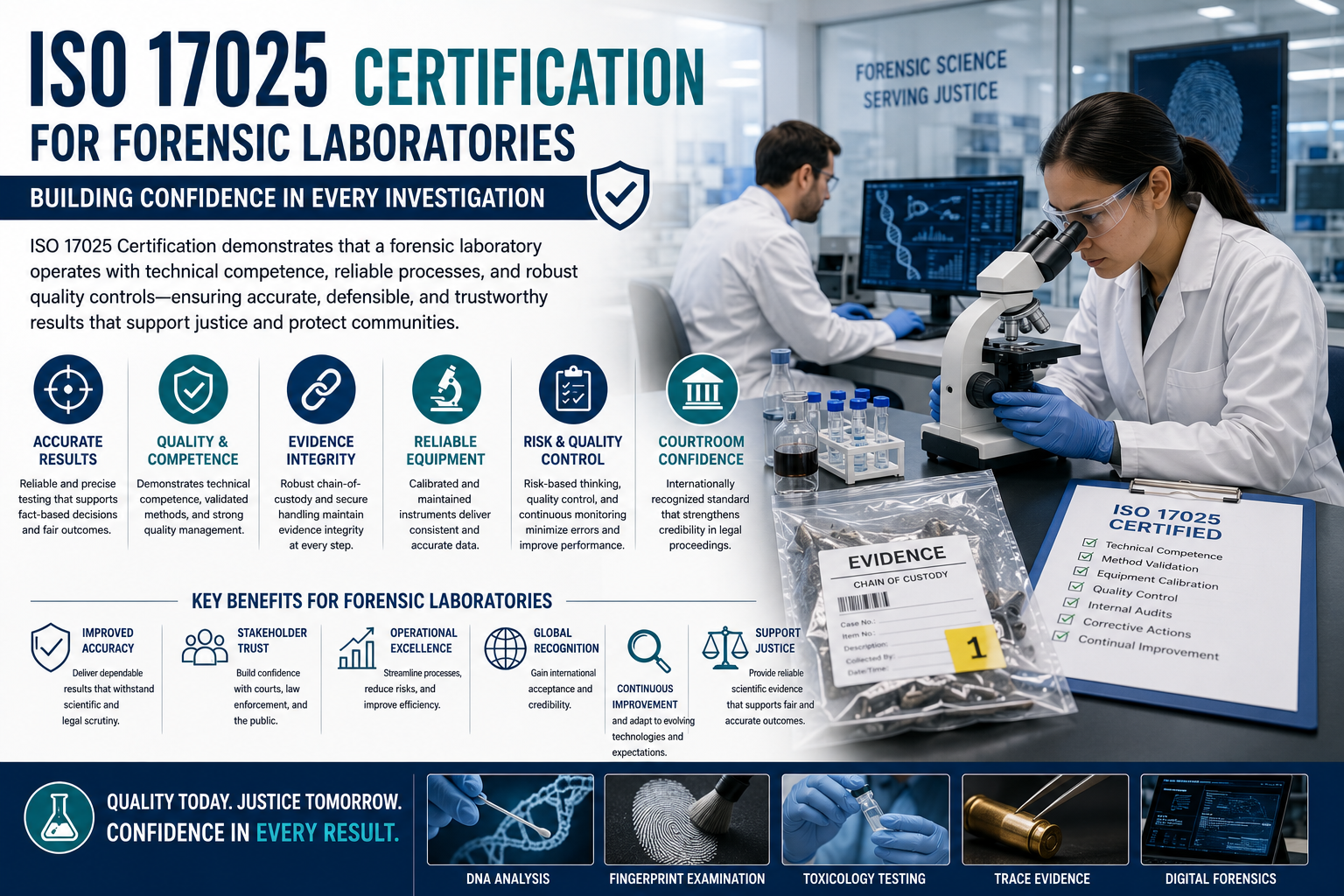
For forensic laboratories, the standard addresses several critical areas, including personnel competency, equipment calibration, method validation, evidence handling, quality control, risk management, and reporting accuracy. Together, these requirements help ensure that laboratory findings can withstand both scientific and legal scrutiny.
Moreover, ISO 17025 Certification promotes confidence in laboratory operations by establishing clear expectations and measurable performance criteria. Consequently, laboratories can demonstrate their commitment to quality while improving operational effectiveness.
The Growing Demand for Credible Forensic Results
Courts and investigative agencies increasingly expect forensic laboratories to operate according to internationally accepted standards. In addition, scientific evidence often becomes a central component of legal proceedings, making reliability a non-negotiable requirement.
Public trust in forensic science depends heavily on transparency and consistency. Therefore, when laboratories achieve ISO 17025 Certification, they provide clear evidence that they manage their operations under a recognized quality framework.
This requirement becomes particularly important as forensic disciplines continue to evolve. Digital forensics, cybercrime investigations, advanced DNA technologies, and sophisticated toxicology testing require laboratories to maintain rigorous technical controls. Furthermore, certification helps laboratories adapt to these changing demands while maintaining confidence in their results.
Additionally, many government agencies, law enforcement organizations, and judicial systems prefer working with accredited laboratories because certification demonstrates compliance with internationally recognized best practices. As a result, laboratories with ISO 17025 Certification often gain greater recognition and credibility within the forensic community.
More Than a Certificate—A Culture of Quality
Many people assume certification is simply about passing an audit. However, ISO 17025 Certification encourages organizations to develop a culture focused on quality, accountability, and continuous improvement.
Forensic laboratories that implement the standard often discover improvements that extend beyond compliance requirements. For example, staff become more aware of quality objectives, procedures become clearer, errors are identified earlier, and communication improves between departments.
As a result, laboratories do more than achieve compliance—they become stronger and more efficient organizations. Furthermore, a culture of quality encourages employees to take ownership of their responsibilities and actively participate in improvement initiatives.
A culture of quality also promotes consistency. Consequently, whether analysts examine evidence today, next month, or next year, the laboratory follows the same documented processes and controls. That consistency is vital when findings are presented in court.
Moreover, quality-focused laboratories often experience improved morale because employees understand their roles, responsibilities, and performance expectations. This clarity contributes to better teamwork and stronger operational performance.
Strengthening Chain of Custody and Evidence Integrity
One of the most sensitive responsibilities within a forensic laboratory is maintaining evidence integrity. Every item received must be tracked, documented, protected, and processed according to strict procedures.
ISO 17025 Certification supports robust chain-of-custody practices by establishing controls that help laboratories monitor evidence throughout its lifecycle. This includes receipt, storage, analysis, reporting, and final disposition.
Imagine evidence as a relay baton in a race. Every handoff must be documented and controlled. Missing information or poor documentation can raise questions about the validity of the evidence. Therefore, certification helps laboratories create systems that minimize such risks.
Furthermore, proper chain-of-custody procedures protect the integrity of investigations by ensuring that evidence remains secure and traceable at all times. As a result, investigators, attorneys, judges, and regulatory authorities can trust that evidence has been handled appropriately from beginning to end.
Strong evidence management practices also reduce the likelihood of contamination, loss, or misidentification. Consequently, laboratories can maintain confidence in their analytical findings while supporting the credibility of legal proceedings.
Competence: The Heart of ISO 17025 Certification
Equipment and procedures are important, but people remain at the center of forensic science. Therefore, laboratory analysts must possess the knowledge, skills, and experience required to perform their duties accurately.
A major component of ISO 17025 Certification focuses on personnel competence. Laboratories must establish training programs, competency assessments, and ongoing evaluation processes to ensure staff maintain their technical abilities.
Technology changes rapidly. New analytical methods emerge, software tools evolve, and scientific understanding advances. Consequently, certification encourages laboratories to invest continuously in professional development and technical training.
In addition, laboratories must document qualifications, monitor performance, and verify competency before personnel perform critical tasks independently. These requirements help ensure that every analyst can conduct examinations according to established standards.
This emphasis on competence helps ensure that forensic professionals base their conclusions on sound scientific practices rather than assumptions or outdated methods. As a result, laboratories can provide more reliable and defensible findings.
Equipment Reliability and Measurement Confidence
Forensic testing often relies on highly specialized instruments. DNA analysers, chromatographs, spectrometers, microscopes, and digital forensic tools must perform accurately and consistently.
To achieve this, ISO 17025 Certification requires laboratories to establish systems for equipment calibration, maintenance, verification, and monitoring. As a result, these activities help confirm that instruments continue to operate within acceptable limits.
Without proper calibration, even advanced technology can generate questionable results. Therefore, certification helps laboratories reduce this risk through structured controls and documented maintenance programs.
Furthermore, equipment management systems enable laboratories to identify performance issues before they affect analytical results. Consequently, organizations can prevent errors and maintain confidence in measurement accuracy.
Reliable equipment supports reliable measurements, and reliable measurements support reliable conclusions. Therefore, equipment reliability remains a cornerstone of forensic laboratory quality.
Method Validation and Quality Control
A forensic laboratory can only produce trustworthy results when it uses scientifically validated methods. Therefore, method validation represents a critical requirement within ISO 17025 Certification.
Validation demonstrates that a method performs as intended and produces accurate, reliable, and reproducible results. Before introducing new testing procedures, laboratories must evaluate performance characteristics and confirm suitability for the intended purpose.
Additionally, laboratories must implement quality control measures to monitor ongoing performance. These measures may include proficiency testing, control samples, duplicate testing, and peer reviews.
Through continuous monitoring, laboratories can identify trends, detect anomalies, and take corrective action when necessary. Consequently, they can maintain confidence in analytical processes and ensure consistent performance over time.
Moreover, quality control activities provide valuable evidence that laboratory systems continue to function effectively. This documentation becomes particularly important during audits, accreditation assessments, and legal proceedings.
Risk Management and Continuous Improvement
One of the strengths of ISO 17025 Certification is its focus on risk-based thinking. Rather than waiting for problems to occur, laboratories identify potential risks and implement preventive measures.
For example, laboratories may evaluate risks related to equipment failures, staff turnover, sample contamination, data security, or procedural inconsistencies. By identifying these issues early, organizations can reduce their impact on operations.
In addition, the standard promotes continuous improvement through internal audits, corrective actions, management reviews, and performance evaluations. These activities help laboratories identify opportunities for enhancement and strengthen overall effectiveness.
At first glance, continuous improvement may seem like additional work. However, it often saves time, reduces costs, and improves efficiency. Furthermore, it helps laboratories remain responsive to changing technologies, regulatory requirements, and stakeholder expectations.
As a result, forensic laboratories can maintain high standards of performance while continuously enhancing their capabilities.
Key Benefits of ISO 17025 Certification for Forensic Laboratories
The advantages of ISO 17025 Certification extend across operational, scientific, and legal areas. While every laboratory may experience unique outcomes, several benefits consistently emerge.
Some of the most significant benefits include:
- Improved accuracy and reliability of forensic results
- Increased confidence from courts and investigative agencies
- Enhanced staff competence and accountability
- Better management of evidence and chain-of-custody procedures
- Stronger quality assurance and quality control systems
- Reduced risk of testing errors and nonconformities
- Greater international recognition of laboratory capabilities
- Improved operational efficiency and documentation practices
- Enhanced transparency and traceability
- Better preparedness for audits and legal scrutiny
Collectively, these benefits contribute directly to the credibility, effectiveness, and reputation of forensic laboratories.
Supporting Courtroom Confidence
A forensic report often becomes a critical piece of evidence during legal proceedings. Attorneys may challenge methodologies, procedures, equipment, or analyst qualifications. Therefore, laboratories must demonstrate the reliability of their work.
ISO 17025 Certification provides a recognized framework that supports courtroom confidence. The documented procedures, competency records, calibration data, and quality controls established through certification help laboratories defend the validity of their findings.
Moreover, judges and legal professionals frequently view accredited laboratories as more trustworthy because they operate according to internationally accepted standards. This recognition can strengthen the credibility of forensic evidence during legal proceedings.
Additionally, certification provides documented proof that laboratory processes follow established scientific principles. As a result, laboratories can respond more effectively to challenges and demonstrate the reliability of their conclusions.
Ultimately, this added credibility can make a meaningful difference when scientific evidence becomes a focal point of a case.
Why Choose ISO 17025 Certification?
For forensic laboratories seeking long-term credibility, ISO 17025 Certification provides a clear path forward. It establishes a recognized framework for quality management while demonstrating technical competence and scientific reliability.
Organizations that achieve certification often experience stronger stakeholder confidence, improved operational consistency, and greater acceptance of their forensic findings. More importantly, they create systems that support fairness, accuracy, and accountability within the justice process.
Furthermore, certification helps laboratories remain competitive in an increasingly demanding environment. As expectations continue to rise, organizations must demonstrate their ability to meet international standards and maintain reliable operations.
When working with an experienced certification provider such as Integrated Assessment Services, laboratories can receive guidance that simplifies implementation while maintaining compliance with international requirements.
Choosing ISO 17025 Certification is not simply about meeting a standard. Instead, it is about building confidence in every analysis, every report, and every conclusion produced by the laboratory.
Conclusion
Forensic laboratories occupy a unique position where science and justice intersect. The quality of laboratory results can influence investigations, legal decisions, and public trust. Therefore, as expectations for reliability continue to rise, ISO 17025 Certification offers a proven framework for maintaining accuracy, competence, and consistency.
From evidence handling and equipment calibration to staff competency and quality management, the standard strengthens every aspect of laboratory operations. Moreover, it helps forensic laboratories demonstrate that their results are based on sound scientific principles and carefully controlled processes.
Furthermore, certification promotes continuous improvement, supports evidence integrity, strengthens courtroom confidence, and enhances operational efficiency. As a result, laboratories can consistently deliver reliable and defensible findings.
Ultimately, in an environment where every detail matters, ISO 17025 Certification provides the assurance that forensic laboratories need to deliver dependable results with confidence, integrity, and credibility. By implementing this internationally recognized standard, forensic laboratories can strengthen their reputation, support the justice system, and build trust in every investigation they undertake.
