

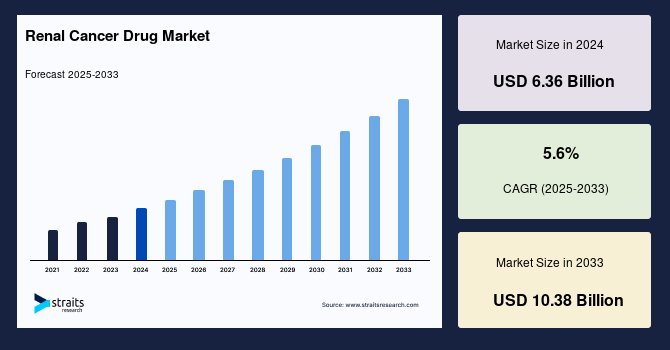
The global Renal Cancer Drug Market is witnessing significant growth due to the increasing prevalence of kidney cancer, rising adoption of targeted therapies and immunotherapies, and growing advancements in oncology drug development. According to the latest report by Straits Research, the global renal cancer drug market is expected to witness substantial growth during the forecast period, driven by increasing healthcare expenditure, rising awareness regarding early cancer diagnosis, and growing demand for personalized cancer treatment solutions worldwide.
Renal cancer, also known as kidney cancer, is one of the most common forms of cancer affecting adults globally. Renal cancer drugs are designed to inhibit tumor growth, prevent metastasis, and improve patient survival rates through targeted molecular therapies, immune checkpoint inhibitors, angiogenesis inhibitors, and combination treatment approaches. The growing focus on precision oncology and innovative cancer therapeutics is significantly contributing to market expansion.
Market Drivers
One of the major drivers of the renal cancer drug market is the rising incidence of kidney cancer worldwide. Factors such as smoking, obesity, hypertension, aging populations, and unhealthy lifestyle habits are contributing to the increasing number of renal cancer cases globally. The growing disease burden is significantly increasing the demand for advanced oncology treatment solutions.
Another significant growth factor is the increasing adoption of immunotherapy and targeted therapies in renal cancer treatment. Immune checkpoint inhibitors and tyrosine kinase inhibitors (TKIs) are improving patient outcomes by enhancing immune system responses and selectively targeting cancer cells with greater precision and effectiveness.
Continuous advancements in precision oncology, molecular diagnostics, and biomarker identification are also supporting market growth. Pharmaceutical companies are increasingly focusing on personalized medicine approaches and biomarker-driven therapies to improve treatment efficacy and minimize adverse effects.
Growing investments in oncology research and development are further accelerating market expansion. Pharmaceutical companies, biotechnology firms, and research institutions are heavily investing in clinical trials, next-generation immunotherapies, and combination treatment regimens for advanced renal cancer management.
Additionally, increasing healthcare expenditure and improving access to advanced cancer therapies in developing economies are supporting global market growth.
Market Challenges
Despite strong growth potential, the renal cancer drug market faces several challenges. One of the primary restraints is the high cost associated with advanced immunotherapies and targeted cancer drugs. Expensive treatment regimens may limit patient accessibility, particularly in low- and middle-income countries.
Another challenge is the side effects associated with cancer therapies. Adverse reactions such as fatigue, hypertension, diarrhea, immune-related complications, and organ toxicity may negatively impact treatment adherence and patient acceptance.
The market also faces stringent regulatory approval processes for oncology drugs. Lengthy clinical trials, strict safety requirements, and complex approval procedures may delay product commercialization and increase development costs for pharmaceutical manufacturers.
Furthermore, limited awareness regarding early cancer diagnosis in certain developing regions may restrict timely treatment adoption.
Market Segmentation
The renal cancer drug market is segmented based on drug type, cancer type, route of administration, distribution channel, and region.
By drug type, the market is categorized into targeted therapy, immunotherapy, chemotherapy, hormonal therapy, and combination therapy. Targeted therapy dominates the market due to the widespread use of tyrosine kinase inhibitors and angiogenesis inhibitors in advanced renal cell carcinoma treatment.
Based on cancer type, the market includes renal cell carcinoma, transitional cell carcinoma, Wilms tumor, renal sarcoma, and others. Renal cell carcinoma accounts for the largest market share owing to its high global prevalence among kidney cancer cases.
By route of administration, the market is segmented into oral and injectable therapies. Oral therapies hold a substantial market share due to ease of administration and increasing availability of oral targeted cancer drugs.
Based on distribution channel, the market includes hospital pharmacies, retail pharmacies, and online pharmacies. Hospital pharmacies dominate the market due to the high volume of oncology drug prescriptions and cancer treatment procedures conducted in hospitals and specialty cancer centers.
Regional Insights
North America dominates the global renal cancer drug market owing to advanced healthcare infrastructure, strong oncology research activities, and increasing adoption of innovative cancer therapies. The United States remains a major contributor due to high healthcare spending and strong presence of leading pharmaceutical companies.
Europe represents a significant market share driven by increasing cancer awareness, favorable reimbursement policies, and rising investments in oncology treatment programs. Germany, France, the United Kingdom, and Italy are among the key contributors to regional market growth.
Asia-Pacific is expected to witness the fastest growth during the forecast period due to rapidly improving healthcare infrastructure, rising cancer incidence, growing healthcare expenditure, and increasing access to advanced oncology treatments across China, India, Japan, and South Korea.
Latin America and the Middle East & Africa are emerging markets supported by improving cancer diagnosis capabilities, expanding healthcare investments, and increasing government initiatives for cancer care accessibility.
Key Players Analysis
The global renal cancer drug market is highly competitive, with major pharmaceutical companies focusing on immunotherapy innovations, targeted therapy development, and strategic collaborations to strengthen their market presence. Major companies operating in the market include Pfizer Inc., Bristol-Myers Squibb Company, Merck & Co., Inc., Novartis AG, F. Hoffmann-La Roche Ltd., Exelixis, Inc., Eisai Co., Ltd., Bayer AG, AstraZeneca PLC, and Johnson & Johnson.
These companies are increasingly investing in clinical trials, combination therapies, biomarker-driven treatments, next-generation immuno-oncology platforms, and personalized medicine approaches to improve treatment outcomes and expand their oncology portfolios globally.
For detailed insights, visit: https://straitsresearch.com/report/renal-cancer-drug-market
About Us
Straits Research is a leading market research and intelligence organization specializing in analytics, advisory services, and comprehensive market research reports across multiple industries. The company provides actionable business insights and strategic market intelligence to help organizations identify growth opportunities and make informed business decisions.
Contact Us
Email: sales@straitsresearch.com
Tel: +1 646 905 0080 (U.S.), +44 203 695 0070 (U.K.)
