

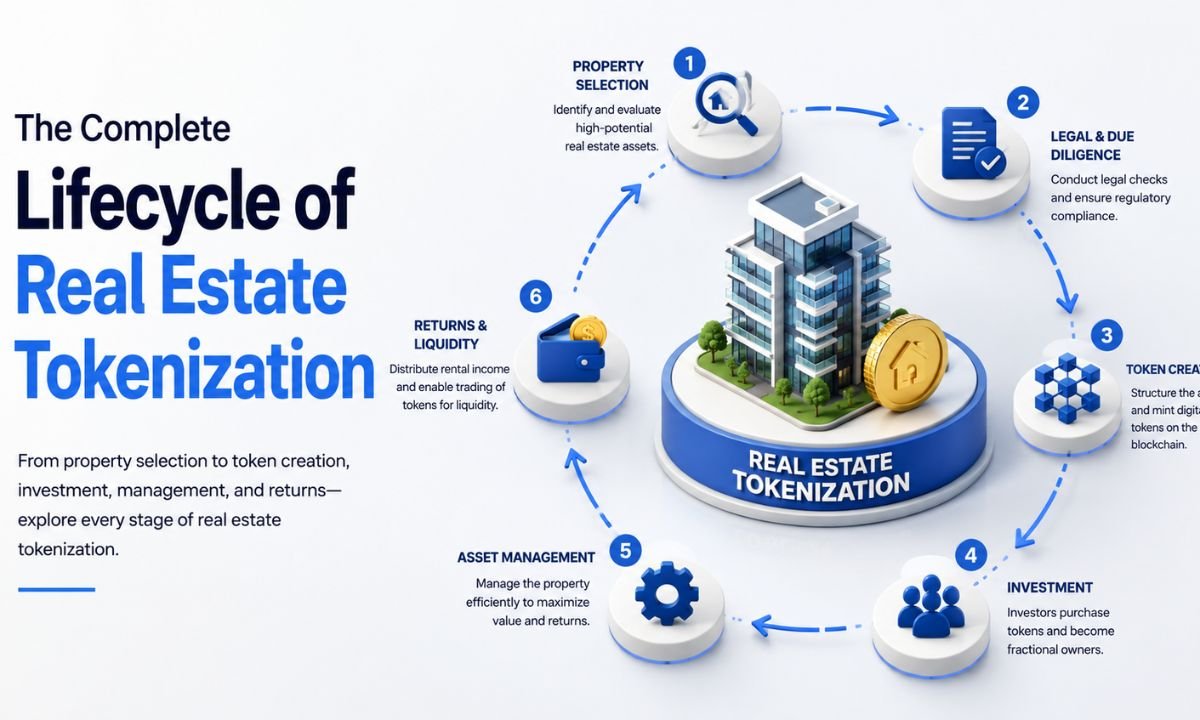
The real estate industry has traditionally relied on paperwork, lengthy verification procedures, multiple intermediaries, and significant capital commitments. While digital platforms have simplified property listings and transactions, ownership management and investment participation have often remained complex. As blockchain technology gains wider acceptance, many organizations are adopting Real Estate Tokenization to represent property ownership through digital tokens. This method offers an alternative way to structure investments, manage ownership records, and simplify transactions across different asset classes.
Rather than viewing tokenization as a single technical implementation, it is better understood as a complete lifecycle that begins with identifying a property and continues through legal preparation, token issuance, investor participation, asset management, revenue distribution, and eventual exit strategies. Every stage requires planning, compliance, technical expertise, and ongoing administration.
Businesses planning to enter this sector frequently work with a Real Estate Tokenization company that understands regulatory requirements, blockchain infrastructure, smart contract architecture, and digital asset management. Selecting the right strategy at every stage reduces operational issues while creating a structured investment environment for property owners and investors.
This article explains the complete lifecycle of Real Estate Tokenization, from the earliest planning stages to long-term asset management.
Understanding the Lifecycle of Real Estate Tokenization
Every successful tokenized property follows a sequence of carefully managed steps. Skipping or overlooking any stage can create legal, financial, or technical complications later. The lifecycle combines property management practices with blockchain-based ownership systems.
The process generally includes:
| Lifecycle Stage | Primary Objective |
|---|---|
| Property Selection | Identify suitable assets |
| Legal Structuring | Establish ownership framework |
| Asset Valuation | Determine market value |
| Token Economics | Define token structure |
| Smart Contract Development | Automate ownership logic |
| Token Issuance | Create digital ownership units |
| Investor Onboarding | Verify participants |
| Secondary Trading | Support ownership transfers |
| Asset Management | Monitor ongoing operations |
| Revenue Distribution | Allocate rental income |
| Exit Strategy | Complete sale or redemption |
Each stage contributes to maintaining a consistent ownership framework throughout the property’s lifecycle.
Stage 1: Selecting the Right Property
Every tokenization project starts with choosing an appropriate property. Not every real estate asset is suitable for fractional ownership. Investors generally seek assets with stable rental income, long-term appreciation potential, and clear ownership documentation.
Common categories include:
- Residential apartment complexes
- Commercial office buildings
- Shopping centers
- Warehouses
- Hotels
- Industrial parks
- Student housing
- Mixed-use developments
Property owners should perform extensive due diligence before beginning real estate tokenization development.
Important considerations include:
- Existing ownership records
- Outstanding debts
- Legal disputes
- Tax obligations
- Occupancy rate
- Rental history
- Maintenance costs
- Future development potential
Choosing a property with complete documentation reduces delays during later stages.
Stage 2: Legal Due Diligence and Ownership Structuring
Legal preparation represents one of the most significant phases of the lifecycle. Digital tokens cannot replace property rights unless ownership is legally structured.
Many projects establish a Special Purpose Vehicle (SPV) or similar legal entity that holds ownership of the real estate asset. Investors then purchase digital tokens representing interests in that legal entity rather than direct ownership of the property itself.
During this stage, professionals verify:
- Property title
- Government registrations
- Tax compliance
- Environmental approvals
- Existing contracts
- Mortgage obligations
- Local real estate regulations
A Real Estate Tokenization Development company generally works alongside legal advisors to align blockchain implementation with applicable regulations.
Without legal preparation, token issuance may create uncertainty regarding investor rights.
Stage 3: Property Valuation
Accurate valuation forms the financial foundation of the tokenization project.
Independent valuation professionals examine multiple factors, including:
- Property location
- Market demand
- Comparable sales
- Rental income
- Occupancy levels
- Future development opportunities
- Local economic conditions
The resulting valuation determines how ownership will be divided into digital tokens.
For example:
| Property Value | Token Supply | Value per Token |
|---|---|---|
| $5 Million | 500,000 | $10 |
| $20 Million | 2,000,000 | $10 |
| $50 Million | 5,000,000 | $10 |
Projects may choose different pricing structures depending on investment strategy.
Professional valuation increases confidence among investors by establishing realistic pricing before token issuance.
Stage 4: Designing Token Economics
Token economics defines how ownership operates after issuance.
Several questions must be answered during this phase:
- How many tokens will exist?
- Will investors receive rental income?
- Are voting rights included?
- Can tokens be traded?
- Will there be lock-up periods?
- What happens if the property is sold?
- How will profits be distributed?
These decisions influence investor participation throughout the asset’s lifecycle.
Different token models serve different investment goals.
| Token Feature | Purpose |
|---|---|
| Ownership Rights | Represents fractional ownership |
| Income Distribution | Shares rental income |
| Voting Rights | Allows governance participation |
| Transfer Rules | Controls ownership changes |
| Redemption Policy | Defines exit options |
Proper planning at this stage reduces confusion once investors begin purchasing tokens.
Organizations providing Real Estate Tokenization Services often collaborate with financial consultants to establish a balanced token model that reflects both regulatory requirements and investor expectations.
Stage 5: Blockchain Selection and Platform Architecture
Once the legal and financial framework is complete, attention shifts toward the technology that will support the tokenized asset. The choice of blockchain network influences transaction speed, security, operating costs, interoperability, and long-term maintenance.
Several public and permissioned blockchain networks are available for tokenization projects. The selection depends on business goals, compliance requirements, investor preferences, and ecosystem support.
During this stage, architects define how the platform will function from both the investor’s and administrator’s perspectives. This includes user registration, wallet integration, asset dashboards, transaction history, document storage, and reporting capabilities.
Real Estate Tokenization Platform Development also involves designing the interaction between blockchain components and traditional business systems. Property management software, payment gateways, compliance tools, and accounting platforms often need to exchange information with the tokenization platform.
A well-planned architecture helps maintain consistent operations throughout the asset’s lifecycle while supporting future property additions if the organization expands its portfolio.
Stage 6: Smart Contract Development
After the platform architecture is finalized, smart contracts are created to automate the rules governing digital ownership. These contracts contain the business logic that controls token creation, ownership transfers, revenue allocation, and administrative permissions. Since smart contracts execute predefined instructions automatically, they help reduce manual intervention once the platform is operational.
During real estate tokenization development, developers work closely with legal and financial teams to translate ownership agreements into blockchain-based logic. Every function must reflect the legal rights associated with the tokenized asset.
Typical smart contract functions include:
- Token creation
- Ownership registration
- Transfer approval
- Rental income distribution
- Voting mechanisms
- Investor eligibility checks
- Administrative controls
- Token burning or redemption
Before deployment, smart contracts undergo multiple rounds of testing. Unit testing, integration testing, and security audits help identify vulnerabilities that could affect investor assets or platform operations.
A Real Estate Tokenization Development company generally performs detailed code reviews and third-party security assessments before moving the contracts into a production environment.
Stage 7: Token Creation and Asset Digitization
Once smart contracts are verified, the property is represented as digital tokens. This stage converts the ownership structure into blockchain assets while preserving the legal framework established earlier.
Each token represents a predefined fraction of the property or the legal entity holding the property. The total token supply depends on the token economics decided during planning.
For example, a commercial property valued at $10 million could be divided into one million tokens, allowing investors to purchase small ownership portions instead of acquiring the entire property.
This process makes real estate asset tokenization suitable for investors with different budget levels while providing property owners with another method of raising capital.
The token issuance process generally includes:
- Deploying smart contracts
- Creating the token supply
- Linking ownership records
- Registering asset information
- Publishing investment documents
- Configuring investor permissions
At this point, the tokenized asset is technically ready for investor participation.
Stage 8: Investor Onboarding and Compliance
Before investors can purchase tokens, identity verification and regulatory compliance procedures must be completed. Compliance remains an ongoing responsibility throughout the lifecycle rather than a one-time activity.
Investor onboarding typically includes:
- Identity verification
- Address verification
- Risk assessment
- Source of funds verification
- Anti-money laundering checks
- Sanctions screening
- Accreditation checks where required
Digital onboarding reduces paperwork while maintaining compliance with applicable financial regulations.
Organizations offering Real Estate Tokenization Services often integrate automated compliance tools that simplify document verification and reduce administrative workloads.
Once verification is complete, investors receive access to the investment portal where they can purchase available property tokens.
Stage 9: Primary Token Offering
Following successful onboarding, the token sale begins. This stage introduces the property to investors and allocates ownership based on token purchases.
The offering documentation usually includes:
- Property description
- Independent valuation
- Investment objectives
- Risk disclosures
- Expected rental income
- Exit strategy
- Ownership rights
- Distribution schedule
Unlike conventional property investments that may require substantial capital, tokenization allows participation through much smaller investment amounts, depending on regulatory requirements and project design.
During the offering period, administrators monitor:
- Token subscriptions
- Investor verification
- Payment confirmations
- Token allocations
- Remaining inventory
Once the fundraising target is achieved, ownership tokens are distributed to investors’ blockchain wallets.
Stage 10: Secondary Market Trading
After the initial sale concludes, many projects provide opportunities for investors to trade their tokens through approved marketplaces, subject to applicable regulations.
Secondary trading offers greater flexibility than traditional property ownership because investors are not always required to wait until the property is sold to recover their investment.
However, trading policies differ between projects and jurisdictions.
Some platforms apply:
- Minimum holding periods
- Qualified investor restrictions
- Geographic limitations
- Transfer approval requirements
- Compliance verification before each transaction
The availability of secondary trading depends on local regulations and marketplace infrastructure.
Comparison Between Traditional Property Investment and Tokenized Property
| Feature | Traditional Property | Real Estate Tokenization |
|---|---|---|
| Minimum Investment | Usually high | Can be significantly lower |
| Ownership Division | Limited | Fractional ownership |
| Documentation | Paper intensive | Digital records |
| Transaction Processing | Often lengthy | Blockchain-based recording |
| Investor Access | Limited by capital | Wider participation potential |
| Asset Transfer | Manual procedures | Digital token transfers |
| Portfolio Diversification | More difficult | Multiple smaller investments |
This comparison highlights why many investors are evaluating tokenized ownership alongside conventional real estate investments.
Stage 11: Property Management After Tokenization
Issuing tokens does not conclude the lifecycle. Property management continues throughout the investment period and directly affects investor returns.
Routine operational responsibilities include:
- Property maintenance
- Tenant management
- Lease renewals
- Financial reporting
- Insurance management
- Tax administration
- Building inspections
- Capital improvements
Property managers continue handling day-to-day operations while the blockchain platform maintains ownership records and investment data.
Investors usually receive periodic updates through the digital platform, providing visibility into occupancy rates, rental collections, maintenance expenses, and financial performance.
Stage 12: Revenue Collection and Distribution
One of the ongoing stages in the lifecycle involves collecting rental income and distributing proceeds according to token ownership.
Revenue distribution generally follows this sequence:
- Rental payments are collected.
- Operating expenses are deducted.
- Property management fees are calculated.
- Taxes are addressed where applicable.
- Remaining distributable income is allocated among token holders.
Depending on the platform, distributions may occur monthly, quarterly, or annually.
Smart contracts can automate portions of this process, reducing manual calculations while maintaining accurate ownership records.
Revenue Distribution Example
| Item | Amount |
|---|---|
| Monthly Rental Income | $250,000 |
| Operating Expenses | $70,000 |
| Property Management | $20,000 |
| Net Distributable Income | $160,000 |
If an investor owns 1% of the token supply, that investor would receive 1% of the distributable income according to the project’s terms.
This structured process creates consistency for both administrators and investors.
Stage 13: Asset Reporting and Investor Communication
After the property becomes operational under a tokenized structure, regular reporting keeps investors informed about financial performance and property activity. Consistent communication helps maintain confidence and allows investors to evaluate how the asset is performing over time.
A reporting framework generally includes:
- Occupancy rates
- Rental income summaries
- Operating expenses
- Property maintenance updates
- Tax information
- Market valuation reports
- Asset appreciation estimates
- Upcoming maintenance projects
Many organizations offering Real Estate Tokenization Services include investor dashboards where stakeholders can review financial reports, token holdings, distribution history, and governance updates from a single interface.
Accurate reporting also supports compliance requirements in jurisdictions where periodic disclosures are mandatory.
Stage 14: Governance and Decision Making
Certain decisions related to the property may require investor participation. Governance mechanisms vary depending on the legal structure and token design established during the planning phase.
Examples of governance decisions include:
- Major renovation approvals
- Property refinancing
- Sale of the property
- Acquisition of additional assets
- Changes in property management
- Budget approvals
- Reserve fund allocations
Voting rights may be proportional to the number of tokens held or structured differently according to the project’s legal documentation.
Smart contracts can record votes while maintaining an auditable record of decisions. This reduces administrative effort and provides a permanent history of governance activities.
Stage 15: Compliance Throughout the Lifecycle
Compliance is not limited to investor onboarding. It continues throughout the entire lifecycle of the tokenized property.
Regulatory obligations may include:
- Periodic investor verification
- Financial reporting
- Tax filings
- Anti-money laundering monitoring
- Data protection compliance
- Record retention
- Security monitoring
- Transaction reviews
As regulations evolve, platform operators may need to update internal policies and technical processes. A Real Estate Tokenization Development company often assists businesses in maintaining platform functionality while adapting to changing regulatory expectations.
Ongoing compliance reduces operational risks and supports long-term project sustainability.
Stage 16: Property Sale or Exit Strategy
Every investment eventually reaches an exit stage. The strategy is usually defined before token issuance so investors understand how ownership will conclude.
Common exit options include:
Property Sale
The asset is sold in the traditional real estate market. After settling liabilities and transaction costs, proceeds are distributed among token holders according to their ownership percentage.
Token Buyback
The issuing organization purchases outstanding tokens from investors based on predetermined conditions.
Refinancing
Instead of selling the property, refinancing may provide liquidity while investors continue holding their ownership interests.
Portfolio Acquisition
Institutional buyers may purchase an entire portfolio of tokenized assets, providing an exit opportunity for existing investors.
Regardless of the chosen method, clear documentation reduces uncertainty and establishes expectations from the beginning of the investment.
Lifecycle Summary
The following table summarizes the complete lifecycle of Real Estate Tokenization.
| Lifecycle Stage | Main Objective | Expected Outcome |
|---|---|---|
| Property Selection | Identify suitable asset | Investment-ready property |
| Legal Structuring | Organize ownership | Regulatory alignment |
| Asset Valuation | Determine market value | Token pricing |
| Token Economics | Define ownership model | Investment framework |
| Platform Architecture | Design infrastructure | Operational platform |
| Smart Contract Development | Automate ownership rules | Digital contract deployment |
| Token Issuance | Create ownership tokens | Fractional ownership |
| Investor Onboarding | Complete compliance checks | Approved participants |
| Primary Offering | Raise investment capital | Token allocation |
| Secondary Trading | Support ownership transfers | Improved liquidity options |
| Property Management | Operate the real estate | Stable operations |
| Revenue Distribution | Allocate rental income | Investor returns |
| Governance | Manage ownership decisions | Collective participation |
| Exit Strategy | Complete investment cycle | Capital distribution |
Common Challenges During the Lifecycle
Although tokenization offers several operational advantages, businesses should prepare for practical challenges throughout implementation.
Regulatory Differences
Every country follows different rules regarding digital assets, securities, and property ownership. Projects operating across multiple jurisdictions require additional legal planning.
Technical Security
Blockchain infrastructure, wallets, APIs, and smart contracts require continuous monitoring. Security audits should be performed before launch and after significant platform updates.
Market Education
Many investors remain unfamiliar with digital ownership models. Educational content, webinars, and detailed documentation can help improve understanding and participation.
Property Valuation Changes
Real estate values fluctuate due to market conditions, economic trends, and local developments. Regular valuation updates provide investors with current asset information.
Platform Maintenance
After deployment, software updates, compliance adjustments, security improvements, and feature enhancements continue throughout the platform’s operational life.
Best Practices for a Successful Tokenization Project
Organizations planning Real Estate Tokenization can improve project outcomes by following several practical recommendations.
- Conduct detailed legal due diligence before token issuance.
- Use independent property valuation professionals.
- Perform multiple smart contract security audits.
- Maintain accurate investor communication.
- Select blockchain infrastructure that aligns with business objectives.
- Keep financial reporting consistent.
- Review regulatory obligations regularly.
- Prepare a documented exit strategy before fundraising begins.
- Work with experienced technology and legal partners.
- Update platform security and compliance procedures as regulations evolve.
Following these practices contributes to a more organized project from launch through long-term asset management.
Conclusion
The lifecycle of Real Estate Tokenization extends far beyond creating digital tokens. It begins with selecting a suitable property, continues through legal structuring, valuation, token design, platform development, compliance, investor participation, operational management, and concludes with a carefully planned exit strategy. Every phase contributes to creating an organized investment structure that aligns property ownership with blockchain technology.
Businesses considering real estate tokenization development should approach the process as a long-term initiative rather than a single technology project. Legal preparation, security, governance, and investor communication remain equally important throughout the asset’s operational life.
Choosing an experienced Real Estate Tokenization company can simplify technical planning while helping organizations address compliance, platform architecture, smart contract implementation, and investor management. Professional guidance also reduces delays during deployment and supports ongoing platform administration.
For organizations seeking dependable Real Estate Tokenization Services, Blockchain App Factory offers expertise in Real Estate Tokenization Platform Development, blockchain integration, smart contract development, digital asset infrastructure, and end-to-end implementation. Their experience helps businesses establish secure and compliant tokenization platforms that support long-term property investment initiatives.
Frequently Asked Questions (FAQs)
1. What is Real Estate Tokenization?
Real Estate Tokenization is the process of representing ownership interests in a property through blockchain-based digital tokens. These tokens may represent fractional ownership, allowing multiple investors to participate in a single real estate asset.
2. How does real estate asset tokenization benefit investors?
Real estate asset tokenization allows investors to purchase smaller ownership portions, diversify investments across multiple properties, access digital ownership records, and participate in projects that may otherwise require substantial capital.
3. What role does a Real Estate Tokenization company play?
A Real Estate Tokenization company assists with legal planning, blockchain integration, smart contract development, platform implementation, investor onboarding, compliance support, and ongoing system maintenance.
4. Why are smart contracts important in tokenization?
Smart contracts automate ownership transfers, revenue distribution, governance functions, and administrative processes according to predefined rules, reducing manual intervention.
5. What is included in Real Estate Tokenization Development Services?
Real Estate Tokenization Development Services typically include blockchain architecture, smart contract programming, investor portals, digital wallet integration, compliance modules, token issuance, security audits, and platform support.
6. Can tokenized real estate generate rental income?
Yes. If the investment structure includes income-sharing provisions, rental income can be distributed among token holders according to their ownership percentage after operating expenses and other obligations are addressed.
7. What is Real Estate Tokenization Platform Development?
Real Estate Tokenization Platform Development involves creating the software infrastructure required to manage digital property assets, investor onboarding, token issuance, reporting, compliance, wallet integration, and ownership transfers.
8. Is Real Estate Tokenization suitable only for commercial properties?
No. Residential buildings, commercial offices, industrial facilities, hotels, warehouses, mixed-use developments, and various other property types may be tokenized depending on legal and investment requirements.
9. How long does a tokenization project usually take?
The timeline depends on property complexity, legal preparation, compliance requirements, technical implementation, and regulatory approvals. Many projects require several months from planning to token issuance.
10. What should businesses evaluate before starting a tokenization project?
Businesses should review property documentation, ownership structure, legal compliance, valuation reports, blockchain infrastructure, investor requirements, security practices, governance models, and long-term operational planning before beginning the tokenization process.