

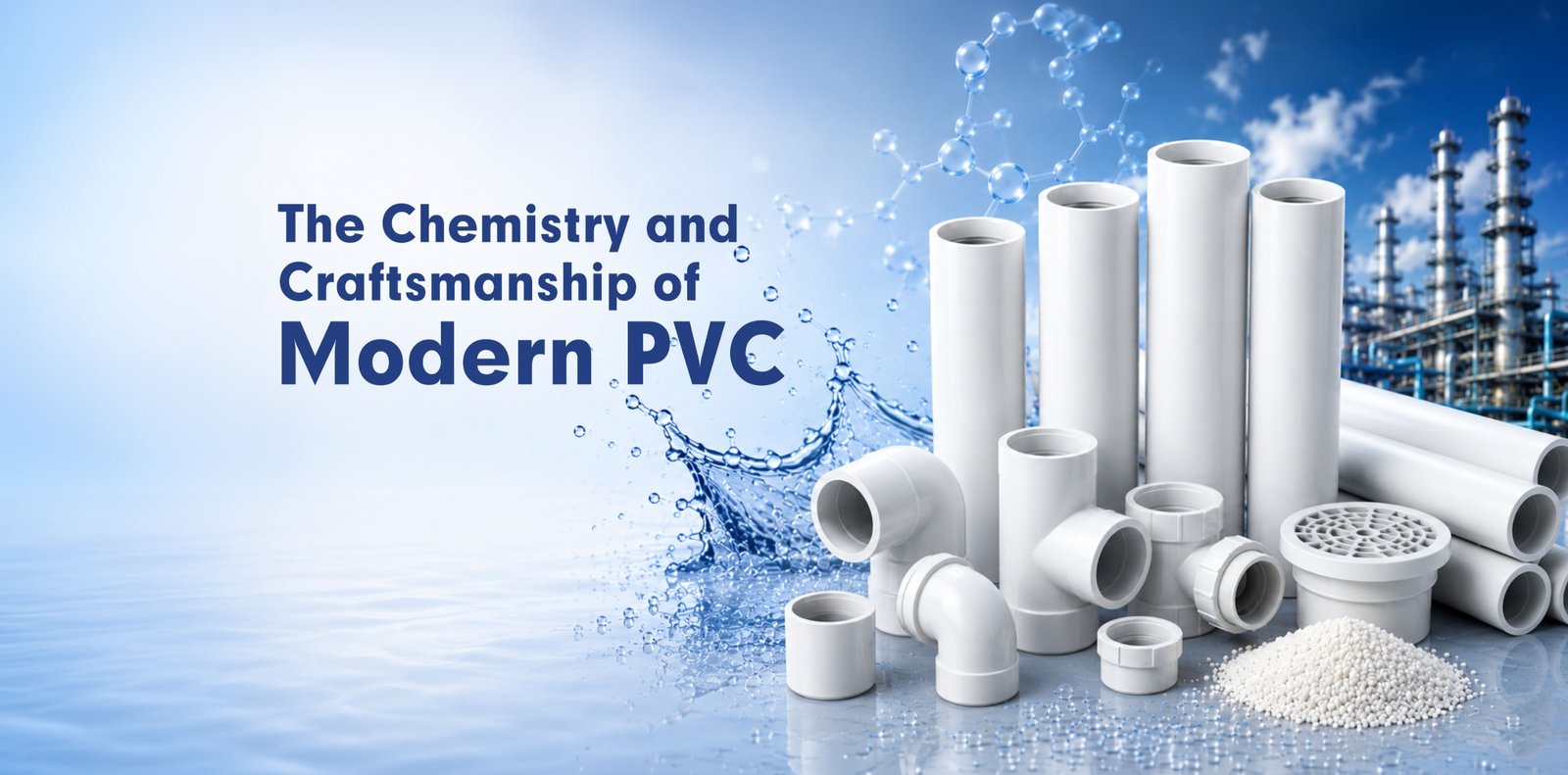
Whenever you flip a switch, flush your toilet, or use a faucet, a massive hidden network swings into action to work in the way that is expected. You never pay attention to it unless something goes wrong. But these systems, hidden behind your walls or beneath your feet, are exactly what make modern civilisation possible. Without durable PVC pipes and fittings, modern homes and buildings simply couldn’t function.
At first glance, PVC pipes just seem like simple plastic tubes. But like anything in life, PVC is far more than the sum of its parts. The underlying science of Polyvinyl Chloride is a masterclass in chemical engineering and material durability. In this blog post, we will dive into the technical details that make this material a global standard.
The Chemistry of Strength: Material Properties
At its core, Polyvinyl Chloride is just a combination of two naturally abundant resources: chlorine derived from industrial-grade salt and ethylene obtained from natural gas. But this specific molecular pairing is what makes PVC rigid and exceptionally resistant to environmental degradation. Unlike metal pipes, PVC pipes don’t rust, scale, or pit when exposed to moisture or varying pH levels in soil and water.
By mixing in special additives, manufacturers can change these basic traits. Adding different stabilisers and impact modifiers creates distinct types of pipes tailored for specific jobs. These include:
- uPVC (Unplasticised PVC): Rigid and highly stable because it contains no added plasticisers. This makes it completely safe for drinking water lines and tough enough for structural conduits.
- CPVC (Chlorinated PVC): Made with extra chlorine to handle high heat up to 93°C, making it the go-to choice for hot water plumbing.
- FR & FRLS Compounds: Packed with fire-retardant and low-smoke ingredients to keep electrical wires safe and prevent toxic smoke during a short circuit.
Key Industry Facts & Statistics
- The Indian Market Surge: The domestic plastic pipes market is growing fast, with PVC pipes capturing over 60% of the total volume. Valued at over 40K Crores, the industry is rapidly expanding, projected to grow at a Compound Annual Growth Rate (CAGR) of 5.8% to 14%, thanks to heavy infrastructure investments, urbanisation, and government initiatives like the Jal Jeevan Mission and PMKSY.
- Built to Last: High-quality PVC pipes are a serious long-term investment. While standard domestic and agricultural setups count on a reliable 50-year service life, proper underground installation can push that lifespan nearing a hundred years. That is a century of leak-free performance.
- The Green Choice:Life Cycle Assessments (LCAs) consistently show that PVC pipes generally have a lower overall carbon footprint than traditional Ductile Iron (DI) pipes. DI pipe manufacturing uses a lot of metal and energy, while PVC needs less energy to produce and transport.
Product Applications: Engineered for Specific Demands
Not all pipes are the same. Depending on where they’re used, PVC pipes and fittings are engineered with specific properties to handle the job right.
- Electrical Systems: Heavy, medium, and light conduit pipes protect wiring from physical damage. Advanced FR and FRLS pipes actually stop fires from spreading and cut down on dangerous smoke. Flexible corrugated pipes and casing solutions make it easy to route wires around tight corners.
- Water Distribution & Plumbing: Agricultural uPVC pipes have incredibly smooth insides, which help water move quickly and efficiently for farming. For residential plumbing, modern uPVC pipes are the perfect choice because they never rust or corrode like metal.
- Waste Management: Underground sewage pipes have to withstand heavy soil weight. Tough uPVC SWR pipes and plain socket fittings lock together tightly, creating leak-proof lines that safely carry away waste and rainwater.
Material Comparison: uPVC vs. CPVC
To show how these chemical formulations have an effect on real-world performance, the table below outlines how the two most common variants differ in function.
| Characteristics | Simple PVC | uPVC (Unplasticised PVC) | CPVC (Chlorinated PVC) |
| Chemical Composition | Contains plasticisers, which can gradually leach over time. | Standard PVC formulation without plasticisers. | PVC base altered through post-chlorination. |
| Max Temperature Resistance | Up to 60°C (140°F) | Up to 60°C (140°F) | Up to 93°C (200°F) |
| Primary Applications | Flexible conduits and hoses; not ideal for drinking water lines. | Cold water distribution, structural conduits, sewage lines. | Hot and cold potable water, industrial chemical transport. |
| Flexibility & Impact Strength | Flexible and soft, but lacks structural rigidity under high soil pressure. | High rigidity, excellent structural integrity under soil pressure. | Higher flexibility and superior resistance to mechanical stress. |
| Flame Resistance | Melts easily and releases heavier smoke under direct fire. | Inherently fire-resistant, but yields to intense direct heat. | Enhanced flame retardancy with lower smoke emission characteristics. |
Compliance and Global Standards: The Blueprint of Trust
A pipe is only as reliable as the certifications backing it up. There exist several rigorous manufacturing regulations that all ensure that these products are safe and can withstand a lot of stress without bursting or leaching chemicals. The best PVC pipe manufacturers strictly adhere to several domestic and international benchmarks.
ISO 9001:2015 and WHO-GMP: High-quality pipe manufacturing starts with these two important certifications. ISO 9001 ensures strict quality control at every step of production. WHO-GMP guarantees that pipes meant for drinking water are made in clean, regulated, and thoroughly inspected facilities.
Bureau of Indian Standards (IS 9537: PART 3: 1983): For electrical installations, safety is non-negotiable. That’s where IS 9537: PART 3: 1983 comes in. This Indian standard governs rigid plain conduits made from insulating materials, replacing the older IS:2509 guidelines. This rigid standard puts pipes through strict tests, checking impact strength, bendability, and heat resistance to ensure they won’t fail under normal electrical loads.
COC-CE Certification: If you’re exporting pipes to Europe or using them in high-pressure applications, you’ll need a COC-CE certificate from Radiance Quality Certifications. This proves compliance with two important EU rules:
- Low Voltage Directive (2014/35/EU): Ensures electrical conduits are safely insulated.
- Pressure Equipment Directive (2014/68/EU): Confirms that pressurised pipes can handle stress without weakening over time.
Choosing the Right Partner for Structural Integrity
Selecting the right pipe formulation involves balancing pressure ratings, temperature limits, and safety standards. Securing these materials from an authorised, certified PVC pipe distributor ensures that your project utilises authentic, rigorously tested components that live up to their technical specifications, protecting your infrastructure for decades to come.
Frequently Asked Questions
1: What is the primary difference between standard PVC pipes and uPVC pipes?
Standard PVC contains plasticisers to make it flexible, whereas uPVC (Unplasticised PVC) contains no plasticisers. This makes uPVC rigid, exceptionally durable, and entirely safe for carrying drinking water since it won’t leach chemicals into the supply.
2: Should uPVC pipes be used for hot water supply lines?
No. Standard uPVC pipes are designed to handle cold water and lose structural integrity if exposed to sustained temperatures above 60°C. For hot water applications up to 93°C, CPVC (Chlorinated PVC) pipes must be used.
3: How do PVC pipes enhance electrical safety in modern buildings?
Specialised PVC conduit pipes utilise FR (Fire Retardant) and FRLS (Fire Retardant Low Smoke) compounds. They are non-conductive, self-extinguishing, prevent flames from spreading during an electrical short circuit, and significantly minimise dangerous toxic smoke production.
4: Why are PVC pipes preferable over traditional cast iron or galvanized steel pipes?
Unlike metal pipes, PVC will never rust, scale, or corrode over time when exposed to water or reactive soils. Additionally, their incredibly smooth inner surfaces minimise friction, maintaining high water pressure and preventing bio-film buildup.
About the Author: With years of experience in construction supply chain management, Gagan Singh is an industry professional specialising in electrical infrastructure and large-scale project procurement.
