

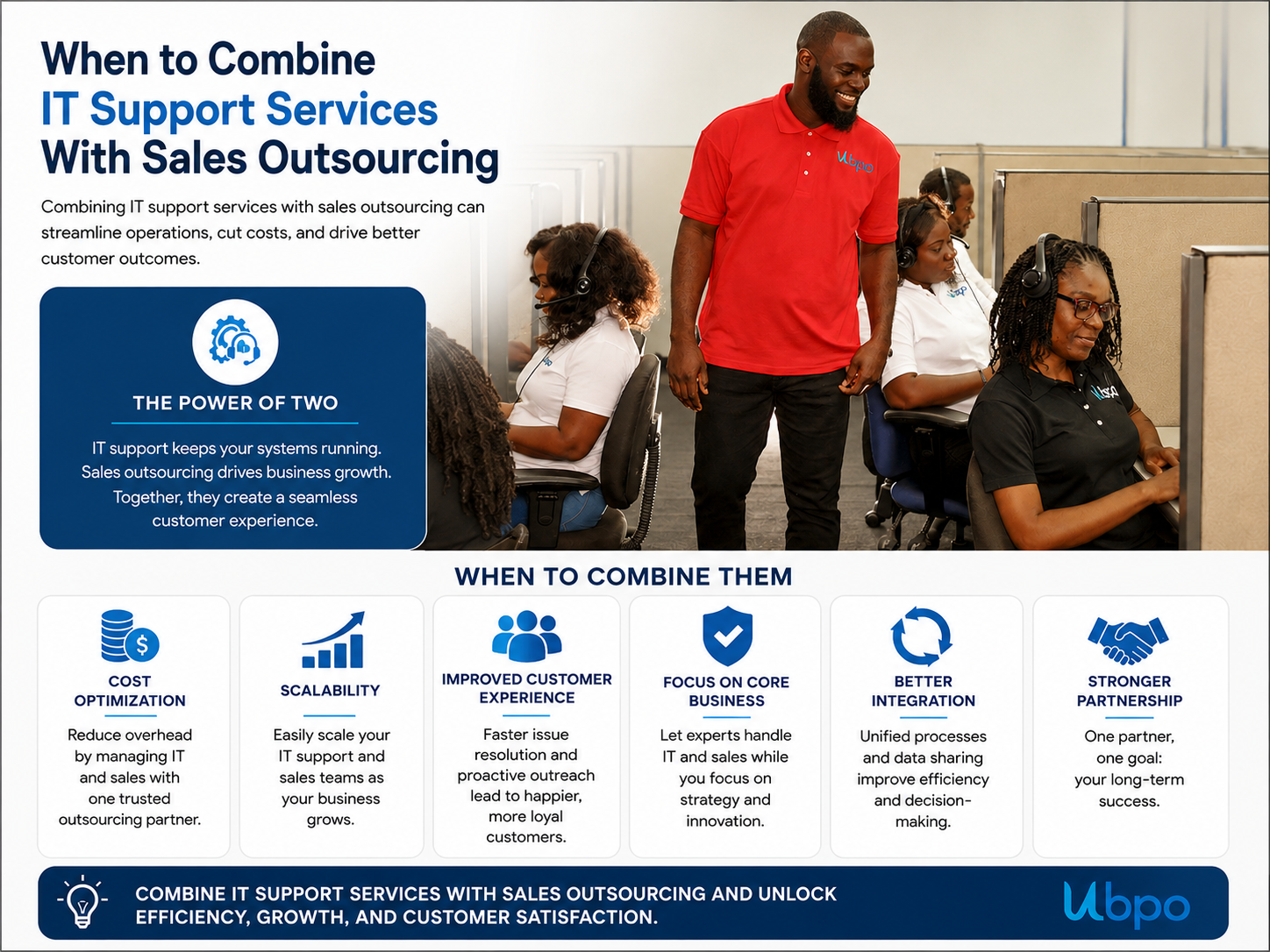
Are your salespeople spending too much time on password resets rather than interacting with prospective customers? This is quite a usual scenario by 2026. Your sales representatives struggle with their logins; you have many tickets to handle and many follow-ups falling behind. The answer is to combine a dedicated external sales machine with a strong technological background. That is why operators combine sales outsourcing with managed IT support services when they need it.
Below is the guide on when you will benefit from this combination, the responsibilities of each partner, and how to integrate it safely.
What Each Side Actually Owns
The sales outsourcing can handle lead generation and pipeline creation without the need for building a whole SDR team within the organization. This will be most effective when complemented with other technology such as CRM and AI.
Technical support will include help desk services, device health, network monitoring, and security to ensure proper functioning of IT processes. A managed approach means that the management of the IT environment is outsourced to experts.
Keep strategy in house. Outsource the mechanics that slow sellers.
Why Combining IT Support Services With Sales Makes Sense Now
First, salespeople devote just 28% to 35% of their workday to actual sales activities, with everything else being devoted to admin duties and technology management. Just 8 to 15 hours of time freed up per rep every week can have a profound impact on achieving quotas.
Second, technology sprawl is very much a thing. Companies use an average of 10 different applications, and reps admit that they find themselves overwhelmed with platforms that need to be mastered.
Third, managed services have seen massive growth, growing from $335 billion in 2024 to $730 billion in 2030. The exact same approach is relevant for revenue operations.
Where Managed IT Support Services Fit Best
Go with the managed plan if constant surveillance and fixed charges each month are important. The reasons are obvious: increased efficiency, cost predictability, improved security, growth potential, minimal downtime, and enterprise-level knowledge without requiring employees.
This is particularly suited for small and mid-sized companies because over half of business owners believe that today’s technology is holding back their company. Your managed provider handles patch management, backup, and endpoints, while your sales rep fills up your sales pipeline.
Seven Signals It Is Time
- Long lead response times due to technical issues for representatives.
- CRM data is dirty, as nobody owns data quality.
- Long onboarding process due to device delays.
- Dropped calls and failing dialers with no solution.
- Deals fall apart due to security reviews.
- The queue gets overwhelmed during peak season periods.
- You’re going into a new region.
If two apply, combine now.
How to Structure It
The sales team is responsible for lead generation, sequencing, and closing qualified meetings. They work in the CRM system and measure their conversions.
The technical team is responsible for SSO, provisioning, dialer health, CRM integration, backups, and endpoint security. They offer proactive monitoring and rapid helpdesk assistance.
Bolster both ends with common SLAs: a new representative available in 48 hours, P1 outage response in 15 minutes, route changes made in 24 hours, and weekly hygiene reports.
Avoid Pitfalls
Outsourcing positioning is a strict no-no. Never buy any tool without consulting the sales team, and never integrate platforms to fix bad processes. Start by mapping your lead flow and then automate it. Always have runbooks for all sales processes.
90 Day Rollout
Days 1 to 30 are allocated to auditing for tools and owners, removing any duplicate licensing, and setting up helpdesk intake for sales.
Days 31 to 60 are all about stabilization. They involve rolling out SSO and automation, connecting CRM and dialer, and setting up monitoring for revenue tools.
Days 61 to 90 will see optimization taking place. An outsourced SDR is scheduled to launch on one of the segments, with measurements being done for speed to lead, meetings, and reviews held with both partners.
Putting It Into Practice
Time zone differences can be reduced by nearshoring. VLBPO, located in Kingston, delivers call center services in Jamaica, which include customer support, technical support, sales outsourcing, and back office services. They now boast over 180 agents using a people-first approach through voice, emails, chats, and social media platforms.
This combination works to ensure that systems are operating smoothly.
Key Takeaway
Use sales outsourcing along with technical support while selling time becomes scarce and there is an increasing number of tools. Matching sales machines with IT support services will reduce conflicts that happen daily; moreover, using them means coverage and scalability for you.
Start from one segment, set up an SLA, and calculate the number of hours you have saved. Until 2026, this combination will safeguard your income.
FAQs
1. What is the difference between support and managed services?
Support takes care of tickets, whereas Managed includes monitoring, patching, and backup in an easy monthly payment plan.
2. When should a small team combine both?
When your representatives are spending hours solving technical problems or when you need coverage beyond normal business hours without hiring more people.
3. Will outsourcing create security risks?
If done right, it decreases risks by way of controls, MFA, backup, and response plans.
