

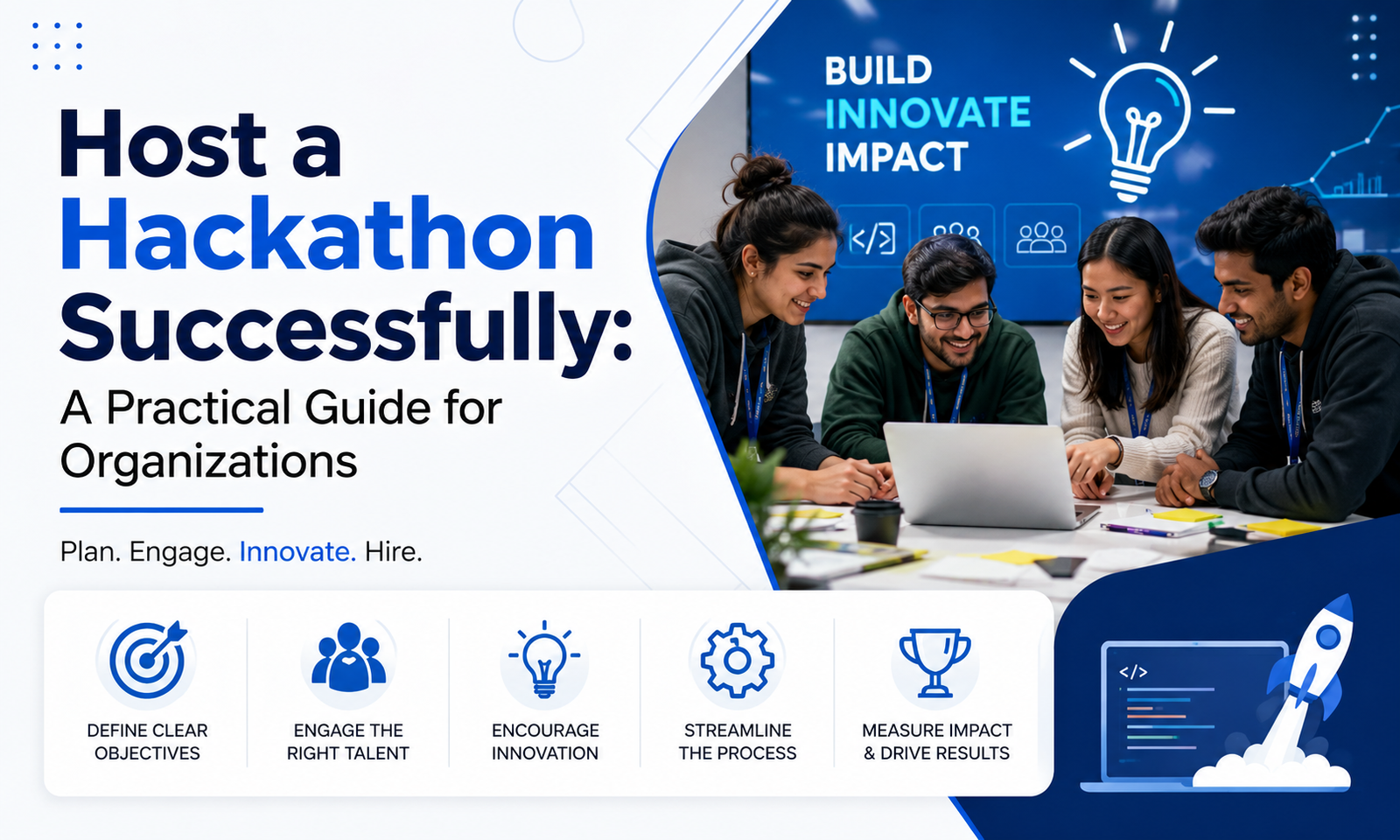
Innovation rarely happens by chance. Organizations that consistently launch new products, solve business challenges, and attract top talent often create structured opportunities for collaboration. One of the most effective ways to achieve this is to host a hackathon.
Whether you’re a startup, enterprise, university, or government organization, a well-executed hackathon can generate innovative ideas, identify skilled talent, and strengthen your brand. However, success depends on more than choosing a date and inviting participants. It requires clear objectives, seamless execution, and measurable outcomes.
Why Organizations Host a Hackathon
A hackathon is a time-bound innovation event where participants collaborate to solve predefined challenges. Depending on your goals, a hackathon can focus on product innovation, AI, sustainability, cybersecurity, healthcare, fintech, or talent acquisition.
Organizations commonly host hackathons to:
- Accelerate innovation through rapid idea generation.
- Discover skilled developers, designers, and problem-solvers.
- Build employer branding among students and professionals.
- Encourage cross-functional collaboration.
- Solve real business challenges with fresh perspectives.
- Strengthen relationships with universities, startups, and technology communities.
Rather than relying solely on traditional hiring or brainstorming sessions, hackathons provide an environment where participants demonstrate practical skills under real-world conditions.
Define Clear Objectives Before You Begin
The most successful hackathons begin with a specific purpose. Before planning logistics, determine what success looks like.
Common objectives include:
- Recruiting technical talent.
- Developing proof-of-concept solutions.
- Engaging developer communities.
- Supporting corporate innovation initiatives.
- Promoting a new technology or API.
- Encouraging employee innovation.
Your event structure, judging criteria, mentors, and evaluation process should align with these objectives.
Build the Right Hackathon Framework
Every successful event follows a structured workflow.
1. Select a Relevant Challenge
Choose problems that are realistic, meaningful, and aligned with your organization’s priorities. Well-defined problem statements encourage better submissions than overly broad themes.
2. Identify Your Audience
Different hackathons target different participants:
- College students
- Professional developers
- Startup founders
- Internal employees
- Researchers
- Mixed innovation communities
Understanding your audience helps determine timelines, communication, mentorship, and evaluation criteria.
3. Establish Transparent Evaluation Criteria
Participants should understand how projects will be judged. Typical evaluation parameters include:
- Innovation
- Technical implementation
- Business impact
- Scalability
- User experience
- Presentation quality
Transparency builds trust and improves participant experience.
Choose Technology That Supports the Entire Journey
Managing registrations through spreadsheets and evaluating hundreds of submissions manually quickly becomes inefficient.
Modern hackathon platforms streamline processes such as:
- Participant registration
- Team formation
- Challenge management
- Submission tracking
- Automated communication
- Mentor scheduling
- Judge evaluation
- Leaderboards
- Certificates
- Analytics and reporting
Using a centralized platform reduces operational complexity while improving the participant experience.
The Importance of Mentorship
Mentors significantly improve the quality of submissions.
Experienced mentors help participants:
- Validate ideas.
- Resolve technical challenges.
- Improve project architecture.
- Refine business models.
- Prepare final presentations.
Organizations also gain better solutions because teams receive guidance throughout the event instead of working in isolation.
Focus on Participant Experience
An engaging participant experience leads to stronger submissions and higher event satisfaction.
Best practices include:
- Clear communication before and during the event.
- Easy access to resources and documentation.
- Responsive support teams.
- Structured schedules.
- Fair judging.
- Timely announcements.
- Recognition for outstanding projects.
Positive experiences encourage repeat participation and strengthen your organization’s reputation within developer and student communities.
Measure Success Beyond Winners
A successful hackathon is not measured solely by prize distribution.
Consider tracking metrics such as:
- Registration-to-participation rate
- Submission rate
- Completion rate
- Mentor engagement
- Judge turnaround time
- Hiring conversions
- Prototype adoption
- Community growth
- Social engagement
- Participant satisfaction
These insights help improve future events and demonstrate business value to stakeholders.
Why Organizations Choose End-to-End Platforms
As hackathons grow in scale, manual coordination becomes increasingly difficult. Organizations often adopt end-to-end hackathon management platforms that centralize operations while providing a consistent experience for participants, mentors, judges, and organizers.
Where U Elevate is one such platform that supports organizations throughout the hackathon lifecycle—from registrations and challenge management to mentoring, evaluations, analytics, and talent discovery. By bringing these capabilities together in a single ecosystem, organizers can focus more on innovation outcomes and participant engagement rather than administrative tasks.
Selecting a platform with flexible workflows, reliable infrastructure, and comprehensive reporting helps organizations deliver professional hackathon experiences regardless of event size or format.
Best Practices to Host a Hackathon Successfully
To maximize outcomes:
- Define measurable business goals.
- Design meaningful problem statements.
- Recruit experienced mentors and judges.
- Use a scalable hackathon management platform.
- Maintain transparent evaluation processes.
- Communicate consistently with participants.
- Collect feedback after the event.
- Analyze performance metrics for continuous improvement.
These practices help organizations deliver events that generate long-term value instead of one-time participation.
Conclusion
To host a hackathon successfully, organizations need more than enthusiasm—they need strategic planning, efficient execution, and measurable outcomes. Clear objectives, engaging challenges, experienced mentors, transparent judging, and the right technology all contribute to an impactful event.
Whether your goal is innovation, talent acquisition, or community engagement, investing in a structured hackathon process can deliver lasting business value. Platforms like Where U Elevate further simplify execution by supporting the complete event lifecycle, enabling organizations to create scalable, professional, and outcome-driven hackathon experiences that benefit both participants and organizers.
For more News:- https://gettonews.com/revocable-living-trust-in-2026-for-modern-estate-planning-success/
