

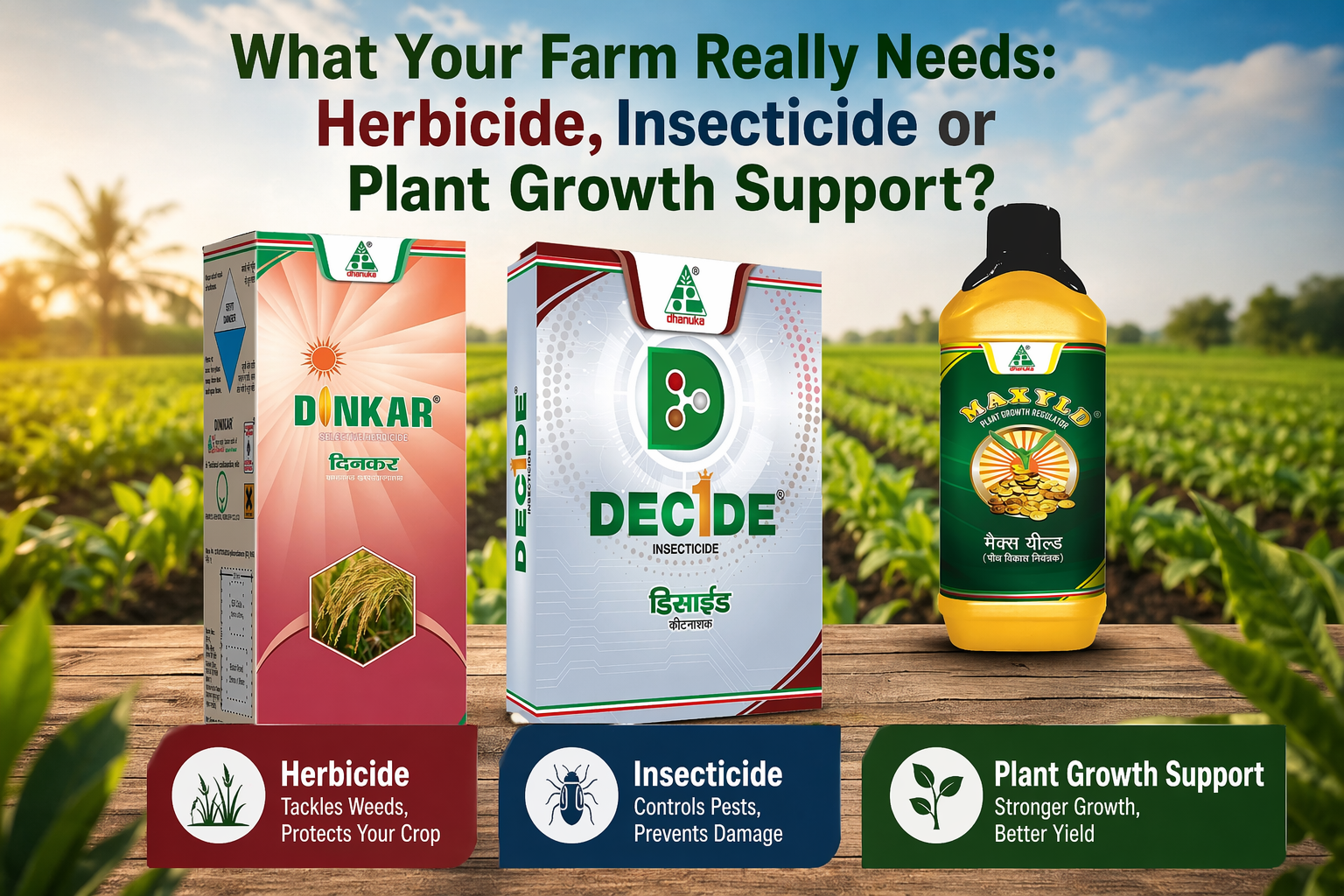
If you ask ten farmers what their biggest challenge is, you’ll hear different answers, but most come back to the same confusion: which input should I use right now?
Some days, it clearly looks like a herbicide is needed as weeds start competing with the crop. On other days, there are no visible issues, yet the crop feels weak. This is where a plant growth solution comes into the picture.
That’s where it gets tricky. Choosing the wrong input at the wrong time doesn’t just waste money; it slowly affects your yield.
Let’s break it down in a way that actually works in real field conditions.
First Things First: Read Your Field, Not the Label
Before thinking about any product, spend a few minutes just observing.
- Are weeds spreading faster than your crop?
- Do leaves show signs of insect damage?
- Or is the crop simply not growing the way it should?
This step sounds basic, but it’s often skipped. And that’s exactly where mistakes begin.
When Weeds Start Taking Over
Weeds don’t look aggressive at first, but give them a little time, and they’ll outgrow your crop, steal nutrients, and block sunlight.
This is when a herbicide chemical becomes necessary.
It’s not about killing plants; it’s about protecting your crop’s space to grow.
Farmers who stay on top of weed control solutions in farming usually notice one thing: their crops look more uniform and stronger, simply because they’re not competing for resources.
Simple rule:
If your crop is fighting for space, deal with weeds first.
When Insects Begin Their Work
You won’t always see insects right away, but you’ll notice what they leave behind.
- Holes in leaves
- Damaged stems
- Sudden drop in plant health
That’s your signal to act with an insecticide chemical.
Good pest control in agriculture isn’t about spraying often; it’s about spraying smart. Catch the problem early, and you’ll need less effort later.
One practical tip:
Don’t panic-spray. Identify the pest first. The right solution works better than a rushed one.
When Everything Looks “Okay”… But Not Great
This is the most confusing situation.
No major weeds. No visible pests. But the crop lacks energy. Growth feels slow. Leaves don’t have that healthy color.
That’s where a plant growth promoter comes in.
It doesn’t fight anything; it supports everything.
Think of it as helping your crop make better use of what’s already available: nutrients, water, and sunlight.
Why These Three Get Mixed Up?
On paper, it’s simple:
- Herbicide = weeds
- Insecticide = pests
- Growth promoter = crop performance
But in real fields, problems overlap.
A weak crop might actually be suffering from hidden weed competition.
Pest damage might look like poor nutrition.
And sometimes, farmers use a growth promoter hoping it will fix everything.
That’s where the confusion and the loss happen.
Can You Use All Three? Yes—But With a Plan
Farming today isn’t about choosing one solution. It’s about using the right combination at the right time.
A practical flow often looks like this:
- Early stage → manage weeds with a herbicide chemical
- Growing stage → handle pests with an insecticide chemical
- Development stage → support growth with a plant growth promoter
When done right, each step supports the next.
What Happens When the Order Is Wrong?
This is something many farmers learn the hard way.
- Using a growth promoter in a weedy field → limited results
- Ignoring pests and focusing only on growth → damaged crop
- Spraying without a clear need → wasted cost
Inputs don’t fail; timing does.
A Ground-Level Example
Imagine a farmer growing cotton.
At the start, weeds come up quickly. If ignored, they slow down early crop growth.
Then pests begin feeding on tender leaves.
Later, even if both issues are controlled, the crop needs support to reach its full potential.
Each stage demands a different response.
Not more products, just the right one at the right time.
Where Experience (and Guidance) Matters
This is where trusted names like Dhanuka come into the picture. Not just for products, but for practical understanding.
Many farmers rely on their field guidance to figure out what to apply and when. Because honestly, the label on a bottle doesn’t always tell the full story, the field does.
Small Mistakes That Make a Big Difference
Sometimes it’s not a major error, just a small habit:
- Spraying a bit more “just to be safe.”
- Mixing products without checking
- Skipping field checks for a few days
These things add up.
And slowly, they affect crop performance more than we realize.
Timing Isn’t Everything—But It’s Close
Even the best herbicide chemical won’t help if weeds have already taken over.
An insecticide chemical works best before pests multiply.
And a plant growth promoter shows real impact when the plant is ready to respond.
Miss the timing, and the results feel average even if the product is good.
Farming Isn’t About More—It’s About Better
There’s a shift happening in how smart farmers think.
It’s no longer about how many inputs you use.
It’s about how well you use them.
- Fewer mistakes
- Better observation
- More precise decisions
That’s what separates an average season from a good one.
Final Thoughts
Every farm has different needs, but the basics stay the same.
- Use a herbicide when weeds start competing
- Use an insecticide when pests begin damaging
- Use a plant growth promoter when your crop needs support to perform better
And most importantly, don’t rush the decision.
Take a walk through your field. Look closely. Trust what you see.
Because in the end, your farm doesn’t need everything.
It just needs the right thing, at the right time.
FAQS
1. How do I know whether my crop needs a herbicide, insecticide, or growth support?
Start by observing your field closely. If weeds are competing, go for a herbicide. If insects are damaging crops, use an insecticide. If everything looks fine but growth is slow, a growth promoter can help.
2. Can I use all three products together on my farm?
Yes, but not at the same time without planning. Each product has a specific purpose, so it’s better to use them based on your crop’s stage and actual need.
3. What happens if I use a herbicide when weeds are not present?
It usually won’t give any benefit and may even stress your crop or waste money. It’s always better to use inputs only when there’s a clear need.
4. How often should I check my field for problems?
Regular checks every few days can make a big difference. Early detection helps you act faster and use the right solution before the issue grows.
5. Can a plant growth promoter fix pest or weed problems?
No, it doesn’t work that way. Growth promoters support plant development but don’t control weeds or insects. Each problem needs the right solution.
6. Is it okay to mix herbicides and insecticides in one spray?
Sometimes yes, but not always. Compatibility matters. If you’re unsure, it’s safer to apply them separately rather than risking crop stress.
7. Why does my crop still look weak even after using inputs?
It could be due to soil health, timing, or incorrect usage. Even good products won’t perform well if the basics like soil condition or irrigation, are off.
8. How can I choose reliable products for my farm?
It helps to go with trusted brands and proven solutions. Many farmers prefer options from Dhanuka because they’ve seen consistent results in real field conditions.
9. Do I need expert advice before using these products?
It’s always a good idea, especially if you’re unsure. Companies like Dhanuka often guide along with their products, helping farmers use them more effectively.
10. What’s the biggest mistake farmers make with these inputs?
Rushing the decision. Many times, farmers apply something without fully understanding the problem. Taking a little time to observe can save both cost and crop health.
Follow the website for daily updates: https://gettonews.com/
