

An Agentforce consulting partner in the USA helps enterprises plan, build, and deploy Salesforce AI agents that run real business tasks. The right partner manages data readiness, agent design, integration, and governance, so projects reach production instead of stalling in pilots. Most large firms hire one because internal teams lack hands-on agentic AI experience.
Demand is rising fast. Gartner predicts that 40% of enterprise applications will run task-specific AI agents by the end of 2026, up from under 5% in 2025. That timeline puts pressure on US companies to move now. This guide covers how implementation works, what to look for in a partner, what it costs, and the results enterprises see.
How do you implement Agentforce in an enterprise?
You implement Agentforce in five stages: define the use cases, prepare clean data, build and test agents in a sandbox, connect them to your CRM and core systems, then launch with human oversight. Most enterprises start with one or two high-volume tasks before scaling. Data quality decides the outcome.
Start with high-value, high-volume use cases
Pick tasks that repeat often and follow clear rules. Customer support tickets, order status checks, and password resets work well early. These jobs show fast returns and build internal trust. A good partner scopes three to five use cases first, not a company-wide rollout.
Get the data foundation right
Agents reason over your data, so messy records produce bad answers. A partner audits your sources, removes duplicates, and connects systems through Salesforce Data Cloud before any agent goes live. Many enterprises follow a structured enterprise AI deployment framework to keep this work on track and repeatable across teams.
Roll out in phases with governance built in
Launch to a small group, watch the results, then widen access. Set guardrails that define what an agent can and cannot do. Governance is the weak point for most firms. Deloitte found only 21% of companies have a mature model for governing autonomous agents. A strong partner fixes this before launch, not after.
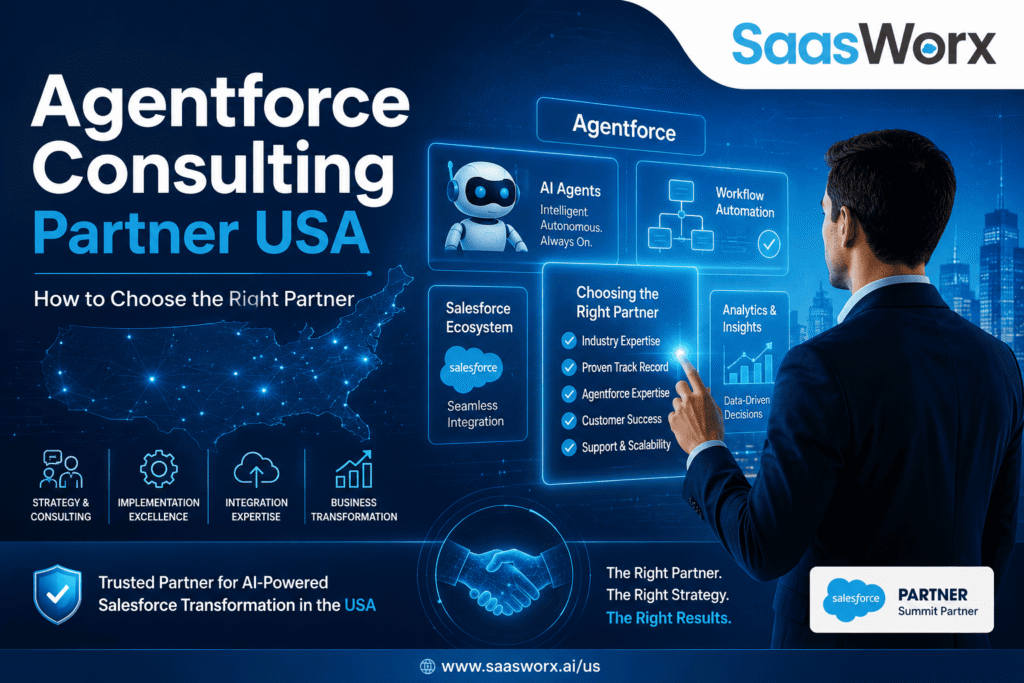
How to choose an Agentforce consulting partner in the USA
Choose an Agentforce consulting partner in the USA based on certified Salesforce expertise, real production deployments, and industry fit. Ask for measured client results, not demos. Check whether the firm handles data engineering and governance, not just agent setup. References from similar enterprises matter more than slide decks.
Credentials worth checking
- Salesforce certifications: Agentforce, Data Cloud, and Platform credentials on the delivery team.
- Production proof: live agents running for real clients, with named outcomes.
- Industry experience: work in your sector, such as finance, retail, or healthcare.
- Full-stack skills: data engineering, integration, and change management, not setup alone.
Questions to ask before you sign
- How many agents have you taken to production, and what did they resolve?
- How do you handle data cleanup and integration?
- What guardrails and monitoring do you set up?
- Who owns the agents after launch, your team or ours?
How long does Agentforce implementation take and what does it cost?
A focused Agentforce deployment takes four to twelve weeks for the first agents, depending on data readiness and integration scope. Salesforce prices Agentforce on usage, historically around $2 per conversation, plus platform and consulting fees. Complex enterprise rollouts take longer and cost more.
A realistic timeline
- Weeks 1-2: scope use cases, audit data, set success metrics.
- Weeks 3-6: build and test agents in a sandbox, connect systems.
- Weeks 7-10: pilot with a small group, tune responses, add guardrails.
- Weeks 10-12+: scale to full traffic, hand over, and monitor.
What drives the cost
Three factors move the price: data condition, the number of systems you connect, and conversation volume. Clean data and few integrations keep costs low. Custom workflows across many tools raise them. Usage-based pricing means a busy support queue costs more each month than a quiet internal helpdesk.
What results can enterprises expect from Agentforce?
Enterprises report strong results when deployments are scoped well. Salesforce’s own support agents handled more than 380,000 conversations with an 84% resolution rate and only 2% human escalation, according to the company . Customer service, IT support, and sales operations show the clearest early returns.
The gains go beyond ticket counts. Salesforce reports that Agentforce users have logged over $100 million in annualized cost savings and a 34% productivity increase from agentic and generative AI across 18,000-plus companies. The pattern is consistent: narrow scope, clean data, and human oversight produce measurable value within weeks.
Final thoughts
An Agentforce consulting partner in the USA turns AI ambition into working agents by managing data, integration, and governance from day one. The firms that win start small, prove value on a few tasks, and scale with guardrails in place. Picking the right partner, with certifications and production proof, is the single biggest factor in success. As agents take on more enterprise work each year, one question matters most: which tasks in your business are ready to be handled by an agent first?
