

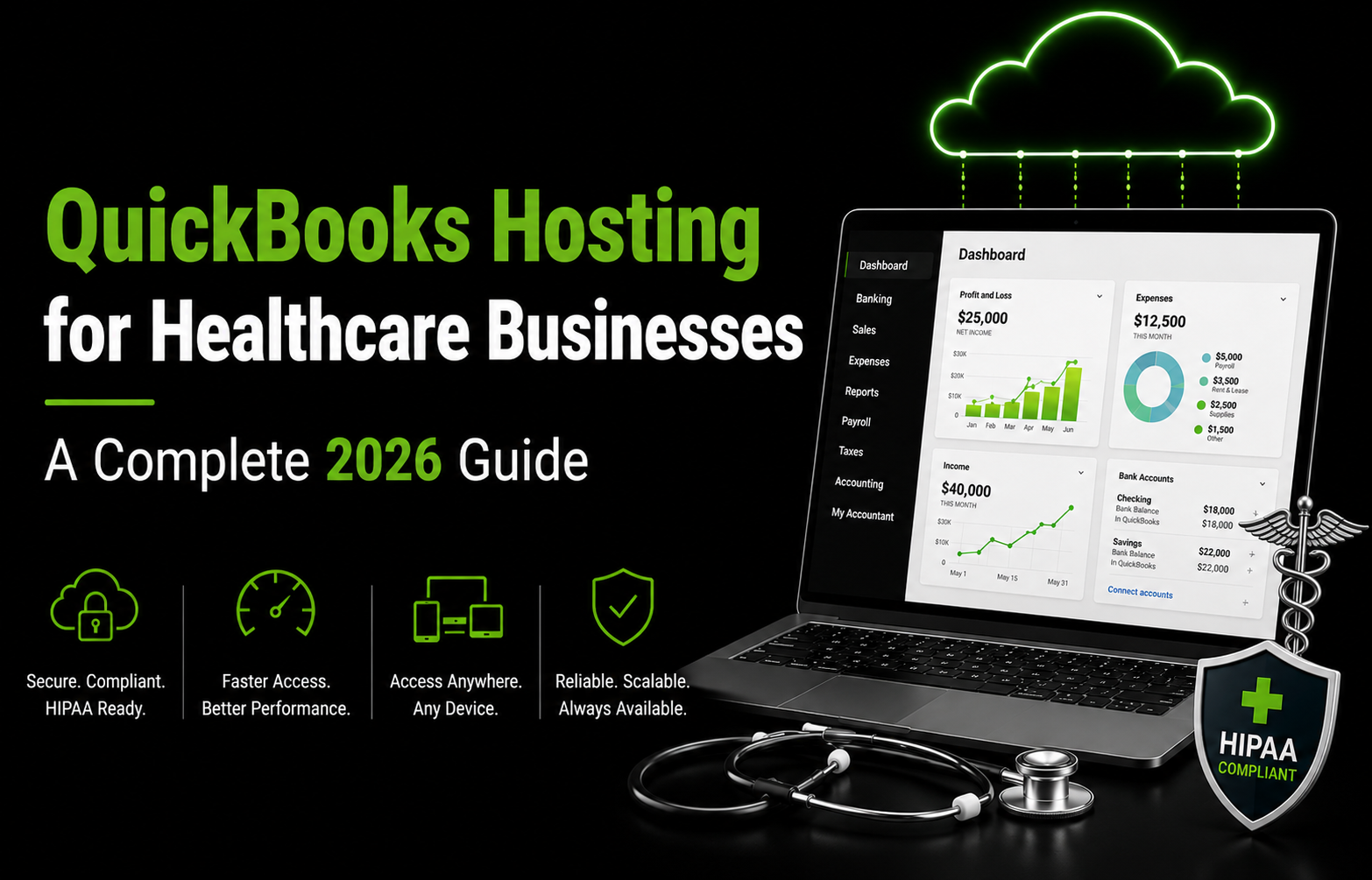
Running the financial side of a healthcare business is no small feat. Between managing patient billing, tracking insurance reimbursements, handling payroll for clinical staff, and staying compliant with strict regulatory standards, healthcare organizations face financial complexities that most industries never encounter.
That’s where QuickBooks Hosting becomes a game-changer.
By moving QuickBooks to a secure, cloud-based hosted environment, healthcare businesses — from private clinics and dental offices to multi-location hospitals and home health agencies — gain the flexibility, security, and compliance infrastructure they need to operate with confidence in 2026.
This complete guide walks you through everything you need to know: what QuickBooks hosting is, why it matters for healthcare, what to look for in a provider, and how to make the transition seamlessly.
What is QuickBooks Hosting?
QuickBooks Hosting refers to running your QuickBooks Desktop software on a remote server managed by a third-party hosting provider, rather than on a local machine or on-premise server. You access it through the internet — via any device, browser, or Remote Desktop Protocol (RDP) client — and the hosting provider handles the infrastructure, maintenance, backups, and security.
In simple terms, it combines the full power of QuickBooks Desktop with the convenience and accessibility of the cloud.
This is particularly significant for healthcare businesses that need:
- 24/7 access to financial data across departments and locations
- Multi-user collaboration without licensing bottlenecks
- Reliable disaster recovery and data backup
- HIPAA-compliant infrastructure for handling sensitive data
Why Healthcare Businesses Need QuickBooks Hosting in 2026
Healthcare finance is under more pressure than ever. Regulatory requirements have tightened, patient volumes are increasing, and staffing models have shifted toward hybrid and remote work. Here’s why QuickBooks Hosting has become essential for modern healthcare organizations:
1. HIPAA Compliance Made Manageable
While QuickBooks itself handles financial data rather than Protected Health Information (PHI), healthcare businesses often deal with data that touches patient billing, insurance identifiers, and payment records. A reputable QuickBooks Hosting provider offers HIPAA-compliant infrastructure — encrypted data transmission, access controls, audit logs, and signed Business Associate Agreements (BAAs) — so your financial workflows stay on the right side of compliance.
2. Remote and Multi-Site Access
Healthcare businesses rarely operate from a single desk. Billing teams may be remote, accountants may work off-site, and administrators across multiple clinic branches all need access to the same financial records. QuickBooks Hosting enables real-time, concurrent access from any authorized device — desktop, laptop, or tablet — without VPN headaches or data sync issues.
3. Stronger Data Security
On-premise QuickBooks setups are vulnerable to physical theft, hardware failure, ransomware, and human error. Hosted environments, by contrast, run in enterprise-grade data centers with features like:
- 256-bit AES encryption
- Multi-factor authentication (MFA)
- Role-based access controls
- Automated daily backups with offsite redundancy
- 24/7 security monitoring
For healthcare businesses handling sensitive billing data, this level of protection is not optional — it’s essential.
4. Always-On Availability
Healthcare doesn’t stop at 5 PM. Claims need to be submitted, payroll needs to run, and end-of-month reconciliations don’t wait. Hosted environments typically guarantee 99.9% uptime with redundant infrastructure, meaning your finance team always has access when they need it.
5. Scalability Without Infrastructure Costs
As your healthcare organization grows — adding providers, opening new locations, or onboarding more billing staff — QuickBooks Hosting scales with you. Add users, increase storage, or upgrade resources without buying new hardware or hiring an IT team.
Key Features to Look For in a Healthcare QuickBooks Hosting Provider
Not all hosting providers are equal. When evaluating options for your healthcare business, prioritize the following:
1. HIPAA-Compliant Infrastructure
Look for providers that explicitly offer HIPAA compliance and are willing to sign a BAA. This signals that they understand the regulatory landscape of healthcare and take data responsibility seriously.
2. High-Availability Uptime
Your SLA (Service Level Agreement) should guarantee at least 99.9% uptime. Ask about redundant data centers and failover protocols to understand what happens if one server goes down.
3. Multi-User Licensing Support
Healthcare finance teams often involve multiple people — accounts payable, billing coordinators, practice managers, and external accountants. Your hosting plan should support concurrent multi-user access without performance degradation.
4. Automated Backups and Disaster Recovery
Data loss in healthcare finance can be catastrophic. Look for providers offering automated daily backups, point-in-time recovery, and geographically redundant storage.
5. Integration With Healthcare Software
Many healthcare businesses use specialized tools like Practice Management Systems (PMS), Electronic Health Record (EHR) platforms, or medical billing software. A good QuickBooks Hosting provider will support integrations and third-party application hosting so all your tools work in one environment.
6. Dedicated Technical Support
Healthcare businesses can’t afford downtime. Choose a provider with 24/7 technical support staffed by QuickBooks-trained specialists who can resolve issues quickly.
QuickBooks Hosting Use Cases in Healthcare
▶ Private Medical and Dental Practices
Solo practitioners and small group practices benefit from hosted QuickBooks by eliminating local IT overhead while keeping patient billing and expense tracking fully organized and auditable.
▶ Home Health and Hospice Agencies
Field-based staff and remote billing coordinators need access to financial data from multiple locations. QuickBooks Hosting provides that accessibility securely, without requiring expensive VPN setups.
▶ Multi-Location Hospital Networks
Large healthcare systems with multiple billing departments across facilities can standardize their financial workflows in one hosted environment, giving administrators and CFOs a real-time, consolidated view of the organization’s finances.
▶ Medical Billing Companies
Third-party billing companies serving healthcare clients handle enormous volumes of claims and payment data. A hosted QuickBooks environment allows them to serve multiple clients with proper data segregation, security, and uptime.
▶ Behavioral Health and Mental Health Centers
These organizations often operate on thin margins and cannot afford IT infrastructure investments. QuickBooks Hosting delivers enterprise-level financial tools at predictable monthly costs, making it accessible even for smaller behavioral health providers.
QuickBooks Desktop vs QuickBooks Online vs QuickBooks Hosting: Which Is Right for Healthcare?
| Feature | QuickBooks Desktop | QuickBooks Online | QuickBooks Hosting |
| Remote Access | ❌ Limited | ✅ Yes | ✅ Yes |
| Full Desktop Features | ✅ Yes | ❌ Partial | ✅ Yes |
| Multi-User (Concurrent) | ❌ Limited | ✅ Yes | ✅ Yes |
| HIPAA-Ready Infrastructure | ❌ No | ❌ No | ✅ Yes (provider-dependent) |
| Custom Integrations | ✅ Yes | ❌ Limited | ✅ Yes |
| Data Control | ✅ Full | ❌ Limited | ✅ Full |
| IT Overhead | ❌ High | ✅ Low | ✅ Low |
For healthcare businesses that need the full feature set of QuickBooks Desktop — advanced reporting, industry-specific configurations, and robust integrations — but also require cloud access and compliance infrastructure, QuickBooks Hosting is the clear winner.
How to Migrate to QuickBooks Hosting: A Step-by-Step Overview
Transitioning to a hosted environment is simpler than most healthcare businesses expect. Here’s a general roadmap:
Step 1: Audit Your Current Setup Inventory your current QuickBooks version, number of users, company files, integrations, and any custom configurations.
Step 2: Choose the Right Hosting Provider Evaluate providers on uptime, HIPAA compliance, support quality, pricing, and scalability. Request a demo or trial period.
Step 3: Sign the BAA Before any data migration, ensure your provider signs a Business Associate Agreement to formalize their compliance obligations.
Step 4: Migrate Your Company File Most providers handle migration for you. They’ll transfer your QuickBooks company file, verify data integrity, and configure user access.
Step 5: Set Up Users and Permissions Define who can access what — billing staff, accountants, department managers — with role-based permissions.
Step 6: Test and Train Run parallel operations briefly to validate everything is working. Train your team on accessing the hosted environment via RDP or browser.
Step 7: Go Live Decommission your local setup and move fully to the hosted environment.
Cost Considerations for Healthcare Organizations
QuickBooks Hosting pricing typically follows a per-user, per-month model. For healthcare organizations, costs generally range from $30 to $80 per user per month, depending on:
- Number of users
- Storage requirements
- Level of support (standard vs. dedicated)
- Additional services (backup, compliance add-ons)
While this represents an ongoing cost, it replaces significant capital expenses — servers, IT maintenance, hardware upgrades, and security software — making it a financially sound choice for most healthcare businesses.
Conclusion
In 2026, healthcare businesses can no longer afford to rely on outdated, locally installed financial software. The demands of remote teams, regulatory compliance, data security, and operational efficiency all point in one direction: the cloud.
QuickBooks Hosting delivers the best of both worlds — the full power of QuickBooks Desktop with the accessibility, security, and scalability of a modern cloud environment. For healthcare organizations looking to streamline their finances, reduce IT burden, and stay compliant, hosted QuickBooks isn’t just a smart choice — it’s the right one.
And with a trusted partner like Apps4Rent by your side, the transition is smooth, the infrastructure is solid, and your financial operations are in safe hands.
Ready to explore QuickBooks Hosting for your healthcare business? Contact Apps4Rent today for a free consultation and discover how they can tailor a hosting solution to your organization’s unique needs.
Frequently Asked Questions
QuickBooks itself is financial software and doesn’t store PHI, but a good hosting provider offers HIPAA-compliant infrastructure — encryption, access controls, and BAA agreements — making the overall environment compliant for healthcare use.
Yes. QuickBooks Hosting supports concurrent multi-user access from any location, making it ideal for healthcare teams spread across offices, remote sites, or multiple facilities.
Reputable providers like Apps4Rent maintain redundant data centers and automated backups, so your data is protected and accessible even during hardware failures or outages.
Most migrations are completed within 24 to 48 hours. Providers typically handle the process end-to-end with minimal disruption to daily operations.
In the long run, hosting eliminates costs for servers, IT staff, hardware maintenance, and security software. For most healthcare businesses, it is more cost-effective and predictable than maintaining an on-premise setup.
