

For decades, a cultural and technological divide has existed between manufacturing sales offices and factory floors. Sales teams focus on pipelines, customer accounts, and quotas. Production teams focus on capacity, lead times, and raw material availability. When these two worlds operate in isolation, businesses suffer from inaccurate demand estimates, unfulfilled orders, and high inventory storage costs.
A standard Customer Relationship Management (CRM) platform does not track production capacity, and an Enterprise Resource Planning (ERP) database lacks real-time insight into sales negotiations. This gap creates massive operational inefficiencies. According to a study by Forrester Consulting, implementing dedicated industry solutions allows companies to achieve up to a 354% Return on Investment (ROI) and a 5% increase in topline revenue growth.
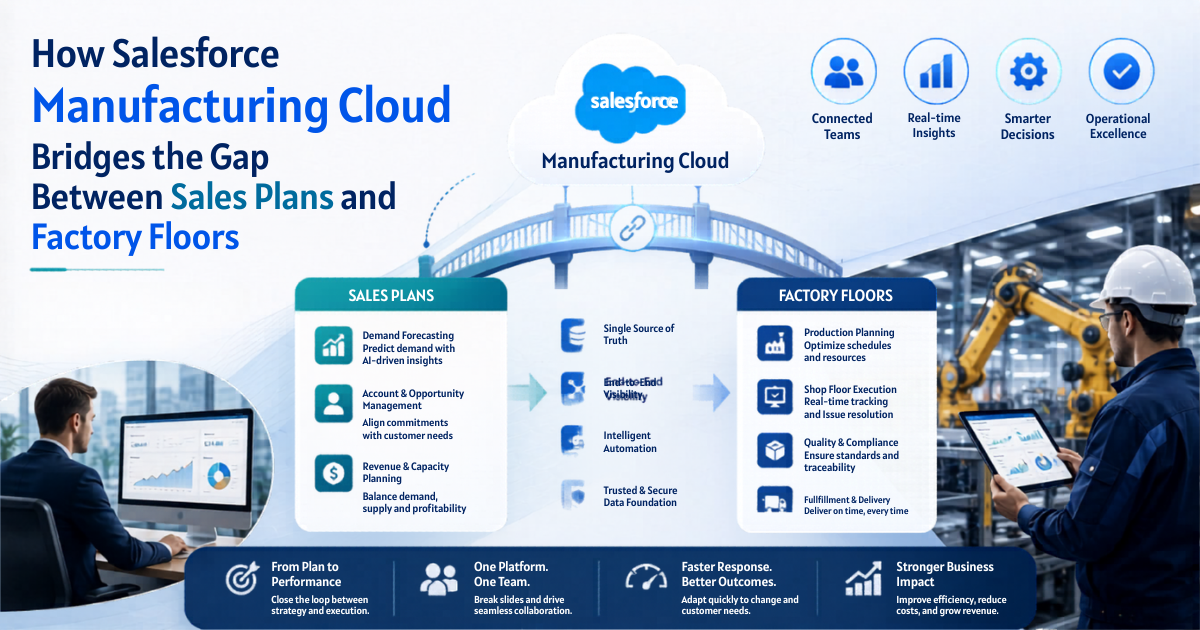
Salesforce Manufacturing Cloud functions as the central bridge between these business units. This industry-specific architecture translates dynamic commercial pipelines into predictable production metrics.
The Core Challenge: Why Traditional Data Silos Fail
Most industrial organizations rely on isolated technology stacks. The sales department tracks customer communications in a commercial CRM, while the plant floor schedules equipment runs using an ERP system. The lack of direct interaction between these platforms creates major supply chain friction.
1. Inaccurate Lead Times
Sales representatives often promise delivery dates based on historical averages rather than current factory conditions. If a production line undergoes unscheduled maintenance or lacks a critical material, the promised delivery date becomes impossible.
2. Inventory Inefficiencies
Without a clear view of upcoming sales orders, plant managers base production runs on backward-looking data. This practice results in either expensive stockouts or excess finished goods that consume warehouse space and tie up operational capital.
3. Broken Revenue Predictability
Run-rate business—the stable, long-term contracts that account for 70% to 80% of a typical manufacturer’s revenue—often stays hidden in separate spreadsheets. Sales leaders cannot see if a customer is meeting their contract volumes until the end of the quarter, making revenue projections highly unreliable.
Unifying Run-Rate Business with Sales Agreements
A major feature of Salesforce Manufacturing Cloud Solutions is the native Sales Agreements object. This component digitizes long-term contracts and connects them directly to operational execution.
1. Consolidated Contract Management
Instead of storing volume commitments in offline documents, teams log contract terms directly inside the CRM. The platform tracks parameters like planned quantities, agreed prices, and discount structures across specific time intervals, such as weekly, monthly, or quarterly schedules.
2. Automated Actuals Tracking
Through APIs and integration tools like MuleSoft, the platform pulls completed fulfillment data from the ERP system back into the CRM interface. This process permits the system to compare “planned volumes” against “actual orders” automatically.
3. Immediate Compliance Monitoring
If a distributor commits to buying 10,000 components every month but only orders 4,000 units by day 20, the platform alerts the account manager. This rapid feedback loops allows sales teams to address shortfalls before the billing period ends. Simultaneously, it warns production schedulers to reduce output, preventing overproduction.
Advanced Account Forecasting: Balancing Demand and Supply
Standard forecasting models rely on historic close rates multiplied by opportunity values. This simple math fails in complex manufacturing environments where product mixes and lead times change constantly. Advanced Account Forecasting inside Salesforce Manufacturing Cloud introduces a multidimensional data analysis model.
1. Multi-Source Data Ingestion
The platform aggregates data from sales opportunities, active contracts, past order histories, and macroeconomic partner inputs. This provides a single, mathematically verified source of truth for all departments.
2. Granular Level Segmentation
Planners view and filter forecast calculations by product category, regional territory, specific manufacturing facility, or individual customer account. This granularity ensures that regional demand spikes do not disrupt national logistics.
3. Real-Time S&OP Collaboration
Sales and Operations Planning (S&OP) teams use the platform to run what-if scenarios. If a sales representative marks a massive automotive client opportunity as “80% likely to close,” the system pushes that volume prediction directly to the operations dashboard. Schedulers can evaluate raw material requirements weeks before the official purchase order arrives.
Integrating Commercial CRM Data with ERP Production Lines
The platform does not replace existing ERP infrastructure like SAP, Oracle, or Rootstock. Instead, it serves as an intelligence layer that enhances the value of those transactional legacy tools.
| Functional Metric | Standard CRM Platform | Salesforce Manufacturing Cloud | Connected ERP System |
| Primary Data Focus | Opportunities & Leads | Agreements & Forecasts | Inventory & Bill of Materials |
| Update Frequency | Manual input by sales | Automated real-time synchronization | Batch processing or transaction-driven |
| Visibility Scope | Front-office personnel | Cross-departmental teams | Back-office & plant floor operators |
| Forecasting Method | Pipeline stage probability | Advanced multi-dimensional algorithms | Historical run-rate calculations |
By connecting front-office inputs to back-office systems via Salesforce Manufacturing Cloud Solutions, data flows bidirectionally. Plant managers see real-time shifts in the pipeline, which lets them adjust material orders and workforce shifts.
At the same time, sales agents view inventory availability directly inside their account panels. This real-time visibility prevents reps from booking deals for products that are currently out of stock or delayed by supply issues.
Real-World Operational Impact: Data and Metrics
Data from industrial deployments shows that connecting front-office expectations with plant floor realities delivers measurable financial benefits. Studies on Salesforce data integration and modern platform implementations highlight several key improvements:
- 30% Average ROI Increase: Companies moving away from manual spreadsheets to dedicated cloud platforms see a significant jump in capital efficiency.
- 25% Operational Capacity Gains: Better visibility into service and ordering patterns allows floor managers to optimize machine setups and reduce idle time.
- 60% Warranty Automation: Integrating asset tracking with the central system speeds up verification processes and cuts down on manual review times.
- 21% Lower Case Wrap-Up Times: Customer service teams resolve account discrepancies much faster when they have direct access to order histories and production timelines.
Technical Execution Example: Program-Based Business Management
For discrete manufacturers, such as those in the aerospace, automotive, or defense sectors, business is won through multi-year development programs rather than individual orders. The Program-Based Business Management component within Salesforce Manufacturing Cloud Solutions organizes this complex data flow step-by-step.
1. Program Inception and Architecture
The engineering and commercial teams define the overall program within the CRM, linking it directly to the OEM (Original Equipment Manufacturer) account. They log key vehicle or equipment blueprints, project milestones, and total production lifespan details.
2. Component Mapping and Hierarchy
System architects map individual supplier parts to the parent vehicle structure. For instance, a tier-one braking system provider outlines the exact number of rotors, calipers, and pads needed for a specific car model.
3. Market Ingestion and Derived Forecasting
The platform pulls third-party industry forecasts, such as global automotive build numbers or regional aerospace build rates, via integration tools.
4. Mathematical Forecast Execution
The system uses built-in data processing engines to multiply the external build rate by the part attachment rate per vehicle. The formula looks like this:
5. Production Allocation
The system exports the calculated component quantities straight to the ERP production module. This allows factory managers to schedule exact manufacturing slots and purchase raw materials up to 18 months ahead of assembly line delivery.
Driving Long-Term Value in Industrial Ecosystems
Modern manufacturing requires deep visibility, speed, and precision. Relying on disconnected communication, fragmented emails, and legacy spreadsheets leads to lost revenue and wasteful overproduction.
Salesforce Manufacturing Cloud provides a unified data environment where sales plans and factory realities match up perfectly. By converting active pipelines into predictable factory data, the platform helps companies protect profit margins, fulfill delivery promises, and lower inventory overhead.
Closing Thoughts: Achieving True Operational Harmony
Bridging the gap between commercial demand and production capacity is no longer an optional efficiency goal. It is a baseline requirement for survival in a volatile global supply chain. When sales teams and plant floors operate on disconnected data layers, companies pay for it with inaccurate lead times, missed quotas, and high warehouse costs.
Salesforce Manufacturing Cloud eliminates this operational disconnect. By turning long-term sales agreements into clear, predictable factory metrics, the platform gives your teams a single source of truth. Connecting your customer relationships directly to your production lines protects your profit margins, reduces waste, and helps you deliver on every promise to your clients.
