

Introduction
Businesses rarely invest in ERP systems simply to replace spreadsheets or modernize outdated software. They invest because they expect measurable improvements that continue delivering value for years—not just during implementation. The most successful projects begin with a long-term strategy that aligns technology with business objectives, operational efficiency, and future growth. Well-planned ERP software development services create flexible systems that evolve alongside changing business needs. Rather than chasing every new feature, organizations benefit most by building solutions that remain reliable, scalable, and adaptable as markets continue to change.
Start with Business Goals Instead of Software Features
Many ERP initiatives begin by comparing feature lists, but lasting business value comes from understanding organizational priorities first. Whether the objective is reducing operational costs, improving inventory visibility, or accelerating customer service, every development decision should support measurable outcomes. When business goals lead the planning process, unnecessary customization becomes easier to avoid. Features should solve genuine problems instead of creating additional complexity. We often remind businesses that software should fit the strategy—not the other way around—and that simple principle consistently produces stronger long-term returns.
Choose a Modular ERP Architecture That Can Grow with the Business
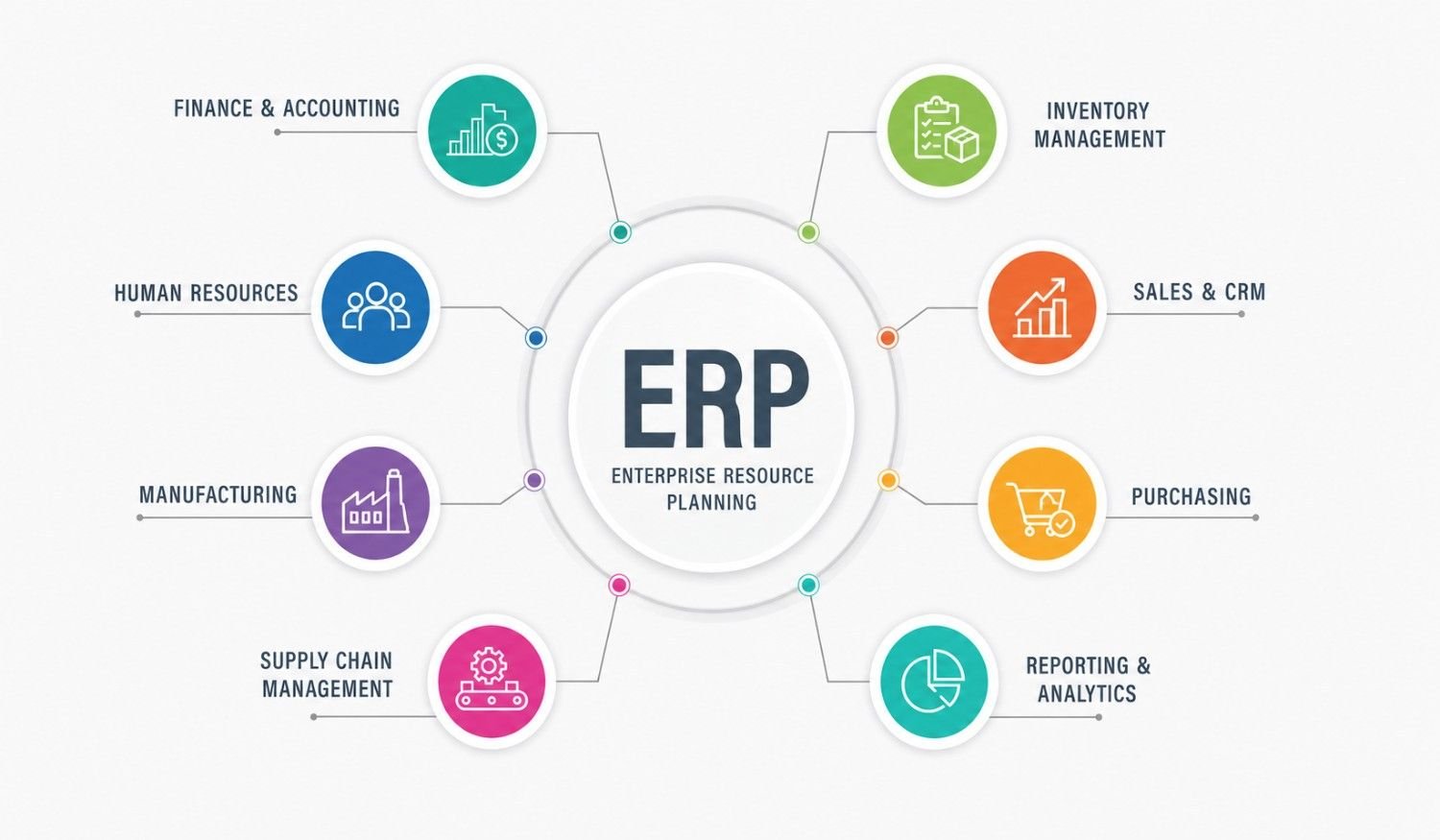
Growth rarely follows a perfectly predictable path, which makes flexibility one of the most valuable characteristics of any ERP system. A modular architecture allows organizations to implement essential functions first while adding capabilities as requirements evolve. Finance, inventory, manufacturing, procurement, or customer management modules can be introduced without rebuilding the entire platform. This approach reduces implementation risks, simplifies maintenance, and controls future costs. Instead of purchasing tomorrow’s requirements today, businesses gain the freedom to expand their ERP at the pace their growth demands.
Prioritize Business Process Mapping Before Development
Developing software without understanding existing workflows is much like assembling furniture while ignoring the instruction manual—it may eventually stand, but probably not the way it should. Careful process mapping reveals bottlenecks, duplicate tasks, manual dependencies, and communication gaps before development begins. This preparation allows developers to build workflows that genuinely improve operations rather than automate inefficient habits. Better process visibility also reduces future revisions, shortens implementation timelines, and ensures every ERP module supports practical business activities instead of theoretical requirements.
Identify Existing Workflow Bottlenecks
Before writing a single line of code, businesses should understand where delays, repetitive work, and communication breakdowns occur. Departments often develop independent processes over time, creating inefficiencies that remain hidden until carefully analyzed. Identifying these bottlenecks provides valuable insight into where automation can create the greatest impact. Instead of simply digitizing outdated procedures, organizations gain the opportunity to redesign them entirely. Removing unnecessary steps early improves employee productivity while creating cleaner, faster workflows that continue delivering operational benefits long after deployment.
Remove Redundant Processes
Redundant approvals, duplicate data entry, disconnected spreadsheets, and repetitive reporting consume valuable business resources every day. Eliminating these inefficiencies before ERP development simplifies future operations and reduces implementation complexity. Streamlined workflows also improve data accuracy because employees enter information once instead of maintaining multiple records across separate systems. The fewer unnecessary processes that exist, the easier it becomes for teams to collaborate efficiently. Simplification rarely receives the attention it deserves, yet it often produces some of the highest long-term returns within an ERP initiative.
Design Efficient Digital Workflows
Effective ERP systems should improve how employees work rather than forcing employees to adapt to confusing software. Digital workflows must balance automation, usability, and flexibility while supporting everyday business operations. Well-designed approval chains, automated notifications, centralized records, and standardized procedures reduce delays across departments. Every workflow should contribute to faster decisions and greater operational consistency. When business users can complete tasks with fewer clicks and less manual effort, productivity naturally improves, making the ERP system a valuable business asset instead of another administrative challenge.
Make Real-Time Data Visibility a Core Strategy
Accurate decisions depend on accurate information, and timing matters just as much as accuracy. Modern ERP systems should provide real-time dashboards that allow managers to monitor sales, inventory, production, finance, and customer activity from a centralized location. Instead of waiting for end-of-week reports, leaders can identify trends and resolve issues immediately. Faster access to live data improves forecasting, reduces operational delays, and strengthens collaboration across departments. Organizations that prioritize visibility gain greater confidence in every strategic decision they make.
Focus on Seamless Integration Across Business Systems
Business applications should communicate with one another rather than operate in isolation. A well-designed ERP integrates smoothly with CRM platforms, accounting software, HR systems, payroll applications, eCommerce platforms, and third-party services. Seamless integration eliminates duplicate data entry while ensuring employees work with consistent information across every department. Automated information sharing also reduces manual errors and improves operational efficiency. Instead of managing disconnected software, businesses gain a unified digital ecosystem where every application contributes to smarter and faster decision-making.
Design ERP with User Experience in Mind
The most advanced ERP platform delivers little value if employees struggle to use it. User-friendly navigation, intuitive dashboards, simplified workflows, and responsive interfaces encourage faster adoption throughout the organization. Employees spend less time searching for information and more time completing meaningful work. Mobile accessibility further improves productivity by allowing users to access critical business information from virtually anywhere. When usability becomes a development priority, organizations experience higher employee satisfaction, reduced training requirements, and stronger long-term adoption across every department.
Implement Strong Security and Compliance from Day One
Security should never become an afterthought once development is complete. ERP systems manage financial records, customer information, employee data, inventory details, and confidential business intelligence, making protection essential from the beginning. Building security into every development phase reduces future vulnerabilities while supporting regulatory compliance. Organizations also strengthen customer trust by demonstrating responsible data management practices. A secure ERP environment protects business continuity while allowing employees to work confidently without exposing sensitive information to unnecessary risks.
Role-Based Access Control
Not every employee requires access to every business function. Role-based access control allows organizations to assign permissions based on responsibilities rather than providing unrestricted system access. Finance teams can manage accounting records, HR personnel can access employee information, and warehouse staff can update inventory without viewing confidential financial reports. This structured approach reduces accidental data exposure while improving accountability across departments. Carefully managed permissions also simplify compliance audits and strengthen overall ERP security without making daily operations unnecessarily complicated.
Data Encryption
Protecting sensitive business information requires more than strong passwords alone. Data encryption safeguards information during storage and transmission, making unauthorized access significantly more difficult. Financial records, customer details, supplier agreements, and confidential business documents remain protected even if security incidents occur. Encryption also supports regulatory compliance across industries where privacy standards continue evolving. Investing in robust encryption measures helps organizations minimize cybersecurity risks while maintaining confidence that critical operational data remains protected against emerging digital threats.
Compliance Planning
Every industry faces unique regulatory requirements, and ERP systems should support compliance rather than complicate it. Planning for compliance during development helps organizations satisfy legal obligations while reducing future operational risks. Automated audit trails, secure document management, standardized reporting, and permission controls simplify ongoing governance activities. Whether addressing financial regulations, healthcare requirements, manufacturing standards, or data privacy laws, compliance-ready ERP systems reduce administrative burdens while improving organizational transparency. Preparing early always proves easier than correcting expensive compliance issues later.
Use AI and Predictive Analytics for Long-Term Competitive Advantage
Artificial intelligence continues transforming ERP systems from operational tools into strategic business advisors. Predictive analytics identifies demand patterns, forecasts inventory requirements, estimates sales performance, and highlights potential operational risks before they become costly problems. Intelligent automation also improves reporting by uncovering insights that traditional analytics may overlook. Businesses gain greater confidence when planning future investments because decisions rely on meaningful data rather than assumptions. Organizations embracing AI today position themselves to remain competitive as technology continues advancing across every industry.
Plan Continuous ERP Improvement Instead of One-Time Deployment
Launching an ERP system is an important milestone, but it should never be considered the finish line. Business requirements evolve, customer expectations shift, and new technologies emerge every year. A successful ERP strategy includes regular performance reviews, feature enhancements, security updates, and user feedback sessions. Continuous improvement ensures the platform remains aligned with business goals while maintaining peak performance. Organizations that treat ERP as an ongoing investment consistently achieve better productivity, stronger user satisfaction, and greater long-term returns than those that rarely update their systems.
Work with Experienced ERP Software Developers
Technology alone cannot guarantee ERP success. The expertise behind the implementation often determines whether a project delivers lasting business value. Experienced ERP software developers understand how to translate complex business requirements into scalable, efficient solutions that support long-term growth. They also anticipate challenges before they become costly issues, helping businesses avoid unnecessary delays and expensive redesigns. Choosing the right development partner means gaining technical knowledge, industry experience, and ongoing support that extends well beyond the initial deployment.
Common Mistakes That Reduce Long-Term ERP Value
Even well-funded ERP projects can underperform when strategic planning is overlooked. Common mistakes often include focusing only on short-term objectives, underestimating employee training, neglecting data quality, and delaying system updates. These issues gradually reduce productivity and limit the return on investment. The good news is that most of these challenges are preventable with careful planning and continuous improvement. Understanding what to avoid is just as important as understanding what to build when creating an ERP system that delivers sustainable business value.
Choosing Price Over Quality
Selecting an ERP solution based solely on the lowest price frequently leads to higher expenses later. Lower-cost solutions may lack scalability, integration capabilities, or customization options, forcing businesses to invest in additional development as operations grow. While budget considerations are important, long-term value should remain the primary decision factor. Investing in quality architecture, experienced professionals, and reliable technology reduces maintenance costs and minimizes disruptions. The cheapest option often becomes the most expensive once ongoing operational challenges begin to appear.
Ignoring Employee Training
Employees play a central role in ERP success, making proper training essential throughout implementation. Even the most advanced system cannot improve productivity if users do not understand its capabilities. Comprehensive onboarding, practical workshops, and ongoing support help employees become comfortable with new workflows and features. Better training also reduces mistakes, increases confidence, and encourages faster adoption across departments. Organizations that invest in people alongside technology consistently experience smoother implementations and stronger long-term business outcomes.
Poor Data Migration
An ERP system is only as reliable as the information it contains. Migrating outdated, incomplete, or duplicate data into a new platform creates problems that continue long after implementation. Careful data cleansing, validation, and testing should occur before migration begins. High-quality information improves reporting accuracy, strengthens business intelligence, and reduces operational confusion. Organizations that prioritize clean data establish a stronger foundation for future growth while minimizing the risk of costly corrections after deployment.
Lack of Executive Support
Successful ERP projects require active involvement from leadership rather than occasional approval meetings. Executive support provides clear direction, ensures adequate resources, and encourages organization-wide adoption. When leaders actively communicate project goals and participate in key decisions, employees are more likely to embrace change. Strong leadership also helps resolve cross-departmental challenges before they delay implementation. ERP initiatives become significantly more successful when decision-makers remain engaged from planning through continuous improvement.
Skipping Future Scalability
Many organizations design ERP systems around today’s requirements while overlooking tomorrow’s opportunities. As businesses expand into new markets, launch additional products, or increase workforce size, system limitations become increasingly apparent. Planning for scalability from the beginning prevents expensive redevelopment later. Flexible architecture, cloud infrastructure, modular functionality, and integration readiness allow ERP systems to grow alongside the organization. Preparing for future expansion protects long-term investments and keeps technology aligned with evolving business objectives.
Why Custom ERP Delivers Better Long-Term ROI Than Generic Solutions
Off-the-shelf ERP platforms often require businesses to adjust their processes to match predefined software capabilities. Custom ERP solutions reverse that approach by supporting existing business operations while remaining flexible enough to evolve over time. Tailored workflows, seamless integrations, personalized dashboards, and industry-specific functionality improve productivity without unnecessary complexity. Although custom development may require greater initial planning, the long-term return frequently outweighs the investment through improved efficiency, lower maintenance costs, and stronger competitive differentiation.
Conclusion
Long-term business value is never created by software alone. It comes from thoughtful planning, scalable architecture, efficient workflows, continuous improvement, and a commitment to supporting business growth at every stage. An ERP system should simplify operations, improve decision-making, and adapt as organizational needs evolve. We believe the most successful implementations focus on solving real business challenges rather than chasing every new technology trend. When strategy guides development and improvement never stops, ERP becomes far more than business software—it becomes a foundation for sustainable success.
Frequently Asked Questions
1. What is the most effective ERP development strategy for long-term growth?
The most effective strategy begins with aligning ERP development to measurable business objectives instead of focusing solely on software features. Organizations should prioritize scalable architecture, workflow optimization, automation, seamless integrations, and continuous improvement. Regular performance evaluations and employee feedback also help the system evolve alongside changing business requirements. A strategic approach ensures the ERP platform remains valuable for many years rather than becoming outdated shortly after implementation, ultimately improving operational efficiency and maximizing return on investment.
2. How does cloud ERP improve long-term business value?
Cloud ERP provides flexibility, scalability, and accessibility that traditional on-premise systems often struggle to match. Businesses can expand operations without major infrastructure investments while benefiting from automatic updates, improved disaster recovery, and stronger collaboration across multiple locations. Employees gain secure access from anywhere, supporting hybrid and remote work environments. Cloud deployment also simplifies maintenance, reduces IT costs, and enables organizations to adopt new technologies faster, making it an attractive option for long-term business growth.
3. Why is process mapping important before ERP development?
Process mapping helps organizations understand how work flows through every department before technology is introduced. It identifies bottlenecks, redundant tasks, communication gaps, and inefficient procedures that could otherwise be automated without improvement. By analyzing existing operations first, businesses can redesign workflows that genuinely enhance productivity. This preparation reduces unnecessary customization, shortens implementation timelines, and ensures the ERP system supports efficient business processes instead of reinforcing outdated operational habits.
4. How often should an ERP system be updated?
ERP systems should be reviewed regularly, with security updates applied whenever available and functional improvements scheduled according to business needs. Many organizations perform quarterly performance evaluations while planning larger feature enhancements annually. Continuous monitoring helps identify changing requirements, emerging technologies, and opportunities for optimization. Regular updates improve security, maintain compatibility with integrated applications, enhance user experience, and ensure the ERP platform continues supporting long-term organizational growth without becoming obsolete.
5. What makes custom ERP more valuable than off-the-shelf ERP?
Custom ERP solutions are designed around an organization’s unique workflows, objectives, and operational requirements instead of forcing businesses to adapt to generic software. This results in better productivity, smoother integrations, improved reporting, and greater flexibility for future expansion. Businesses also avoid paying for unnecessary features while gaining functionality that directly supports their goals. Over time, the ability to adapt the platform as the organization grows often delivers significantly higher long-term value.
6. How do AI features improve ERP performance?
Artificial intelligence enhances ERP systems by automating repetitive tasks, improving forecasting accuracy, identifying business trends, and supporting faster decision-making. Predictive analytics helps organizations anticipate inventory needs, customer demand, and operational risks before they become significant problems. AI-powered reporting also uncovers valuable insights that traditional reporting methods may overlook. These capabilities allow businesses to respond proactively to market changes while improving efficiency, profitability, and overall strategic planning.
7. What industries benefit the most from custom ERP solutions?
Custom ERP solutions benefit nearly every industry, including manufacturing, healthcare, retail, logistics, construction, professional services, wholesale distribution, and eCommerce. Organizations with specialized workflows, regulatory requirements, or complex operational processes often experience the greatest advantages. Tailored functionality improves efficiency while supporting industry-specific compliance and reporting needs. Because every business operates differently, customized ERP systems provide greater flexibility than standardized software designed for broad markets.
8. How can businesses maximize ROI from ERP implementation?
Maximizing ERP return on investment requires careful planning before development begins and ongoing optimization after deployment. Businesses should establish measurable objectives, invest in employee training, maintain clean data, encourage executive involvement, and continuously monitor system performance. Regular updates, scalable architecture, and proactive process improvements help the ERP platform remain aligned with changing organizational goals. When technology, people, and strategy work together, businesses achieve stronger efficiency, higher productivity, and sustainable long-term growth.
